NASA's Roman Space Telescope gets vertical at Kennedy Space Center
Published in News & Features
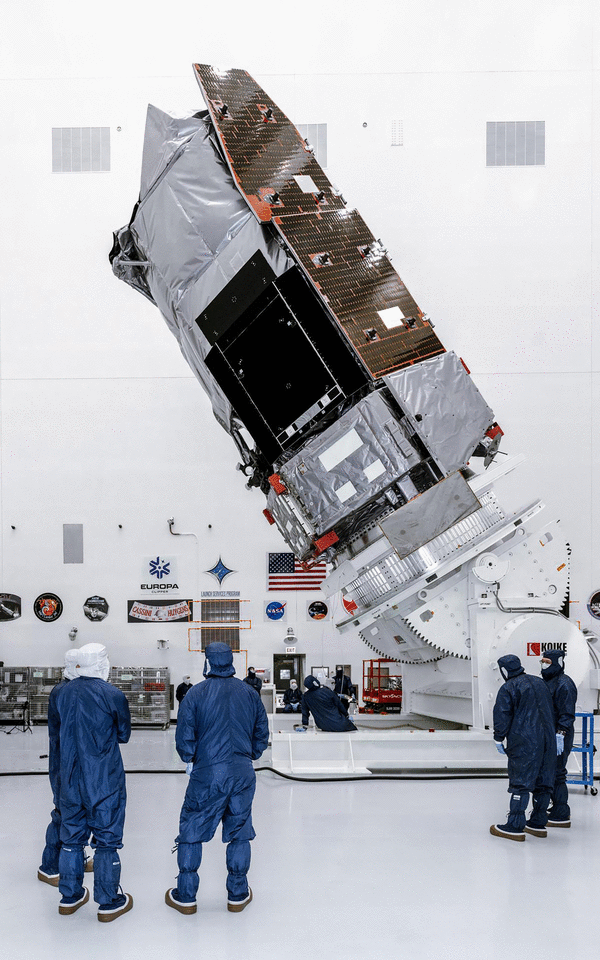
NASA’s $4.3 billion Nancy Grace Roman Space Telescope has risen from its horizontal slumber at Kennedy Space Center in Cape Canaveral, Florida, ahead of its planned launch next month.
The planet hunter, which will seek to unravel the mysteries of dark energy in the universe with infrared sensing, had made the trip to KSC in June from NASA’s Goddard Space Flight Center in Greenbelt, Maryland, boxed up and lying on its side while sitting in NASA’s Pegasus barge.
It was then hauled over by truck to KSC’s Payload Hazardous Servicing Facility, where teams used cranes to bring it back to upright life as they prepare it for its launch that could come as early as Aug. 30.
Its ride will be SpaceX’s powerhouse Falcon Heavy rocket, making only its second launch of 2026 and 13th ever since its debut flying Elon Musk’s Tesla Roadster in 2018. It will lift off from KSC’s Launch Pad 39-A, which as of this year has been solely for Falcon Heavy.
SpaceX had shifted its smaller Falcon 9 launches to its pad at neighboring Cape Canaveral Space Force Station so it can continue work on the new Starship and Super Heavy launch tower adjacent KSC’s 39-A launch pad.
The previous Falcon Heavy launch came in April flying a commercial satellite for ViaSat. Its next could still come before the end of the year, flying Astrobotic Technology’s Griffin lunar lander to the moon.
The rocket is essentially three Falcon 9’s strapped together, producing 5.1 million pounds of thrust at liftoff, which trails only NASA’s Space Launch System rocket used on the Artemis missions in terms of power among active rockets launch from Florida. Starship, when it arrives, will be more than three times as powerful as Falcon Heavy.
For now, though, the rocket can help NASA deliver this year’s marquee science mission to its destination about 1 million miles from Earth at a spot called Lagrange point 2, which is on the opposite side of the planet from the sun.
It’s the same spot James Webb and other space telescopes are parked, giving them a pristine view of the galaxy.
Its initial five-year universe-mapping mission expects to catalog tens of thousands of new planets and attempt to measure dark energy, which remains a mysterious force that scientists say is the reason the universe is expanding.
“Roman will investigate dark matter, dark energy and the structure of the universe itself, and accelerate the future of discovery of potentially habitable planets outside our solar system,” said NASA Administrator Jared Isaacman during a media event in April. “Its surveying capabilities are over 1,000 times faster than Hubble, and can chart 200 times more sky in a single image. What would take Hubble 2000 years to process, Roman can do in a year.”
As it scans the sky, it will map billions of galaxies and within those, tens of billions of stars.
“The images it captures will be so large there is not a screen in existence large enough to show them. Roman will give the Earth a new Atlas of the universe,” Isaacman said.
_____
©2026 Orlando Sentinel. Visit orlandosentinel.com. Distributed by Tribune Content Agency, LLC.






Comments