NATO agrees to $50 billion in defense deals to placate Trump
Published in News & Features
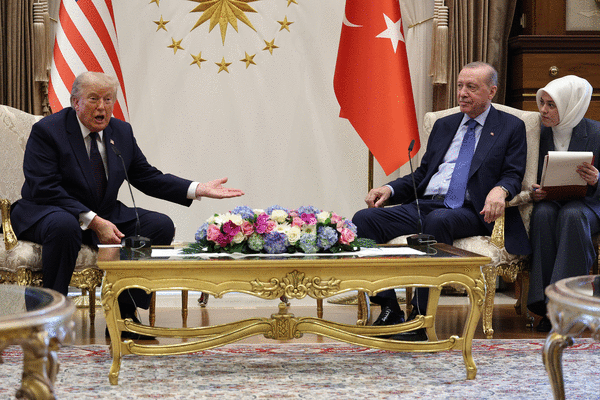
NATO allies have agreed to at least $50 billion in defense industry deals, according to an alliance official, to show to U.S. President Donald Trump that Europe is heeding his spending demands.
Secretary-General Mark Rutte revealed some of the contracts Tuesday during a defense industry forum in Ankara, Turkey’s capital, where the military alliance’s leaders are meeting for their annual summit this week. Those included $12 billion in deals to buy next-generation drones, surveillance planes and military aircraft.
Notably, some of the contracts show Europe moving to locally source some equipment it previously bought from the United States. Eleven countries, for instance, will now buy airborne radar-detection systems from Swedish aerospace firm Saab AB, replacing a U.S.-made Boeing Co. model. The deal is worth $5 billion, according to a NATO diplomat.
Others deepen ties to U.S. manufacturers for crucial items. Denmark, Finland, Germany and Norway will buy up to five Northrop Grumman Corp Triton surveillance aircraft at a cost of $2.7 billion, the diplomat said, speaking anonymously to describe the agreements.
Officials have structured the entire week as one big appeal to Trump, putting on an industry-friendly display and coming armed with figure after figure meant to convey the message: Europe is stepping up in NATO and spending billions in the process.
Trump has for years railed against the North Atlantic Treaty Organization, arguing it lets Europe and Canada piggy-back off America’s defense prowess without having to invest in their defense. Alliance members have responded with billions in fresh military spending, spurred on by Russia’s war on Ukraine, which left Europe fearing for its security.
Other purchases revealed Tuesday include seven allies saying they will acquire Airbus SE’s A400M military aircraft, which helps with airlift and tanker capabilities. That contract is worth $4.3 billion, the diplomat said.
Separately, allies will invest more than $40 billion in counter-drone capabilities over the next five years, Rutte said.
Europe is still far from military self-sufficiency, however, and is lacking the ability to produce key modern tools of warfare, including drones and advanced air defense systems.
The deals announced Tuesday aim to address some of those shortcomings.
In the case of SAAB’s radar-detection system, the shift reflects a growing European desire to ensure its safety is not completely tied to U.S. manufacturers.
Boeing’s planes “have served us well and continue to do so,” Rutte said, “but they are reaching the end of their life.”
The new products “will ensure” NATO’s capabilities are “strong and credible for decades to come.”
The Europe-first push has caused friction with the U.S., which wants its allies to spend more on their own defense — but still buy American. Those tensions increased after the European Union designed a 150 billion euro ($172 billion) defense loan scheme — and its 90 billion euro loan to Ukraine — to prioritize local companies.
In key areas, however, Europe hasn’t been able to find its own equivalents for American products, and Tuesday’s contracts reflect that.
The Triton maritime surveillance equipment, for example, is a capability Europe has yet to develop. The Triton equipment “gives us the situational awareness we need to make the decisions we need and stay ahead of threats,” Rutte said.
©2026 Bloomberg L.P. Visit bloomberg.com. Distributed by Tribune Content Agency, LLC.





Comments