Gov. Pritzker signs first-in-nation Illinois law requiring third-party safety audits for AI giants
Published in News & Features
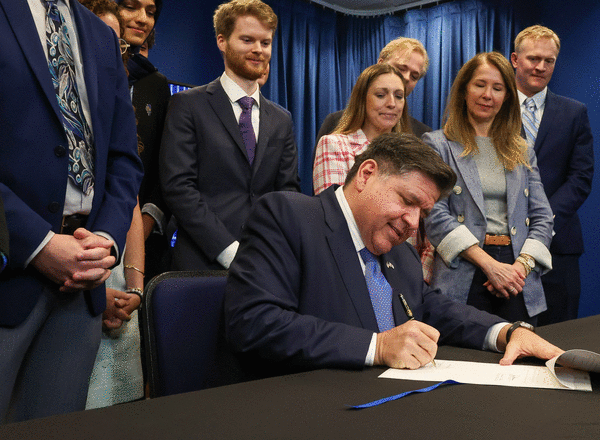
CHICAGO — Illinois will be the first state to require independent audits of large artificial intelligence developers’ safety practices under a new law Gov. JB Pritzker signed Monday.
The measure was part of a broader package of bills the Democratic-controlled General Assembly pushed to fill what lawmakers view as a void left by federal inaction on AI regulation, and its enactment further strengthens state lawmakers’ case that Illinois can be a leader in regulating the emerging technology.
“Where the federal government is unwilling to step up, states must venture once more unto the breach,” Pritzker said at a news conference in Chicago. “History has shown time and again that thoughtful regulation is a requirement for sustainable innovation when our economic and national security is at stake.”
The legislation that Pritzker signed will require large AI developers — those with more than $500 million in annual gross revenue — to publish explanations of how their products could pose a “catastrophic risk” and how those risks would be addressed. The requirements take effect Jan. 1, 2028.
Companies will also be required to disclose how they identify and respond to “critical safety incidents” and to report such incidents to the state within 72 hours of having sufficient reason to believe one has occurred. Developers will be required to retain a third party each year to conduct an independent compliance audit; auditors would need to demonstrate technical expertise in the safety of so-called frontier AI models.
The legislation also includes whistleblower protections, prohibiting companies from adopting policies that would prevent employees from disclosing information to state or federal authorities if they believed the company posed a public safety hazard. Companies will be required to maintain an anonymous internal reporting process for employees who believe in good faith that the company’s activities present a danger to public health or safety.
Fines could run up to $1 million for an initial violation and $3 million for subsequent violations.
The chief Senate sponsor, Democratic state Sen. Mary Edly-Allen of Grayslake, framed the legislation as a way to ensure that government stays ahead of AI technology in a way it may have missed in the past.
“If we got social media wrong, and we did, we cannot afford to get AI wrong at an even greater scale,” she said.
Decision-making on AI is too important to be left to the federal government or “tech bros whose culture of ‘move fast and break things’ is moving faster and faster and breaking more and more as it goes,” Democratic House Speaker Emanuel “Chris” Welch of Hillside said.
Some AI companies embraced the legislation, which drew broad support from both sides of the aisle, during the spring legislative session. AI developer Anthropic, which created the Claude chatbot and supported the bill, said it “takes the safety practices leading labs already follow voluntarily — publishing a safety framework, transparent reporting, protecting whistleblowers — and helps establish a baseline that every leading AI developer is expected to meet.” ChatGPT maker OpenAI also supported the legislation.
The new Illinois law comes after Republican President Donald Trump’s administration has shown reluctance to regulate AI at the federal level, out of concern that too much oversight could stifle technological advancement.
While other states, including California and New York, have also passed significant AI regulations, no other state has enacted an independent audit requirement, supporters said Monday.
Several other measures on AI were also on the table during this spring’s legislative session.
Pritzker last month signed another AI-related law banning people from using bots to buy up tickets for live events.
A proposal to crack down on AI-driven rental pricing platforms that lawmakers say facilitate rent-fixing is also on the governor’s desk. It would prohibit landlords from coordinating prices through shared third-party software or algorithms.
Still, several AI-related measures failed to pass both chambers of the General Assembly before it adjourned for the summer. One, which passed without opposition in the Senate, would require AI companies to detect signs that a user may be suicidal or at risk of self-harm and refer the person to a crisis service such as the 988 Suicide and Crisis Lifeline.
Another bill that didn’t pass in the House would prohibit companies from selling consumers’ most sensitive data without first giving them the opportunity to opt out.
_____
Chicago Tribune’s Jeremy Gorner contributed.
_____
©2026 Chicago Tribune. Visit chicagotribune.com. Distributed by Tribune Content Agency, LLC.




Comments