Trinidad and Tobago PM wants Caribbean Court of Justice to intervene in latest quarrel
Published in News & Features
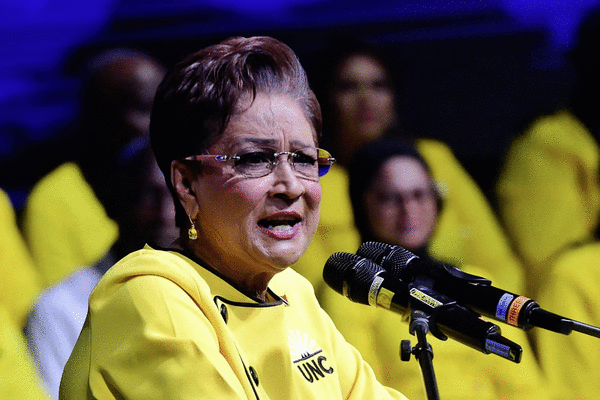
CASTRIES, Saint Lucia — Trinidad and Tobago Prime Minister Kamla Persad-Bissessar says the reappointment of the Caribbean Community’s secretary-general earlier this year was unlawful, and she wants the Caribbean Court of Justice to intervene in the dispute.
Carla Barnett, who has been secretary-general of the 15-member Caribbean Community regional grouping since 2021, was reappointed to her role in February when leaders met in Saint Kitts and Nevis. But Persad-Bissessar, who left that summit early, argues the decision violated the Revised Treaty of Chaguaramas, the agreement governing the bloc known as CARICOM.
The Trinidadian leader has laid out her objections in a 22-page letter circulated to heads of government on Sunday as they prepared to kick off a four-day summit in Saint Lucia.
In the letter reviewed by the Miami Herald, Persad-Bissessar said her objections were neither personal nor political.
“Rather, it concerns the legality of the process adopted, the integrity of our institutions and the faithful observance of the constitutional framework established by the Revised Treaty of Chaguaramas,” she wrote.
Her government, Persad-Bissessar said, does not accept the process by which Barnett “was purportedly reappointed, and consequently, is unable to recognize the validity of the purported second term of the secretary-general.”
Barnett’s new term is supposed to start in August. But in her appeal to Caribbean leaders, Persad-Bissessar argues that several procedural requirements were not respected, and she wants the issue placed on the agenda of the ongoing summit. Among the issues she raises:
—Barnett’s reappointment was never listed on the conference agenda or included in the working papers circulated before the meeting, which took place in Saint Kitts and Nevis.
—Trinidad and Tobago, Antigua and Barbuda, and The Bahamas — whose leaders all left the conference early — were prevented from sending designated representatives to the government-heads-only retreat where the matter was discussed.
—The Community Council did not make the recommendation required under the Revised Treaty.
—The decision was never formally confirmed in a plenary session before the conference ended.
—The process fell short of the revised treaty’s voting requirements.
Those procedural deficiencies meant that Barnett’s second term was never lawfully approved, Persad-Bissessar said. She is asking that the bloc seek a legal opinion from the Caribbean Court of Justice and that all sides agree to abide by the court’s opinion.
Persad-Bissessar also said that CARICOM’s general counsel and Barnett should recuse themselves from any consideration of the dispute, and she’s proposing that Barnett only be allowed to continue on a month-to-month basis if her current term expires before the court rules. The term expires in August.
It’s unclear if the Caribbean Court of Justice has been privy to the push to have it play referee. The court’s president, Justice Winston Anderson, said he cannot comment on the matter. Those familiar with the court’s inner workings say the matter is something that Caribbean leaders can resolve among themselves, rather than ask the court for an advisory opinion.
The court was established in 2001 and began functioning four years later as both an international court to settle disputes among Caribbean countries and as a final court of appeal. On the latter, only five countries — Barbados, Belize, Dominica, Guyana and Saint Lucia — currently rely on the court rather than the London-based Privy Council for appellate decisions.
Persad-Bissessar first made her objections public after the bloc’s chairman at the the time, Saint Kitts and Nevis Prime Minister Terrance Drew, indicated that leaders had reappointed Barnett during the February meeting by “the required majority.” In response, Trinidad, a founding member of the regional bloc, threatened to reduce its annual financial contribution.
The public airing irritated some fellow leaders because it had followed other public rows and a highly critical speech by Persad-Bissessar at the meeting over support for Caribbean countries’ support for Cuba and their disagreements over U.S. attacks on fishing vessels in the Caribbean Sea.
The Trinidadian leader acknowledges that issues surrounding Barnett’s reappointment “have caused much discomfort and dissonance” in the grouping but insists that “our position is not held to create division within the Community.”
It’s aimed at preserving “the constitutional order upon which the legitimacy and credibility of CARICOM ultimately depends,” said Persad-Bissessar, who has sided with U.S. President Donald Trump’s policies over her fellow Caribbean leaders’ consternation.
“Regional unity cannot rest upon expediency and irregular practices masquerading as precedent. It must rest upon adherence to the rules which every member state has freely accepted and undertaken to uphold,” she added.
A lawyer, Persad-Bissessar has repeatedly clashed with CARICOM on regional issues, prompting questions about the bloc’s cohesion and its ability to manage internal divisions.
During Sunday’s opening ceremony here in St. Lucia, Barnett did not address the dispute, and speakers did not mention Persad-Bissessar by name. She in turn did not enter the conference room until after Barnett spoke.
While it's unclear if the item will be added to the agenda, leaders went into a closed-door retreat at an undisclosed location on Monday.
Rahym R. Augustin-Joseph, a 24-year-old Saint Lucian youth advocate and the opening ceremony’s featured speaker, urged the region’s presidents and prime ministers to seek common ground despite their differences.
In a stinging rebuke of the internal fights, he told leaders they have “traded a quiet call to one another for public quarrels.
“We have traded the revered maturity of regional politics for a mimicry of 280 characters on social media, and what is worse is that the young children and young people of this region are watching,” he said. “And they’re confused as to whether they’re watching an episode of 'Long Island USA' or watching the regional integration.”
Disagreements within families are inevitable, Augustin-Joseph said as leaders listened inside the Sandals Grand Lucian ballroom. But what is not acceptable “within the spirit of this family,” he said, “is waking up tomorrow morning, cursing your sisters and brother ... with your neighbors and your friends, not dealing with the differences of this movement within house and attempting to break the toys or our institutions that our godfathers and parents have left for us.
“The family member that this region wants to remember is not the auntie that comes to the reunion and brings up a family gossip from 20 years ago, but the one who is focused on building the future of that family,” he said. “We will quarrel, we will disagree, we may even disappoint each other, but what we cannot deny is our shared history, our shared geography, our shared borders, and truthfully, our shared future.”
_____
©2026 Miami Herald. Visit at miamiherald.com. Distributed by Tribune Content Agency, LLC.






Comments