Caribbean leaders continue to urge unity over divisions as leaders meet in St. Lucia
Published in News & Features
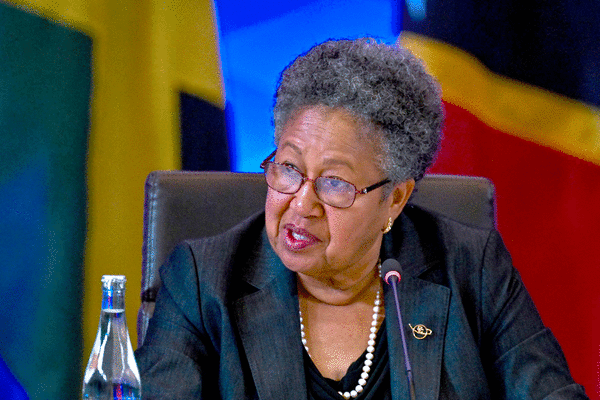
Caribbean leaders opened a four-day summit in this windswept eastern Caribbean island on Sunday once more seeking to project unity over division and cooperation over confrontation amid an increasingly complex political environment and growing strains within the bloc.
In the five months since they last met, the region has seen the return of ruling governments in The Bahamas and Antigua and Barbuda, had its longstanding support to Cuba tested by escalating U.S. pressure, and welcomed the first deployment of Chadian troops on Haitian soil as part of the new United Nations authorized and Washington-backed Gang Suppression Force. But it has also found itself having to continue to navigate tensions within its 15-member grouping.
The source of the tensions this time isn’t the political friction over support for President Donald Trump’s attacks on fishing vessels in the southern Caribbean Sea. It’s the stewardship by Belizean economist Carla Barnett, the current secretary-general of the Caribbean Community known as CARICOM.
Following her reappointment in February, Barnett became the target of criticism from Kamla Persad-Bissessar, the Trinidad and Tobago prime minister and steadfast Trump ally, who publicly questioned the decision.
Persad-Bissessar, who has said after August she will not recognize Barnett, has circulated a letter among Caribbean leaders calling Barnett’s reappointment a violation of the bloc’s revised treaty, several sources confirm. She’s claiming the decision was not fully discussed and the Miami Herald has learned that at least one Caribbean country is reportedly prepared to support Persad-Bissessar.
Barnett did not address the dispute in her remarks during the opening ceremony Sunday of the group’s 51st regular meeting taking place at the Sandals Grande St. Lucian all-inclusive resort in Gros Islet. Instead, she used her remarks to highlight the regional bloc’s achievements — and by extension her own – during her tenure over the last five years.
Among them, she cited the expansion of categories of skilled workers eligible to move freely across the 15 member states, increased agricultural investments aimed at reducing the region’s dependence on imported food, and continued engagement with Haiti as it grapples with a prolonged security and governance crisis.
“Over the past two years we have organized a relatively large number of CARICOM Electoral Observer Missions, the most recent being two in Antigua and Barbuda and The Bahamas this year,” Barnett said. “We also continue to expand our associate membership.”
In addition to the Dutch Caribbean island of Curaçao, which joined as an associate member two years ago, CARICOM formally welcomed Martinique, the French overseas territory, on Sunday. Leaders also expect to sign an agreement admitting French Guiana before the conference concludes Wednesday.
Philip J. Pierre, the prime minister of Saint Lucia and the incoming chairman of CARICOM, used his opening address to address the overall divisions and public skepticism over the bloc’s usefulness in a world marked by profound uncertainty, climate change and geopolitical tensions. He urged leaders to “act with clarity, urgency and unity” to safeguard the regional bloc’s long-term future.
With people across the Caribbean increasingly facing higher food and fuel prices, rising crime and soaring living costs, many are asking what benefits the community provides, he acknowledged.
“CARICOM must move from conference rooms to communities, from rhetoric to reality, from communiqués to results,” Pierre said. “Our people must be able to see and feel the benefits of regional cooperation.”
He added: “It is not enough for us to agree with principle. We must implement in practice. It is not enough for us to speak of integration. We must make integration work for the ordinary citizen. It is not enough for our decisions to be recorded. It must be acted upon, be measured and followed through. ... Every decision we take must be connected to the lived experience of Caribbean people.”
He ended: “When the Caribbean speaks with one voice, when we act together, when we negotiate as a bloc, our collective influence is far greater.”
Since Trump’s return to the White House, Caribbean governments have struggled to maintain a common voice as Washington imposed travel restrictions, tightened visa policies, threatened sanctions over the employment of Cuba health professionals and urged countries to accept U.S. based migrants who are being deported but cannot return to their home countries.
The pressures have led to public disagreements among regional leaders, raising questions about whether the bloc can endure, outgoing chairman and Saint Kitts and Nevis Prime Minister Terrance Drew acknowledged.
Drew, who hosted the last meeting in his twin-island nation said in trying to put people’s concerns at ease, said he “made a deliberate decision to visit every full member state and to sit privately with every head of government” earlier this year. Haiti, however, was not among the countries he visited and neither was Belize, according to sources.
Reflecting on his six-month chairmanship, Drew said he believes that the region’s resolve has been strengthened.
“The question before us is whether we have the courage to build an even stronger community for the generations that will follow us,” he said. “Unity and togetherness is not simply our highest ideal ... it is our greatest strategic advantage.”
Drew concluded by praising Barnett’s stewardship of the secretariat and its work in advancing the Caribbean Single Market and Economy.
“You have served and continue to serve CARICOM with distinction,” he said as the leaders, including Persad-Bissessar, who arrived at the opening after Barnett spoke, listened. “You have understood the importance of preserving the impartiality of the secretariat, while faithfully implementing the decisions of heads of government, that balance has strengthened this community. And for this, I offer on behalf of all of us, our sincerest gratitude.”
Among the issues on the leaders’ agenda this week: the situation in Haiti, a youth summit and reparations. Leaders will also discuss their situation in Cuba, including ongoing efforts to provide humanitarian assistance.
_____
©2026 Miami Herald. Visit miamiherald.com. Distributed by Tribune Content Agency, LLC.






Comments