Filing reveals Florida House speaker's private client list, including Airbnb, Newsmax
Published in News & Features
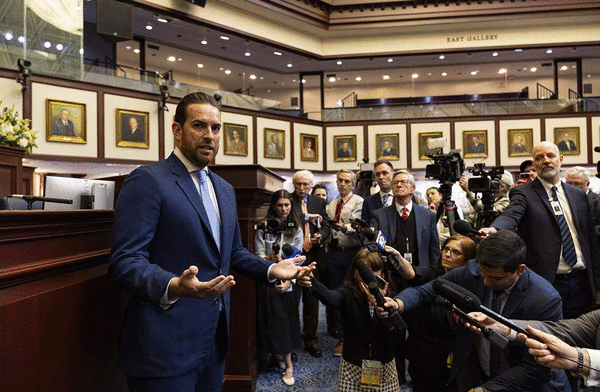
TALLAHASSEE, Fla. — A newly filed federal financial disclosure provides the clearest public look yet of outgoing Florida House Speaker Daniel Perez’s private legal practice, revealing that the Miami Republican has been representing a far-right media outlet and companies with significant financial interests before the state, including a government contractor and a vacation rental giant.
Among Perez’s clients over the past two years were CDR Maguire, a consulting firm owned by two Republican donors that has earned more than $120 million in new government contracts since 2024. He was also paid by Airbnb, whose business interests overlapped with legislation that died in Perez’s chamber this past legislative session, and Newsmax, the pro-Trump news channel that paid $67 million last year to settle a defamation lawsuit over false claims about the 2020 presidential election.
Perez, whom President Donald Trump recently nominated to serve as the next U.S. ambassador to Brazil, disclosed earning $1.1 million from his private legal work over the past year. Federal ethics disclosure rules required Perez to disclose his income for the preceding calendar year and list any clients who paid him more than $5,000 within the past two years.
That client list, contained in a federal financial disclosure filed May 12 and made public last week as part of Perez’s ambassadorial nomination, offers one of the most detailed public accounts to date of his outside legal work.
The filing raises questions about the extent to which Perez’s private clients had business before the state while he served as one of Florida’s most powerful elected officials. While there is no evidence in the disclosure that Perez acted improperly, and a federal ethics official ruled that the filing complied with laws and regulations, some of the companies Perez represented had business before the Legislature or the state during his two-year tenure as speaker.
The nature of Perez’s legal work for each client remains unclear. The disclosure identifies the companies but does not describe the services he provided or whether his work involved matters related to Florida state government.
In a statement to the Miami Herald/Tampa Bay Times, Perez noted that “the State of Florida has an expansive reach and there is almost no sector or industry — agriculture, home building, medicine — that doesn’t have some intersection with state government.”
“As an attorney, I have the ability to select what work I do and decline to do any work that might raise ethical concerns not only for myself but for my client,” he added.
One of Perez’s clients, Airbnb, had a clear interest in recently debated housing legislation that ultimately died in Perez’s chamber.
The Senate voted 38-0 to approve a bill in February that would have made it easier for homeowners in single-family zoned districts to build accessory dwelling units — commonly referred to as ADUs or granny flats — on their own property “by right.” The measure would have effectively stopped cities and counties from imposing bureaucratic hurdles on homeowners seeking to build such units.
The unanimously passed Senate bill also included a strict ban on using ADUs as short-term rentals — a measure that posed a clear threat to Airbnb and other vacation rental companies’ business in tourism hotspots like Miami.
The House under Perez advanced its own version of the legislation that omitted the short-term rental prohibition. The measure stalled in committee and never reached the House floor.
“I had no involvement with the ADU bill. The House Commerce Chairman, Rep. James Buchanan, drove the House position on that legislation,” Perez said in his statement, adding that his “legal work has been confined to transactions between private parties and transactions outside of Florida.”
Perez also received at least $5,000 for legal services he provided to CDR Maguire over the past two years, the financial disclosure report shows. CDR Maguire is of the companies affiliated with the Miami-based CDR Companies, whose executives, Carlos Duart and Tina Vidal-Duart, are allies of Gov. Ron DeSantis and donors to his failed presidential bid.
Three other CDR-linked companies received $210 million in contracts for the state-run immigration detention centers the state named Alligator Alcatraz and Deportation Depot.
CDR Maguire itself did not receive any contracts for immigration detention, according to state contract records, but the consulting firm did receive $123 million in other new government contracts over the past two years. Most of those contracts were with the governor’s office for “disaster preparedness and relief,” contract records show.
“With respect to companies with contracts with the State, the insinuation is laughable,” Perez said in the statement to the Herald/Times. “State-term contracts are controlled by the executive branch. No one with even a passing familiarity with Florida politics would suggest an association with me would benefit any company seeking work from the DeSantis administration.”
Perez’s federal disclosure became public as part of the Senate confirmation process following his Brazil ambassador nomination from Trump. If confirmed, Perez would serve as the Trump administration’s chief envoy to Latin America’s largest economy and leave behind a two-year tenure as House speaker marked by Republican infighting with DeSantis and the GOP-led Senate.
Perez performed most of his legal work through the Miami-based RHF Law Firm, which bills itself as a go-to practice for “business and commercial litigation, election and ethics law, and public procurement.”
According to its website, Perez is one of the firm’s two attorneys. The other, Robert H. Fernandez, is a DeSantis appointee on the 11th Circuit Judicial Nominating Commission and previously served as deputy general counsel to former Gov. Jeb Bush.
The RHF income made up the lion’s share of Perez’s annual earnings, accounting for nearly three-quarters of the combined $1.2 million value of the six salaries listed in his federal disclosure. He also reported earning $121,458 as in-house counsel for Doctors HealthCare Plans Inc., a privately owned South Florida insurer specializing in Medicare plans.
Less than 4% of Perez’s salaried income came from his taxpayer-funded House speaker job, which pays $45,000 annually.
“Florida has a part-time, citizen-legislature, which means not only do most Members work, it is part of the strength of our system,” Perez said. “A legislature populated by only retirees or the independently wealthy would not reflect the values and challenges faced by Florida’s families.”
As part of his federally required ethics disclosures, Perez also sent a letter to the U.S. Department of State detailing the ways he plans to avoid any “actual or potential conflicts of interests.”
Perez plans to stop representing all of his current private practice clients if his nomination is confirmed. He will also be resigning from RHF Law Firm and the health insurance company he works for. Part of the agreements include not participating in any ambassadorial matters tied to his former clients — like Airbnb — for at least a year after he last represented them.
The financial disclosure is one of several documents that nominees for diplomatic posts are required to submit to the federal government to identify potential financial interests before taking office. As of July 5, the U.S. Senate Committee on Foreign Relations has not scheduled a confirmation hearing for Perez, according to its website.
Senators may confront Perez with questions about his financial disclosures, his familiarity with Brazil and a controversial tax break for diplomats recently passed by the Florida House that Perez stands to benefit from. He has declined to answer reporters’ questions about whether he speaks Portuguese, Brazil’s official language.
_____
(Miami Herald staff writer Max Klaver contributed reporting.)
_____
©2026 Miami Herald. Visit miamiherald.com. Distributed by Tribune Content Agency, LLC.





Comments