10 years after an officer shot Philando Castile, how have traffic stops changed?
Published in News & Features
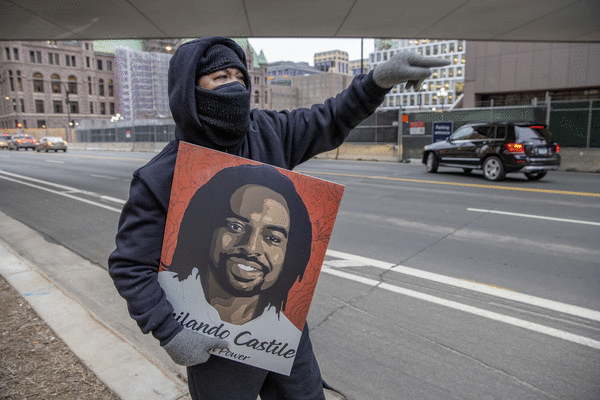
Ten years ago, a St. Anthony, Minn., police officer pulled over Philando Castile for a broken taillight. The encounter ended with the officer fatally shooting Castile in Falcon Heights.
Such a traffic stop would be less likely today, with Ramsey County’s top prosecutor and law enforcement leaders asking officers to focus on moving violations rather than equipment violations.
The goal in enacting the change in 2021 was for moving violations to increase to more than 90% of traffic stops and equipment violations to fall to 10% or less in participating cities, and that has happened, Ramsey County Attorney John Choi said recently. In St. Paul, moving violations comprised about 74% of traffic stops in the four years before the shift, a Pioneer Press analysis found.
Maplewood and Roseville are also among the agencies taking part.
The change “had a dramatic impact around building community trust, getting to a better version of public safety, getting police to really focus on the types of traffic enforcement that matters: speeding, careless driving, impaired driving,” Choi said.
Choi faced criticism when he announced the change, as did the Hennepin County attorney when she publicized a similar policy shift last year.
The Ramsey County Deputies’ Federation said in 2021 that the “use of the term ‘pre-textual traffic stop’ is a loaded and weighted term to negatively portray officers who make valid traffic stops based on violations of the law. To unilaterally decriminalize illegal activity discovered pursuant to a legal traffic stop … sends a strong signal to those engaged in criminal activity that they can do so with impunity.”
Choi said concerns about the changes haven’t been borne out: Previous research showed police found guns or drugs in less than 2% of pretextual stops, referring to cases when police stop a driver for an equipment violation to seek evidence of a more serious crime.
Law enforcement worried there would be reductions in gun recoveries, said St. Paul Police Chief Axel Henry, though he noted that officers were not often finding guns when they pulled over drivers for equipment violations. Gun recoveries in St. Paul have been increasing annually.
Crime rates have been down, which Choi said can’t be attributed to the change in traffic stops, but shows they haven’t negatively affected crime.
Underlying ‘hunch’ wasn’t valid, prosecutor says
Just before officer Jeronimo Yanez pulled over Castile on July 6, 2016, he stated over a police radio that Castile’s “wide-set nose” matched that of a robbery suspect from four days earlier. He stopped Castile, 32, for a broken taillight.
It was the definition of a pretextual stop, Choi said.
“An officer finds a legal reason to pull somebody over; typically, it’s an equipment violation, and they’re investigating a hunch that never gave them probable cause to stop that person,” Choi said. But “it wasn’t a reasonable hunch at all,” Choi said, and without the brake light out, Yanez wouldn’t have had legal grounds to pull Castile over.
Castile was determined not to be the robbery suspect, according to the criminal complaint against Yanez, and Castile’s family said it was a case of racial profiling.
Valerie Castile, Philando’s mother, said the changes to traffic stops have been important.
“What we’re looking for is safety — someone driving erratically, speeding, things where you’re putting someone in danger,” she said. “But a light out on the car, a light bulb over your license plate being out, that’s not a good reason to pull someone over. It’s fishing expeditions, because a lot of times it’s African Americans and people of color that are being pulled over for those minor infractions.”
There have long been racial disparities in traffic stops in the U.S.
In St. Paul, officers pulled over a smaller percentage of Black drivers in 2024 compared to 2020 — 35% vs. 42%, though data since 2001 shows Black drivers were pulled over at lower rates in previous years. About 15% of St. Paul residents are Black, according to Minnesota Compass.
First-time charge, and a change
Castile’s girlfriend livestreamed the encounter on Facebook Live, which was new at the time.
Yanez asked Castile for his driver’s license and proof of insurance at his driver’s-side window before Castile told him, “Sir, I have to tell you, I do have a firearm on me.” Castile had a permit to carry the gun, which he did not disclose to the officer.
A jury acquitted Yanez after Choi’s office charged him with manslaughter, the first time in the state an officer was charged for shooting a civilian in the line of duty. Since then, officers have been charged in additional cases, most notably in George Floyd’s killing in 2020.
With the changes in traffic stops, “what we’re trying to do here is provide some form of justice in the context of change, so that something like this doesn’t happen again,” Choi said of Castile.
In September 2021, Choi announced he would no longer prosecute most felony cases that result from non-public-safety traffic stops. At the same time, then-St. Paul Police Chief Todd Axtell told officers not to pull over people for equipment violations unless there are public safety concerns.
Instead of a traffic stop, a letter in the mail
The county attorney’s definition of “non-public-safety” stops are the following:
—Expired license plate tabs.
—No light illuminating the rear license plate.
—Loud muffler.
—Air fresheners or other objects hanging from the rearview mirror.
—Cracked windshield.
—Windows tinted too dark.
—One headlight or rear brake light not working (both headlights or both brake lights out are considered a public safety hazard and not included in the county attorney’s policy).
Roseville police changed department policy on traffic stops; St. Paul and Maplewood police take part in the initiative but did not change their policies. Roseville, Maplewood and St. Paul account for approximately 80% of all cases presented to the county attorney’s office.
The police departments not making stops for equipment violations send letters to a vehicle’s registered owner to notify them about a violation spotted by an officer. It does not involve a citation. When vouchers are available to pay for equipment fixes, departments are making them available to those who need them.
Of St. Paul police traffic stops last year, 95% were for moving violations, Choi said of preliminary information. Maplewood police reached 91%, said Lt. Mike Hoemke.
Choi said the change was overdue because drivers of color and people who can’t afford to make repairs are disproportionately affected by such traffic stops.
“There’s a lot of folks out there that are living check-to-check, and if they got a taillight out, they have to make a choice: Do I get the taillight fixed, or do I roll the dice?” said Henry, the St. Paul police chief. “And then you get a ticket for the taillight; now you’ve got to pay for the ticket or fix the taillight, and you’re in this never-ending loop financially.”
The Ramsey County Attorney’s Office was a national leader in moving away from non-public-safety traffic stops, particularly in prosecutor-led efforts, said Kelly McConney Moore, deputy director of legislation at the Policing Project at New York University School of Law.
“It’s still something that we need a lot more of in this country,” she said, though the Los Angeles City Council recently voted to ban them and the Virginia legislature has taken action on them.
Not all local departments have been on board.
Ramsey County Sheriff Bob Fletcher said they continue to “enforce any laws that the legislature has passed, but we certainly prioritize moving violations far above anything else.”
For Mounds View Police Chief Ben Zender, he said he thinks “it’s still important that we have face-to-face contact with motorists.” He noted the “vast majority” of their traffic stops are for moving violations or investigative stops, though they haven’t stopped pulling people over for equipment violations.
How St. Anthony changed
St. Anthony contracted with Falcon Heights to provide police services in 2016 and, after a period when the Ramsey County Sheriff’s Office took over the contract, St. Anthony returned to policing in Falcon Heights again last year.
After the 2016 shooting, St. Anthony officials requested a voluntary review by the U.S. Department of Justice’s Office of Community Oriented Policing Services, including traffic stops. The department developed a strategic plan with the office’s assistance and community feedback.
As of 2024, 84% of traffic stops by St. Anthony police were for moving violations, up from 57% in 2017, according to a department report.
“This is consistent with our strategic plan of a traffic safety approach to education and enforcement, and not prompted by the agendas of either the Ramsey County or Hennepin County Attorney’s Offices,” the report notes.
St. Anthony Police Chief Jeff Spiess, who was a captain in the department when Yanez shot Castile, said they “didn’t want … to prohibit officers from stopping cars that are violating the traffic laws that the Legislature has enacted. But we wanted to shift their focus to driving behaviors that we know cause or are more likely to cause crashes, injuries and deaths on our roadways.”
The St. Anthony Police Department posts annual reports about traffic stops on its website and, since 2020, has expanded information to include 37 categories of traffic stops.
Of white and African-American drivers who were pulled over, they were stopped at the same or nearly the same percentages in each category, Spiess said of what the 2024 data shows.
Overall, 57% of traffic stops in 2024 were of white drivers and 37% were of Black drivers. Spiess notes that 93% of drivers stopped in 2024 were not residents of St. Anthony or Lauderdale, the cities patrolled by the department at that time, and it’s difficult to determine a baseline of demographics of all drivers traveling through the area.
All racial demographic information noted by departments in their traffic stop data is based on officers’ perceptions: They don’t ask the driver and it isn’t noted on Minnesota driver’s licenses. While some departments allow officers to mark “unknown,” which can account for a large percentage and potentially affect the statistics, St. Anthony police officers are no longer allowed to indicate “unknown” to more accurately report on who is being pulled over, Spiess said.
Philando’s legacy
Choi’s policy change in 2021 said his office wouldn’t charge cases such as illegal drugs or guns that emerge from non-public-safety traffic stops. The policy says the office will make “public safety exceptions … in limited circumstances.”
Soon after the change, some law enforcement agencies were still presenting cases for charging consideration, but that’s no longer happening, Choi said. Twelve cases were submitted in the year after the program took effect.
The county attorney’s office charged three of the cases and did not charge five. Three were charged by city attorneys’ offices and another was being reviewed as of 2023.
Valerie Castile said she’s grateful her son’s legacy has been one of change, not only about traffic stops but also for motivating her to push Minnesota to enact a law that provides free breakfasts and lunches to all students.
Philando Castile worked as a nutrition services supervisor at J.J. Hill Montessori in St. Paul. His mother found out after he was killed that he had been paying out of his own pocket for students who didn’t have money for lunch, and the Philando Castile Relief Foundation took up the cause of paying school lunch debt.
“We should keep having these conversations because these events that happened in the past help shape a community,” Valerie Castile said. “We can’t say, ‘That happened 10 years ago, it don’t matter anymore.’ Yes, it does. And it continues to matter, and we have to keep talking about these things because it’s part of history.”
Castile remembrances
Philando Castile’s family holds two events each year that are open to the public:
On Monday at 8:35 p.m., a candlelight vigil for Restoration Day will be held at the Philando Castile Peace Garden on Larpenteur Avenue near Underwood Street in Falcon Heights.
Tuesday, starting at 5:30 p.m., is Unity Day with a community barbecue outside Falcon Heights City Hall, 2077 W. Larpenteur Ave. Food, beverages, live entertainment and kids’ activities are provided for free. People are asked to bring blankets or lawn chairs.
_____
©2026 MediaNews Group, Inc. Visit at twincities.com. Distributed by Tribune Content Agency, LLC.




Comments