Venezuela quake death toll rises to 2,645 as UN estimates $37 billion in damage
Published in News & Features
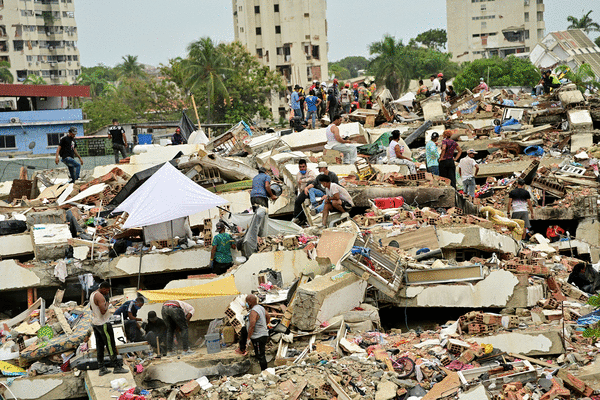
Venezuela’s official earthquake death toll climbed to 2,645 on Friday as a new United Nations-backed assessment estimated the twin earthquakes caused at least $37 billion in direct physical damage, underscoring the enormous reconstruction challenge facing a country already weakened by years of economic decline and deteriorating infrastructure.
The twin 7.2- and 7.5-magnitude earthquakes that struck north-central Venezuela on June 24, just 39 seconds apart, have now left 12,666 people injured, according to updated figures released by the Ministry of Communication. Authorities said 6,462 people have been rescued alive, while 15,050 remain without permanent housing after losing their homes.
Officials also reported 890 aftershocks since the main quakes, 885 buildings affected, including 189 that collapsed completely, nearly 86,117 families assisted, and almost 29,600 military, police and emergency personnel deployed alongside 3,305 international rescuers and more than 25,800 registered volunteers.
Although search-and-rescue teams remain active across La Guaira and other hard-hit areas, the emergency is increasingly giving way to the far more daunting task of rebuilding entire communities while thousands of families continue waiting for answers about missing loved ones.
One of the disaster’s greatest uncertainties remains the fate of people who are still unaccounted for.
While Venezuelan authorities have not released an updated nationwide tally of missing persons, humanitarian organizations and citizen-led registries continue reporting tens of thousands of unresolved cases.
The International Organization for Migration (IOM) and other aid organizations have previously estimated that roughly 50,000 people remain unaccounted for, with many believed to have been trapped beneath collapsed buildings and other structures when the earthquakes struck. Volunteer-run online registries contain more than 43,000 reports submitted by relatives searching for loved ones
Most of those cases are concentrated in La Guaira state and Caracas, where crews continue clearing debris from collapsed apartment buildings, homes and commercial structures. Authorities caution that not every report necessarily represents someone trapped beneath the rubble, as communications failures, population displacement and transportation disruptions have complicated efforts to reunite families.
For thousands of Venezuelans, however, the lack of definitive answers has become one of the tragedy’s cruelest consequences. Outside hospitals, temporary shelters and makeshift morgues, families post photographs of missing relatives and circulating their names on social media in hopes that someone may have information about their fate.
A preliminary assessment prepared for the United Nations Office for Disaster Risk Reduction (UNDRR) offers the clearest picture so far of the disaster’s economic impact.
Produced with support from engineering firms Ingeniar CAD/CAE Ltda. and ERN, the study estimates the earthquakes damaged buildings and critical infrastructure worth approximately $37 billion, equivalent to about 3.4% of the exposed physical assets in the affected region.
The authors stress the figure should be viewed as an initial technical assessment rather than a final accounting. Even so, they say it points to destruction on a scale unprecedented in modern Venezuela.
Approximately $24 billion in direct losses occurred in residential, commercial, industrial, educational, health-care and government buildings, the study found. Another $13 billion involved damage to infrastructure, including telecommunications, power grids, highways, railways, ports, airports, water systems and oil and gas facilities.
Among infrastructure sectors, telecommunications sustained the heaviest estimated losses at approximately $5 billion, followed by energy infrastructure at $3.1 billion, transportation networks at $2.1 billion, water and sanitation systems at $1.6 billion, oil and gas infrastructure at $1 billion, and ports and airports at roughly $300 million.
The assessment covers only direct physical losses and excludes business interruptions, lost economic output, emergency response costs, environmental damage, supply chain disruptions and the enormous expense of rebuilding and strengthening damaged structures.
For that reason, the authors conclude the disaster’s total economic cost will almost certainly prove substantially higher.
The analysis also sheds new light on the unusual nature of the disaster itself.
‘Earthquake doublet’
Rather than a traditional main earthquake followed by an aftershock, researchers concluded Venezuela experienced an “earthquake doublet,” in which the initial 7.2-magnitude quake triggered a neighboring fault that was already close to rupture, unleashing the larger 7.5-magnitude earthquake just 39 seconds later.
According to the report, the first rupture originated along the Boconó fault system, while the second occurred on the San Sebastián fault, two of Venezuela’s principal tectonic structures.
Researchers estimate that an event of similar magnitude has an average return period of about 180 years, based on Venezuela’s seismic hazard profile.
As attention begins to shift from rescue to reconstruction, the country’s engineering community is mobilizing to assess thousands of damaged structures.
The Venezuelan Guild of Engineers (CIV) announced it has launched an emergency training program for engineers, architects and other technical professionals who will inspect damaged buildings throughout the disaster zone.
“We are doing what corresponds to us: providing urgent training so professionals obtain the tools necessary to inspect structures effectively in post-earthquake scenarios,” architect José Gregorio Chacón, a member of the organization’s national board, said in a statement.
The intensive training sessions are open to engineers, architects, technical specialists and senior university students as authorities prepare for what is expected to become one of the country’s largest structural inspection efforts.
Interim President Delcy Rodríguez said Thursday that her administration has begun discussions with the U.S. State Department and the International Monetary Fund to recover financial resources needed to rebuild damaged infrastructure.
Rodríguez has already announced an initial $200 million reconstruction fund, although the U.N.-backed assessment suggests reconstruction costs will be many times higher.
Thousands lost their homes
Authorities are operating 59 temporary camps for displaced families.
While the government reports 15,050 people remain homeless, the U.N. refugee agency (UNHCR) estimates that approximately 16,000 people have been forced to seek alternative shelter after losing access to their homes.
Humanitarian organizations continue warning that shelter, clean water, sanitation, health care and psychological support remain among the country’s most urgent needs.
The International Rescue Committee (IRC) says hospitals and health centers remain overwhelmed in several affected areas, while many temporary shelters continue operating at or near capacity.
The humanitarian impact extends well beyond those who lost their homes.
The International Organization for Migration estimates that as many as 6.76 million people may have been affected in some way by the earthquakes, reflecting widespread disruption to housing, transportation, public services and economic activity across Venezuela’s north-central region.
©2026 Miami Herald. Visit miamiherald.com. Distributed by Tribune Content Agency, LLC.






Comments