US says Witkoff, Kushner had positive talks in Doha on Iran deal
Published in News & Features
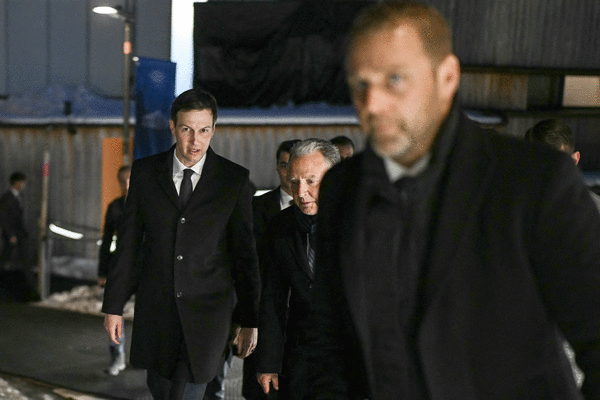
U.S. negotiators Steve Witkoff and Jared Kushner held positive discussions in Qatar and progress is being made on technical talks with Iran, according to a senior administration official, as the countries seek to turn an interim peace deal into a permanent end to the war.
The two Americans were in Doha on Tuesday as part of ongoing indirect talks between Washington and Tehran. An agreement signed last month opened the door to a 60-day negotiating period, but those efforts faced a rocky start after a series of clashes over the Strait of Hormuz and debates over the future management of the critical waterway.
Talks between U.S. and Iranian officials via mediators are continuing on Wednesday, AFP reported, citing a diplomat it didn’t identify. Witkoff and Kushner aren’t taking part, the news agency said.
Tehran has formed working groups to discuss the implementation of the current agreement and negotiating a final peace deal, but no talks have yet taken place, state-run Islamic Republic News Agency reported, citing Deputy Foreign Minister Kazem Gharibabadi.
President Donald Trump’s two top envoys had traveled to Qatar after the U.S. and Iran agreed to halt renewed attacks over Hormuz late last week. Still, uncertainty hangs over control of the strait, with Iran’s state TV reporting that a foreign vessel ran aground in shallow waters on an “unapproved route.”
Qatari officials had downplayed expectations for the new round of negotiations, saying that Witkoff and Kushner would not meet directly with their Iranian counterparts. The senior administration official, who spoke on condition of anonymity to provide an update on the discussions, said progress continued to be made in the separate technical talks, which are being carried out by lower-level representatives.
The Wall Street Journal, citing unnamed U.S. officials, reported Tuesday evening that Trump had decided against resuming a broad military campaign, and told his staff that he didn’t mind if the negotiations extended beyond the Aug. 18 deadline.
The U.S. leader is keen not to derail the diplomatic process and is satisfied with ordering one-time strikes on Iran when necessary, the WSJ said.
Prominent among the many unresolved issues is the future management of the Strait of Hormuz, which before the war handled the flow of about a fifth of the world’s oil and liquefied natural gas supplies.
Iran has insisted that it will have some degree of control over maritime traffic through the waterway and has signaled that some ships may have to pay fees to transit, raising the stakes in negotiations.
Any suggestion of imposing a fee has been strongly opposed by the U.S., Europe and most Gulf Arab states. The interim agreement says Iran would not charge tolls for 60 days but leaves open the possibility ships may be forced to pay some fees after that point.
The Strait of Hormuz was largely shut from the start of the U.S.-Israeli bombardment of Iran in late February until last month’s interim peace deal. That triggered a surge in energy prices and supply shortages.
Brent crude oil was down 0.9% at just over $72 a barrel, extending a decline Tuesday on hopes the ceasefire would hold.
Other outstanding issues include the proposed release of Iran’s billions of dollars of frozen funds and the future of the Islamic Republic’s nuclear program.
—With assistance from Patrick Sykes, Meghashyam Mali and Eltaf Najafizada.
©2026 Bloomberg L.P. Visit bloomberg.com. Distributed by Tribune Content Agency, LLC.





Comments