These Minnesota laws take effect July 1
Published in News & Features
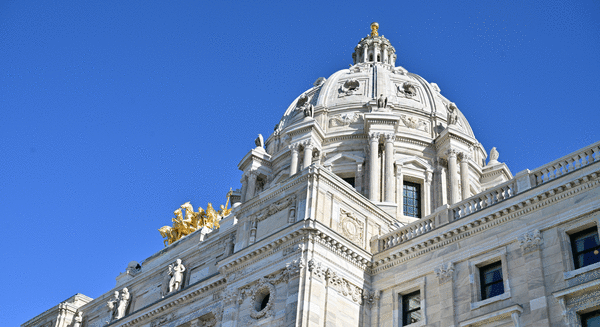
A requirement for anonymous school threat reporting systems, funding for security measures at the Capitol, and a social media health warning requirement are among new laws that take effect on Wednesday, July 1.
Minnesota’s House Public Information Services will often publish summaries of new laws set to take effect.
Here are some of the more significant changes:
Anonymous threat reporting
School districts and charter schools are now required to develop an anonymous threat-reporting system to protect against violence and other dangerous activity in schools. While they’ll have a few years to implement systems, the requirement comes into legal effect on Wednesday.
Reporting systems can include a mobile application, a website or a toll-free hotline. They’re funded by $4 million this coming year and other state aid. Schools that don’t create their own system are required to give information to students and families about the Department of Public Safety’s statewide reporting system.
The state will collect data from anonymous threat reports and hold on to it for two years after the reported threat has passed. It’ll be shared between the public safety and education departments and schools.
Mandatory reporting
When a teacher is charged with a crime that could result in losing their license, the arresting agency is required to notify the state. It’s part of an already existing law that makes grooming of minors a felony.
IT upgrades
Minnesota county computer systems running out-of-date technology to administer state human services programs will get upgrades with funding available under a law that goes into effect on July 1. The state will dedicate tens of millions to upgrades and new fraud prevention measures.
Minnesota is among just 10 states that run Medicaid programs at the county level, and amid increasing scrutiny on fraud, the state is under additional pressure to modernize systems.
Technology used by counties is from the 1980s, and Gov. Tim Walz earlier this year proposed updates as one way to combat fraud in state programs.
Capitol security
New security measures at the Capitol and in courtrooms across the state get funding in a public safety bill that includes $8 million for new security measures for lawmakers.
Boosting security for lawmakers both at their homes and at the Minnesota Capitol complex has been a top issue for state leaders since last summer’s shootings of two state lawmakers and their spouses.
Threats against legislators are on the rise. By October 2025, there were at least twice as many threats as in 2024, according to the Minnesota State Patrol.
Lawmakers this year passed a bill to create a dedicated protective services unit for lawmakers, statewide officials and justices on the Minnesota Supreme Court.
Another $13 million goes toward the new security costs at the Capitol itself. The state installed metal detectors and X-ray machines at entrances in February. The money is intended to cover the added equipment and staffing costs.
Until this year, Minnesota was among a minority of states with no weapons screening at its entrances.
Social media warning
Unless an industry group’s legal challenge prevails in court, Minnesota will require a “conspicuous mental health warning label” on social media websites. Platforms like Facebook, Instagram and TikTok will display a pop-up warning that includes suicide hotline information.
Similar laws have passed in other states, but one isn’t currently enforceable because of a legal challenge. A judge paused enforcement of a social media health warning in Colorado late last year after agreeing with an industry group’s concerns about free speech protections.
That same group, NetChoice, which represents Facebook and Instagram Parent Meta, TikTok and others, has sued in Minnesota, though as of Tuesday a judge hadn’t issued any ruling.
Bonding
Money from a $1.2 billion state infrastructure and capital investment package that passed during this legislative session is for the large part already technically available as of late May, but a non-borrowing cash component totaling roughly $46 million goes into effect July 1.
A big part of that is $10 million for renovations at downtown St. Paul’s Grand Casino Arena. Overall, the complex is getting $50 million, with $40 million going toward modernizing Roy Wilkins Auditorium.
Other east metro projects include $1 million for a park at The Heights neighborhood development on the former Hillcrest Golf Course in St. Paul, more than $2 million for environmental remediation at a South St. Paul Public works facility and $350,000 for a Stillwater veterans memorial.
_____
©2026 MediaNews Group, Inc. Visit at twincities.com. Distributed by Tribune Content Agency, LLC.





Comments