Boyle Heights warehouse fire is nearly out, but health and economic uncertainty still reign
Published in News & Features
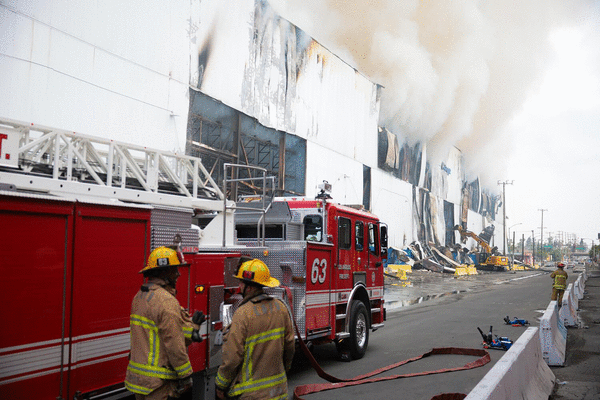
LOS ANGELES — A fire that has burned at a Boyle Heights warehouse for more than a week is nearly out, officials said Wednesday, but residents in many Eastside communities were just beginning to assess the health implications from days of dirty air as well as significant economic losses.
The announcement coincided with the official expiration of a particle pollution advisory that has kept residents inside and on edge for days as firefighters worked to get a handle on the hazardous situation.
Fire Chief Jaime E. Moore tasked crews with completing knockdown by the end of the day, hoping to wrap up the noxious and stubborn fire, which has burned for eight days. But hot spots detected inside the building in the morning suggested it may take more time.
“There’s still some smoldering fires inside,” Fire Capt. Milo Cope said as a series of water-dropping helicopters dumped 480 gallons of water at a time through a hole in the roof just before noon.
To put out the remaining flames inside the nearly 500,000-square-foot cold storage facility, crews were also continuing the same strategy they’ve employed the last few days — shooting thousands of gallons of water into the massive warehouse from outside.
Officials say it’s only a matter of time before crews bring the fire under control.
On June 17, the warehouse, operated by Lineage, a global temperature-controlled storage facility company, caught fire reportedly during work on solar panels on the building’s roof. The flames got inside the building, which is insulated, and have been slowly burning through 85 million pounds of food and goods inside ever since.
Lineage had crews on site clearing food and debris. Los Angeles Sanitation & Environment staff members were also at the scene, working with the company and fire crews to make a plan to haul away the material once knockdown was declared, a spokesperson for the agency said.
The goal on Wednesday, said Fire Capt. Jacob Raabe, was to extinguish what’s left burning inside the building. But firefighters had to try to do that without going in, he said.
The roof, Raabe said, is resting on the 600-foot-long, 50-foot-tall racks that hold massive amounts of food that are thawing, spoiling and burning, posing a danger to anyone who goes in.
“We still cannot send firefighters into this building, and, to be quite honest, we’re probably never going to send anyone into this building because there’s no life hazard right now,” Raabe said. “We’re going to put out this fire from the exterior and reevaluate as conditions change. But this tactic is working and it’s putting out the fire.”
For businesses and residents in the area, it’s been a difficult time. Many sought refuge at government-run shelters. Some struggled to get air purifiers for their homes. Both local and county governments have been trying to provide assistance.
But on the streets of Boyle Heights and other communities, there remains deep uncertainty.
Inside Jim’s Burgers, not far from the burning warehouse, restaurant owner Manuel Orozco and his workers wore face masks as they tried to keep busy in a mostly empty diner on Tuesday.
“No one is coming and it’s because of the smoke,” he said.
Orozco estimated that the nearby fire had caused sales to drop by 70% over the last week. He said at least two workers had been unable to come in because of health issues such as high blood pressure and asthma.
At MV Automotive at East Olympic Boulevard and Alma Avenue, Manny Villasenor, whose father owns the mechanic shop, said the smoke had forced him to close earlier. He uses fans in the bays for the mechanics. He said at least one worker with asthma was told to stay home.
Three blocks away, Cristina Medrano, owner of Kassandra’s Beauty Salon, said the heavy smoke had forced her to cancel several appointments, including four on the day the fire erupted.
She and another employee wear masks inside the shop and keep the doors closed at all times. The smoke meant fewer clients and curtailed shop hours. At one point, the shop was closed for two days, she said.
Once the fire is knocked down, the plan is to demolish half of the building and have crews monitor the debris for any reemerging hot spots that could rekindle a fire, Cope said.
That could take months, and officials are still considering how to complete the task.
Though this isn’t the first fire that Lineage has experienced at one of its cold storage facilities — which are essentially warehouse-size ice chests walled with thick insulation — it is highlighting a strategy for fighting these types of fires, Raabe said.
The agency partnered with a company in Texas to use two water cannons — which are typically used on burning oil rigs.
Those cannons, Cope said, can shoot more water per minute and can reach a farther distance than the department’s equipment — about 8,000 gallons per minute from up to 400 feet away, versus 1,000 gallons per minute at a maximum distance of 200 feet. Although city hydrants can’t support the Texas water cannons at their maximum capacity, the cannons can still shoot up to 2,000 gallons per minute from the same distance.
Crews also “peeled” back the building’s walls to expose more of the interior and give better access to firefighters, Raabe said.
“We’re able to incorporate this public-private partnership,” Raabe said. “That is how we have taken a fire that in other jurisdictions has taken over 60 days to put out, we’re on day eight now and we’re close to final extinguishment.”
In 2024, a fire at a Lineage cold storage warehouse in Finley, Wash., took eight weeks to extinguish. Some residents have filed a lawsuit alleging the company has a history of hazardous chemical releases and regulatory violations that should have compelled it to adopt stronger safety protocols at the site. Lineage said that health and safety are its top priority and that it vigorously disputes the lawsuit’s characterization of its safety record.
Though an air quality advisory expired on Wednesday afternoon, experts point out that air quality monitors may not account for large ash particles and debris, and people who see or smell smoke or ash should take precautions to protect their health.
On Tuesday, the Los Angeles County Board of Supervisors ratified its local emergency proclamation to expedite access to state and federal resources, support ongoing response and recovery efforts, and help secure disaster assistance for affected communities.
The board also approved a motion directing county agencies to continue health monitoring, environmental assessments and community support efforts.
The motion, introduced by board Chair Hilda Solis and co-authored by Supervisor Janice Hahn, also directed the county to work with city and state partners to investigate the incident, pursue potential enforcement actions and explore compensation options for affected residents and businesses.
In discussing the matter, Hahn also called for the county to look into establishing an emergency stockpile of air purifiers and other crucial supplies to better prepare for future disasters. A feasibility study is expected to be completed in 30 days.
Orozco, the owner of Jim’s Burgers, said he too worried about the health effects on his wife and two kids.
He started his business more than 20 years ago, he said, and has faced a number of challenges. The introduction of food delivery services with the pandemic led to a decline in walk-in business. Then, the ongoing federal immigration operations in the city have also driven people away. Street vendors offer lower prices compared with his, which have been affected by high inflation. Now, the fire has delivered another blow.
Still, Orozco remains optimistic.
“Life is not always terrible,” he said. “It will get better.”
_____
©2026 Los Angeles Times. Visit at latimes.com. Distributed by Tribune Content Agency, LLC.






Comments