Trump defends Iran deal, hints at early signing
Published in News & Features
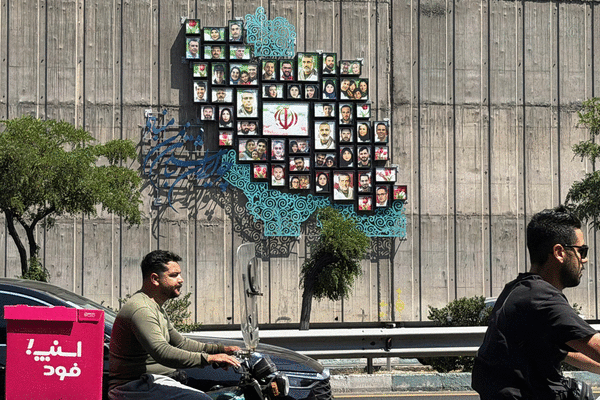
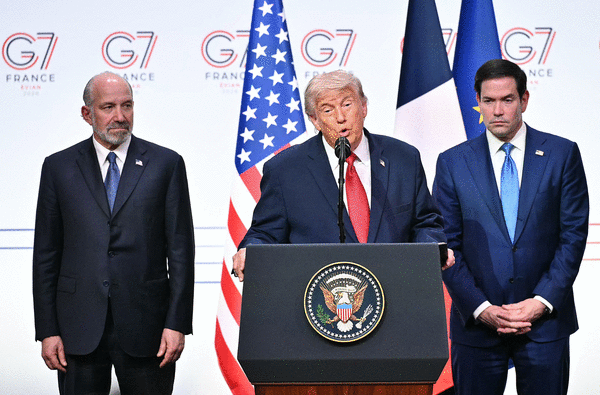

President Donald Trump defended the interim peace deal he’s reached with Iran and said it could get signed as soon as Thursday, amid pushback from Republican hawks at home who object to the billions of dollars set to flow Tehran’s way.
The so-called memorandum of understanding could be signed “shortly, tomorrow, maybe the next day,” Trump said Wednesday at a news conference in France where he’s attending a summit of the Group of Seven advanced economies.
A draft seen by Bloomberg foresees the rapid reopening of the Strait of Hormuz, along with immediate sanctions waivers for Iranian oil. Talks on nuclear issues, and potential further financial gains for Iran, will follow.
With Gulf energy supplies dwindling during the three-month conflict, and economic strains building around the world, Trump signaled the risk of a major economic crisis played a key role in his decision to call off the war he started in February.
He said military escalation “could have caused an international depression” and cited the U.S. leader on whose watch the Great Depression of the 1930s began.
“The one president I did not want to be was the late, great Herbert Hoover,” Trump said.
Trump also defended aspects of the preliminary deal that have drawn criticism among some of his Republican allies in Washington. That includes the exclusion from the deal of Iran’s ballistic missile program, which was cited by Israeli officials and his own Secretary of State Marco Rubio as justifications for the war.
On Wednesday, Trump said the missiles will be discussed along with Iran’s nuclear program during subsequent talks, though Iran will “have to have some because other people have some.” Rubio has previously argued that Iran’s missiles and drones could create a shield for Iran to develop nuclear weapons.
He also defended the $300 billion development program for Iran that’s envisaged in the MOU, reiterating that there’ll be no U.S. government cash in it, and Iran will only get to benefit if it “behaves.” He added that U.S. forces would hit Iran again if its leaders didn’t adhere to the deal.
But Trump did signal that he’s ready to release the billions in Iranian assets frozen over the years by the United States, something he’s ruled out in the past — arguing now that it’ll be bad for the dollar if he doesn’t. “At a certain point in time I guess we’ll have to give it back,” he said. “If we didn’t give it back, nobody would ever invest in the dollar again.”
The preliminary accord has brought relief to world energy markets, with Brent crude plunging below $80 a barrel this week, though it pared the decline slightly on Wednesday.
At the same time, the MOU will leave most of the thorniest disputes — such as the one over Iran’s stockpiles of highly enriched uranium — to a 60-day period of future talks. Those will likely be tense as Trump comes under pressure from GOP allies who say he’s conceding too much and have argued U.S. forces should “finish the job.”
“It’s much bigger than a mistake,” Mike Pence, Trump’s vice president from his first term, told CNN of the provisional deal. “These immediate concessions, particularly sanctions waivers right out of the gate, would essentially be a lifeline to the Iranian regime. I think it’s ill-advised. We’ve got to keep the pressure on.”
The deal presents political risks for Trump, who had claimed for years that a 2015 accord negotiated with Iran during President Barack Obama’s administration was the “worst deal in history” and amounted to a massive financial giveaway to Tehran. Trump scrapped that agreement in 2018 and promised something far better.
The MOU is scheduled to be formally signed by U.S. Vice President JD Vance and Iranian Parliament Speaker Mohammad Bagher Ghalibaf in the Swiss town of Bürgenstock, a mountain resort overlooking Lake Lucerne. Trump joked about Vance’s role, when asked by a reporter in France why he wouldn’t attend the signing.
“This way if it works out, I’m going to take the credit,” he said. “If it doesn’t work out, I’m blaming JD.”
Neither Washington nor Tehran has yet officially released the document, though Trump said he’ll soon do so.
Trump and Israeli Prime Minister Benjamin Netanyahu began the war by bombing Iran on Feb. 28, arguing it was necessary to stop the Islamic Republic from building a nuclear weapon.
But the war has fallen short of its initial aims. While their forces battered Iran’s military and economy, the Islamic Republic is still standing, despite Trump saying Iranians would be able to “take over” their government.
Tehran has also shown it can still menace the region with drones and missiles and put pressure on the White House to strike a deal by effectively closing the Strait of Hormuz, sending oil prices soaring and hurting the global economy. The rise in prices in the U.S. hit the standing of Trump and his Republican Party ahead of November’s midterm elections.
At its core, the interim deal “trades the reopening of the Strait Hormuz for economic relief,” said Bloomberg Economics analysts including Dina Esfandiary and Ziad Daoud. “But the exchange is uneven: Tehran’s gains will be plenty and new. Washington will just recover some benefits that existed before the war began in February.”
_____
(With assistance from Eltaf Najafizada and Arsalan Shahla.)
_____
©2026 Bloomberg L.P. Visit bloomberg.com. Distributed by Tribune Content Agency, LLC.




Comments