US Attorney's Office brings conspiracy charges against 15 people involved in anti-ICE actions in Minnesota
Published in News & Features
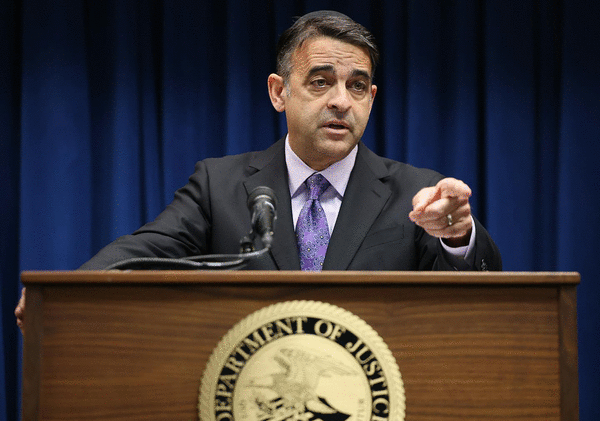
MINNEAPOLIS — Federal prosecutors on Tuesday unsealed conspiracy charges against 15 people they accuse of coordinating with each other to impede immigration enforcement efforts in Minnesota this year.
During a news conference, Minnesota U.S. Attorney Daniel Rosen described the indictment against 15 defendants as part of a broader effort by the federal government to “address organized, lawless behavior,” which he said “seeks to disrupt execution of federal law, endanger law enforcement and importantly endanger the very communities that these defendants falsely claim to be protecting,”
“The conspiracy was not to interfere with their voice but to do it by force, that’s a crime and it will not be tolerated in the United States,” Rosen said. Twelve of the defendants were arrested on Tuesday, with one already in custody and two at large.
The charges against the defendants include conspiracy to impede or injure a federal officer, interstate stalking, assault on a federal officer and destruction of government property. The indictment targets the group Direct Action Minnesota and several of its subgroups, including Black Cat Workers’ Collective, which the U.S. Attorney’s Office alleges is part of the leftist antifa movement, an umbrella term short for antifascist — which the Trump administration has vowed to target.
The majority of the 94-page indictment focuses on messages between the defendants coordinating actions through Signal group chats or on social media, such as setting up blockades around the Whipple federal building. Those indicted include Isaac Auman Sant, Emmett James Doyle, Cameron Kennedy, Callum Robinet, Erik Davis, Brian Stillwell Apland, Kyle Wagner, Hannah Margaret Van De Water Davis, Treasure Cay Thoreson, Nathan Junho Kim, Alec Stewart, Douglas Misterek, Dustin Scott Beisell, William Morgan and Natasha Rakotz. Court records did not immediately list attorneys for the accused, many of whom made court appearances Tuesday afternoon.
About 80 people protested the charges outside the federal courthouse in Minneapolis to condemn the indictment. They included attorneys from the National Lawyers Guild, who characterized the accusations as a political stunt.
Bruce Nestor, an attorney who attended the Department of Justice’s news conference, called the presentation a “propaganda show.”
“[Rosen] talked that people were being prosecuted for their acts, not their thoughts, and then recited their thoughts — somebody posting that we need to become ungovernable.” Nestor said. “What’s wrong with being ungovernable by a fascist government?”
According to the charges:
Tuesday’s indictment is the first by the Justice Department against a batch of Minnesota-based protesters under one case. A Star Tribune analysis of prior charges against protesters show many of the individual cases have faltered in the courtroom. Of the three dozen people charged during Operation Metro Surge, a third of the cases have been dismissed for a variety of reasons, including a lack of probable cause or evidence contradicting law enforcement’s claims.
Asked how Tuesday’s indictment will hold up in comparison, U.S. Attorney Daniel Rosen said, “I don’t think any cases have failed in any way, but I’ll tell you, read the indictment and you’ll understand the full magnitude of this case.” Rosen, pressed on the topic again, responded: “You watch how this case plays out, you watch how the evidence plays out, and the evidence will prove it all out.”
Nestor said he anticipates the same weaknesses in the dismissed protesters’ cases will show in Tuesday’s indictment.
“They were based on lies,” Nestor said of the past charges. “They were based on false information, they were based on violation of judicial orders. And now today, 15 more people are going to go through that process, and the same thing will be true of the charges.”
The charges align with the Trump administration’s targeting of “antifa.” In an executive order last year, President Donald Trump described the movement as a “militarist, anarchist enterprise” that suppresses speech. During the news conference, Rosen said the definition of antifa “goes beyond the scope” of the indictment, then said many of the defendants self-identify as part of the movement and “you might want to ask them that.” He did not directly answer whether similar charges are expected against other protesters.
Among the indicted is Kyle Wagner, one of the leaders of Direct Action Minnesota. Wagner, 37, “identifies himself as antifa and doesn’t shy away from it,” Rosen said, playing a video Wagner posted to social media in which he said “we’re not talking about peaceful protests anymore.” Wagner was also arrested and charged in February with interstate domestic violence.
Asked how many federal agents were injured as a result of the actions of the indicted, Rosen said: “We have a group of people who quite deliberately got together, planned violence, used violence, and whether or not the extent to which they achieved their ends of harming people — whether it was by the overturning of vehicles and RVs in the street, whether it was by the throwing of ice blocks at vehicles, whether it was by use of vehicles in other ways, whether it was by their stalking — whether or not they actually at the end of the day caused bodily harm is not the measure of whether or not they committed a serious federal crime.”
“I would dare say, we just cannot have in this country people getting together, engaging in all of these violent acts, and then simply saying ‘Well, you know, nobody got hurt, so how bad could it have been?’”
_________
(Louis Krauss of the Minnesota Star Tribune contributed to this report.)
©2026 The Minnesota Star Tribune. Visit at startribune.com. Distributed by Tribune Content Agency, LLC.





Comments