11 Massachusetts nurses were diagnosed with brain tumors: Is it a cancer cluster?
Published in News & Features
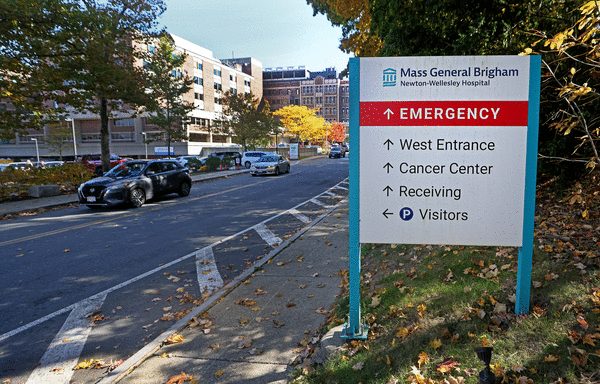
BOSTON — As the state investigates a possible cancer cluster at a high school, many Herald readers have asked whatever happened with the potential tumor cluster at a local hospital.
Seven current and former nurses in Newton-Wellesley Hospital’s fifth floor maternity wing were diagnosed with brain tumors, the Herald reported last year.
The number of current and former nurses with confirmed or suspected brain tumor diagnoses was actually 11, the Herald has learned while reviewing an independent report of the tumor concerns at the hospital.
Ultimately, the outside expert from Harvard determined there’s no evidence of “a true workplace tumor cluster” at the Mass General Brigham facility.
Stefanos Kales, a professor at Harvard Medical School, in the external report stressed that the hospital workplace is a safe environment — and is not the cause of the brain tumors.
There was no evidence of “any adverse or harmful chemical or other exposures,” he wrote. A series of independent assessments found “no excess radiation exposure.”
“Thus, all available information and data indicate that the NWH 5th floor is a safe working environment without evidence of any carcinogenic/tumorigenic occupational exposures,” wrote Kales, who’s also professor and director of the Occupational Medicine Residency at the Harvard Chan School of Public Health.
“The most important finding of this review is that multiple comprehensive exposure assessments done to examine the NWH 5th floor environment found no evidence of any potential occupational exposure that could cause brain tumors,” Kales added. “The likelihood of a true environmental tumor cluster in the absence of plausible exposures is very unlikely.”
When news broke last year of the several nurses being diagnosed with brain tumors, hospital officials continued to assure staff and patients that the environment was safe.
After hospital officials learned of the reported brain tumors, they launched an investigation. Experts reviewed air and water quality, and conducted comprehensive testing for any potential radiation, chemical, or pharmaceutical exposures.
Hospital officials in recent months updated employees about the fifth floor environmental investigation, and the conclusion of the external reviews.
“Their findings align with all previous assessments: no environmental risks have been identified in the hospital workplace,” Ellen Moloney, hospital president and COO, wrote to employees. “These evaluations included extensive testing of air quality, water quality, radiation exposure, chemical and pharmaceutical safety, interviews with current and past staff, and a detailed review of potential risk factors.
“No exposures or environmental conditions were identified that could cause the types of benign brain tumors reported,” Moloney added.
In Kales’ external report, more details were shed about the diagnosed nurses who worked in the maternal care labor/delivery unit on the hospital’s fifth floor at some point over the last 23 years. All of the nurses with brain tumors are women.
Nine of the 11 brain tumors were considered benign or not malignant. Six were meningiomas, the most commonly reported brain tumors in the country. Two were pituitary adenomas, and one was an optic nerve schwannoma.
The two malignant tumors were glioblastoma and glioma.
“The types of prevalent tumors and their proportions among the NWH 5th floor employees were compared statistically to the proportions of different tumor types in national United States surveillance data on brain tumors,” wrote Kales, who’s also the chief of Occupational Medicine and Medical Director for Employee Health/Industrial Medicine at the Cambridge Health Alliance.
“The distribution of brain tumor types was remarkably similar to national data with no statistically significant differences in the frequency of these tumor types on the NWH 5th floor and national data for brain tumors,” he added.
Kales evaluated latency considerations, which is the required lag time from when a person is first exposed to a carcinogen until a tumor grows to a diagnosed size. Most solid tumors in adults have a minimum latency of at least 10 years.
“Among the six NWH 5th floor employees with confirmed or suspected meningiomas, the latency ranged from 1 to 18 years and 3 of the 6 cases had less than 7 years of latency. Thus, at least three of the six cases were not compatible with a hypothesis of causation by radiation or other occupational exposure,” Kales wrote.
Among the two reported pituitary adenomas, one case had less than five years of latency. That also eliminated the possibility of a pituitary cluster.
“Among the two reported gliomas, each had a latency of 20 years, and therefore, no potential latency issues are present,” Kales wrote. “However, overall biological plausibility is lacking as there are no known, no reported and no measured carcinogenic/ tumorigenic exposures.”
As more brain tumor cases were reported from the fifth floor maternity wing, many hospital employees grew increasingly concerned.
“The perception of a cancer cluster and/or concerns regarding the surrounding environment among the involved population may exist despite the absence of a true cancer cluster,” Kales wrote. “Epidemiologists define a true cancer cluster as the confirmed observation of cases of the same or etiologically related cancers in numbers greater than the expected number during a specific time among a discrete group of people (defined by geography, workplace, etc.).”
He added, “True clusters are generally rare and sufficient evidence of occupational/environmental causation is very unusual… Although the occurrence of these tumors may seem related or have some association in the eyes of the community, they are medically distinct and unrelated phenomena.”
_____
©2026 MediaNews Group, Inc. Visit at bostonherald.com. Distributed by Tribune Content Agency, LLC.






Comments