What to know about denaturalization as the DOJ pushes to strip citizenship from more US residents
Published in News & Features
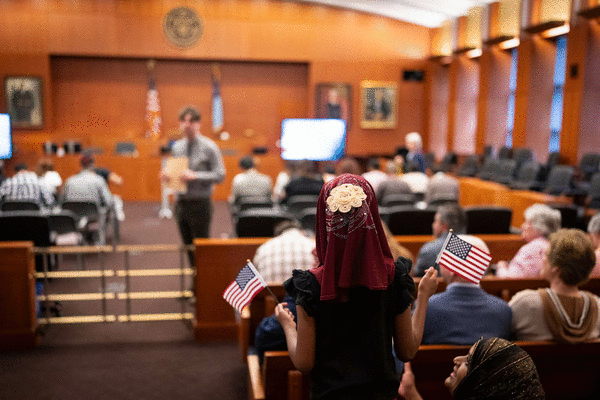
MINNEAPOLIS – Two Minnesotans are among the latest foreign-born residents whose citizenship has been targeted by the Justice Department as the Trump administration seeks to increase denaturalization cases.
Historically a rare process, denaturalization has been ordered a priority by President Donald Trump, with civil cases being filed across the country. The Justice Department said the Immigration and Nationality Act — the 74-year-old law that oversees immigration, naturalization and deportation — allows for naturalized citizenship to be revoked if it was illegally acquired. The Trump administration has used the provisions under the INA to implement its immigration agenda.
Immigration experts have expressed concern that the administration’s push may set a precedent to view naturalized U.S. citizens as a separate or lesser category than those born in this country.
“This is the attack on the most protected of the immigration population,” said Julia Decker, policy director for the Immigrant Law Center of Minnesota.
Denaturalization is the legal process that the U.S. government uses to strip citizenship granted to foreign-born immigrants who qualified for naturalization through residency and other requirements.
The U.S. Attorney’s Office files a complaint in federal district court to revoke someone’s citizenship. If citizenship is revoked, the person’s immigration status could return to what it was before citizenship, such as when they held a green card, or they could face deportation.
Those who acquired citizenship at birth are not affected.
The government can denaturalize someone on a few narrow grounds, experts said. That includes alleging someone obtained citizenship through fraud or by misrepresenting a material fact.
Unlike in immigration court where an immigrant bears much of the burden to fight deportation, the federal government bears a high burden of proof to revoke citizenship, said Ana Pottratz Acosta, visiting professor at the University of Minnesota Law School.
In the most recent round of denaturalization filings, the Justice Department targeted foreign-born U.S. citizens who committed a range of serious offenses that officials said resulted in them unlawfully obtaining citizenship.
Two Somalia-born Minnesotans are among the dozens of people whose citizenship the Justice Department sought to revoke in the past month.
The Justice Department most recently sought to strip citizenship from Abdikadir Ali Kadiye, who the federal government alleges tried to enter the United States under two names in April 1997. According to his complaint, Kadiye initially applied under the name Liban M. Degel and claimed he was married with no children.
After an immigration judge denied his application, he submitted another application in March 1998 under the name Abdikadir Ali Kadiye. He admitted in 2012 to a Customs and Border Patrol agent that he had used two identities for admission. Kadiye is also one of nearly 80 people charged in the $250 million federal food fraud prosecution involving the nonprofit Feeding Our Future. He pleaded guilty in September 2023 and awaits sentencing.
The government is arguing Kadiye misrepresented and concealed his past in his application.
The Justice Department also filed last month to revoke citizenship from Salah Osman Ahmed. Ahmed was convicted of trying to join the terrorist organization al-Shabab in September 2007, just after he was granted citizenship in August 2007.
“[Ahmed’s] material support for this terrorist group so shortly after he gained citizenship establishes that when he naturalized, he lacked the requisite attachment to the principles of the Constitution and dedication to the good order and happiness of the United States,” read the government’s petition to revoke his citizenship.
His attorney said federal law does not support denaturalization under those circumstances.
Hearings have not been scheduled in either case.
Reports from immigration groups say that the number of denaturalization cases increased during both of Trump’s terms. A report by the National Immigration Forum said 168 denaturalization cases were filed in federal court during Trump’s first term compared with 64 under President Joe Biden.
In a memo last year, Trump directed the Justice Department’s Civil Division to prioritize denaturalization cases against individuals for a range of reasons, including those who pose a danger to national security, did not disclose prior felonies, engaged in human trafficking or participated in fraud. The memo also called for prioritizing cases referred by the U.S. Attorney’s Office in connection with pending charges or against a person that the Justice Department “determines to be sufficiently important to pursue.”
In January, U.S. Rep. Tom Emmer introduced a bill that sought to expand the grounds to denaturalize U.S. citizens convicted of certain crimes, including fraud, affiliating with a terrorist organization or committing an aggravated felony. He dubbed it the Stop Citizenship Abuse and Misrepresentation (SCAM) Act.
“If you came to this country to harm and take advantage of the American people, I’ve got news for you: You’re going home,” Emmer’s office said in a statement. “Anyone who commits fraud against American taxpayers, affiliates with a terrorist organization, or commits an aggravated felony or espionage after becoming a naturalized U.S. citizen never met the requirements for naturalization in the first place and should be denaturalized and deported.”
—Paul Walsh of the Minnesota Star Tribune contributed to this story.
©2026 The Minnesota Star Tribune. Visit at startribune.com. Distributed by Tribune Content Agency, LLC.





Comments