Judge halts Trump's $100,000 H-1B visa fee
Published in News & Features
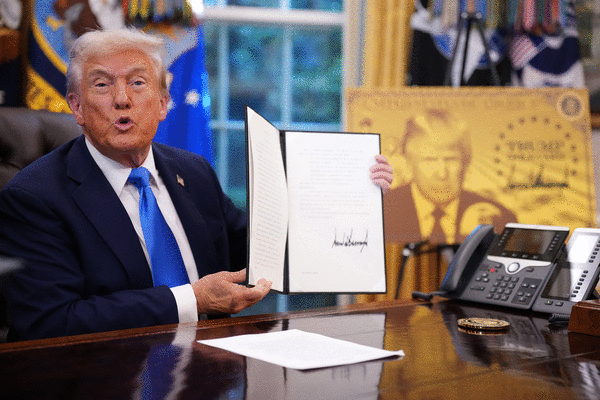
WASHINGTON — A federal judge in Massachusetts on Monday blocked President Donald Trump’s attempt to charge a $100,000 fee for companies seeking to employ foreign workers with an H-1B visa, ruling in part that it oversteps Congress’ taxing power.
In the ruling, Judge Leo T. Sorokin of the U.S. District Court for the District of Massachusetts found the Trump administration’s policy was effectively a tax, and that Congress in an immigration law had not given presidents the power to tax.
Sorokin wrote that although the statute gives the president broad powers to restrict entry into the country, “none of these terms, by their ordinary meaning, include the power to tax.”
He also rejected the administration’s effort to call the fee a “regulatory payment” that could fall within Trump’s power to raise.
“Defendants offer no definition for what constitutes ‘a regulatory payment,’ cite no cases or statutes employing the term, and advance no reasoned argument explaining how this term encompasses something different than a tax or a penalty,” Sorokin wrote.
California and other states filed the lawsuit against the Trump administration in December, arguing that the new fee endangered communities’ ability to find qualified teachers, health care professionals and other needed services. The suit is one of several pending against the administration’s effort to restrict visas for high-skilled workers.
The program provides some 85,000 visas for so-called high-skill foreign workers on a lottery program, with some exceptions for nonprofit organizations and educational institutions.
Arguing that companies had abused the visas to replace American workers with lower-skill foreign workers, Trump in September sought to hike the fee to apply for a visa to $100,000.
Sorokin, in finding the fee was essentially a tax, wrote that “the President has no authority to levy a tax unless such a power is delegated by Congress through statute.”
And he brushed aside the Trump administration’s arguments that it was not a tax because it is collected by the Department of Homeland Security, and that it may end up reducing revenue because of a reduction in H-1B applications.
“Moreover, every $100,000 payment made pursuant to the Policy does raise revenue. That is indisputable. No legal authority suggests that a payment requirement qualifies as a tax only if it increases the total revenue generated from that particular tax,” Sorokin wrote.
Sorokin compared the fee to Congress’ power to tax still-legal products like tobacco. Just because higher taxes on tobacco products may reduce revenue does not make them anything other than a tax, he wrote.
_____
©2026 CQ-Roll Call, Inc. Visit at rollcall.com. Distributed by Tribune Content Agency, LLC.




Comments