US-China rivalry is laid bare by a contract to deepen an Argentine river
Published in News & Features
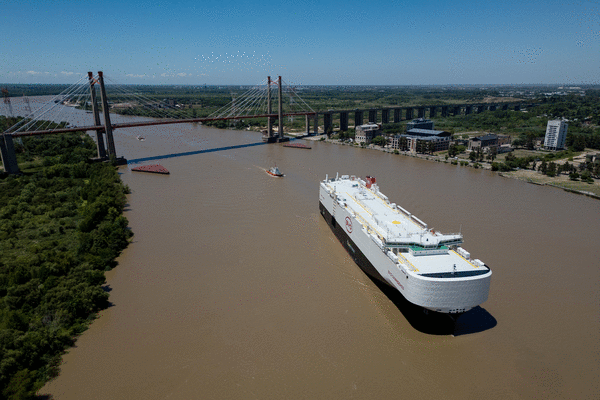
A government tender in Argentina underscored tensions between Washington and Beijing in Latin America as President Javier Milei’s administration awarded a 25-year contract to upgrade a key trade artery to a venture with a history of ties to China.
Milei officials announced late Thursday that Jan de Nul NV, a Belgian dredger, won the bidding to expand and maintain the shipping lane of the Parana River. Deepening the crucial export-import route for the Southern Cone region, which runs from the estuary at Buenos Aires inland to the world’s biggest crop-loading hub in Rosario and beyond, will require some $10 billion.
To the losing bidder, DEME Group NV — another Belgian dredger, favored by an array of U.S. interests — the problem is that Jan de Nul’s partner for the job is Servimagnus SA, a local company that’s worked for years with China’s state-run CCCC Shanghai Dredging Co.
Milei officials have given participants until late next week to lodge challenges to the decision. DEME’s U.S. partner, Great Lakes Dredge & Dock Corp., said it’s considering its options. “We are disappointed in the announcement,” said Chris Gunsten, senior vice president for project services. “It is a bad sign toward American investors.”
A triumph for Jan de Nul-Servimagnus may put Milei himself in a difficult spot. The libertarian leader barred state-run entities from participating in the tender, in what was widely viewed as a move by one of President Donald Trump’s staunchest allies to exclude China. Yet his underlings awarded the contract to a joint venture that some Republicans warned is a front for Beijing.
Though Servimagnus has worked with Shanghai Dredging on several projects in the River Plate estuary and on the Atlantic coast over the past two decades, the venture vehemently denies there’ll be any Chinese involvement in the new Parana operations.
What seemed a run-of-the-mill infrastructure tender took on a geopolitical aspect right after Trump and Treasury Secretary Scott Bessent bailed out Milei during a period of political and market upheaval late last year. The U.S. president, who is reasserting Washington’s influence in Latin America after seeing Beijing hugely expand its footprint, told Milei at the time that Argentina’s ties to China should be constrained to trade only.
The Parana quickly became a flashpoint. At stake is the future of a waterway that’s not only vital to Argentina — which ships out most of its vast crop cargoes via the river and also relies on it for imports — but also to landlocked neighbors Paraguay and Bolivia. Brazil uses it for iron ore exports, too.
“Control and governance of critical infrastructure have acquired a geopolitical significance not always seen in the past,” said Antonio Sanchez, an Argentine shipping infrastructure expert at Panama-based consultancy firm Talasonomica, citing the recent closure of the Strait of Hormuz in the Middle East. “Infrastructure used to be viewed mainly in economic or productive terms, but now there’s geopolitical value.”
Benjamin Gedan, director of the Stimson Center’s Latin America program, highlighted how the White House officially took that view in the Americas in its November National Security Strategy. It stated that U.S. alliances “must be contingent on winding down adversarial outside influence — from control of military installations, ports, and key infrastructure to the purchase of strategic assets.” That strategy was crystallized early this year, Gedan said, when Panama rescinded Chinese port contracts along its canal and Beijing retaliated.
So it was perhaps little surprise when DEME’s Parana bid drew backing from U.S. players including Great Lakes, KKR & Co. and the U.S. International Development Finance Corp., and then lobbied Washington for help. Sanchez also pointed out recent involvement by the U.S. Army Corps of Engineers in South American waterway maintenance.
“Often, the U.S. is motivated by sour grapes and simply complains about the danger of Chinese investments and infrastructure finance in the region,” Gedan said, citing the sprawling Chancay port on Peru’s Pacific coast. “In this case, there’s a U.S. alternative Washington is promoting, reflecting some recognition that if the U.S. wants to out-compete China, it should actually compete — even if it’s uncomfortable for governments to get caught in the middle.”
While Milei has cozied up to Trump and even lured U.S. investment to Argentina’s booming shale oil patch, he’s also conceded that the country’s economy simply couldn’t thrive without Chinese trade. That may have been a factor in the Parana tender, potentially putting Milei in a bind.
“Beijing may have been unhappy if it felt like the U.S. once again elbowed a Chinese company out of a major contract as occurred in Panama,” Gedan said.
©2026 Bloomberg L.P. Visit bloomberg.com. Distributed by Tribune Content Agency, LLC.





Comments