As anti-ICE protest cases falter, prosecutors notch first conviction on lesser charge
Published in News & Features
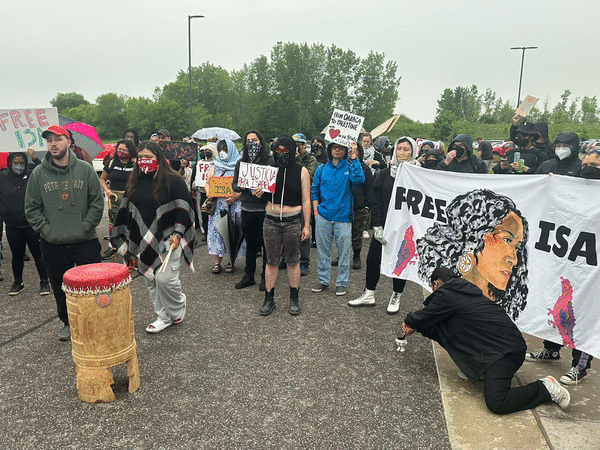
MINNEAPOLIS — Twin Cities activist Isabel Lopez faced the possibility of decades in prison after being accused of assaulting federal agents during an anti-immigration enforcement protest in south Minneapolis last summer. Yet with just weeks to go before trial, prosecutors downgraded her four felony charges to a single misdemeanor in return for Lopez’s guilty plea.
When she officially pleads later this month, Lopez will hand federal prosecutors their first conviction — albeit on reduced charges — against a Minnesota protester. In exchange, she’s expected to avoid prison time and a felony record.
Lopez’s case is the latest example of prosecutors downgrading or dropping charges against Minnesota-based protesters after publicly characterizing them as “violent agitators.” Three dozen were initially charged with assault, accused of crossing the line from protected speech into violence. Pam Bondi, U.S. attorney general at the time, posted some of the shackled defendants on social media during Operation Metro Surge.
Since then, a third of the cases have been dismissed. The remaining defendants are still hoping to clear their names.
Lopez says she’s accepting the deal with mixed feelings. Going to trial would have given her the chance to counter the federal government’s narrative. But the existence of social media video showing her clashing with officers made it risky to roll the dice with a jury.
Mostly she felt like a dark cloud has lifted.
“I’m thinking about other people that still have charges on them, and I have more hope for them,” Lopez said this month. “But I’m still looking over my shoulder constantly, and always thinking about the people they’re targeting.”
The dismissals against Minnesota protesters mirror a national pattern. In Chicago, 29 of 33 assault against law enforcement cases have resulted in dismissal, acquittal or pre-trial diversion, according to The Chicago Sun-Times. A Los Angeles Times analysis of similar cases last year found a third had been dismissed.
Former Minnesota U.S. Attorney Anders Folk said the national trend of dismissals, downgrades and acquittals shows federal prosecutors are charging cases without merit.
“You really shouldn’t be bringing cases unless you believe you can convict beyond a reasonable doubt,” said Folk, a candidate for Hennepin County attorney. “You owe that to the person who’s potentially about to have their life turned upside down.”
The U.S. Attorney’s Office in Minnesota did not respond to detailed questions about Lopez’s case, including why they downgraded charges against her and other protesters. In previous court filings, however, prosecutors said its evidence against Lopez included body camera and social media footage showing Lopez kicking and pushing agents and chucking a softball at a sheriff’s deputy.
“She repeatedly engaged in physical acts of violence that impeded, obstructed, or interfered with law enforcement,” Assistant U.S. Attorney Rebecca Kline argued in court documents.
Lopez, who grew up in St. Paul, is the American-born daughter of Mexican immigrants. A poet and Aztec dancer, she works for the Indigenous Protector Movement, a nonprofit based in Minneapolis’ Ventura Village that does neighborhood safety patrols and advocates for American Indian causes.
Last June, Lopez joined a south Minneapolis contingent of progressives, socialists and anti-fascists as they clashed with federal law enforcement trying to raid a taco shop in the Latino business corridor. While police insisted they were executing a warrant that wasn’t immigration related, activists zeroed in on the presence of officers wearing ICE insignia. It was one of the first major conflicts in Minnesota over escalating immigration enforcement under the second Trump presidency.
Videos captured Lopez and federal agents scuffling during the protest. In one clip, she’s in a throng of people yelling when an officer pushes her and grabs the back of her head. She gets away and lunges for them, but is held back by other protesters. Another video shows federal agents throwing another protester to the ground right before Lopez hurls an object in their direction.
There’s also footage of a large male agent straddling Lopez and forcing her arm across her throat as she lies on her back in the street. It’s difficult to determine the sequence of each action.
When the indictment against Lopez was unsealed last June, it made no mention of any agents using force against her. Rather, it said officers were trying to “assist” her for her own safety when she slipped and fell.
Lopez was the only person that the U.S. Attorney’s Office of Minnesota charged after the protest.
At the time of her arrest, then-interim U.S. Attorney Joe Thompson upbraided Lopez in a news release: “The defendant physically attacked law enforcement agents in the course of their duties,” he said. “Let me make clear: it is against the law.”
In March, Thompson told The Minnesota Star Tribune that the raid occurred on his second day on the job, and he didn’t know enough about Lopez’s case to discuss it. Thompson resigned in January and is now representing Don Lemon, the former CNN anchor charged after covering a protest at the church of the local ICE field office director.
In a coordinated effort to target critics, the federal government has worked to frame the leftist circles Lopez moves in as dangerous.
Last year, President Donald Trump issued an executive order arguing “anti-fascist” ideology, including “extremism on migration, race, and gender,” was the root of a new breed of domestic terrorism that was anti-American, anti-capitalist and anti-Christian.
Specifically describing border control as a “foundational American principle,” Trump blamed mass protests over immigration enforcement in Los Angeles and Portland for a 1,000% increase in attacks on federal agents since he returned to office compared to the same period the previous year.
Under its new domestic terrorism strategy, the Justice Department cracked down on hundreds of anti-ICE activists nationwide, including some who protested during Operation Metro Surge in Minnesota.
During that enforcement, some protesters were temporarily apprehended and charged with vandalism, obstruction and interrupting religious worship. Others weren’t protesting, but commuting to work, driving home or working as journalists when encounters with law enforcement landed them in detention.
Thirty-six Minnesotans were federally charged with violently assaulting federal officers. While the initial charging documents described felony actions, prosecutors later quietly resubmitted several cases as misdemeanors.
Fourteen cases have been dropped altogether, with another pending dismissal at the request of prosecutors. Some because they lacked probable cause. Others because evidence contradicted law enforcement’s initial claims.
In one case, the government couldn’t present witnesses of a man accused of ramming a federal vehicle.
Charges were also dropped against two defendants after an assistant U.S. Attorney objected to his name listed on a court filing when he had nothing to do with their cases.
Another protester successfully argued it was officers who brutalized her instead of the other way around, by pushing and pepper spraying her in the face.
Roughly two dozen Minnesotans are still facing federal assault charges. Protesters allegedly hit agents, rammed federal vehicles and, in one case, bit off the tip of an agent’s finger, according to charging documents.
Others were never charged despite the federal government publishing their names and faces on the Justice Department’s social media pages.
Lopez’s attorney Jordan Kushner believes federal prosecutors charged Lopez to send a message to deter future protesters from targeting federal immigration raids.
“Normally an encounter like this would result in a misdemeanor charge in state court, not a federal felony,” he said. “Charging this as a felony was a political statement.”
At the height of Metro Surge, Lopez took a month-long sabbatical from her job and started delivering supplies to the American Indian prayer camp near the Whipple Federal Building.
Huddled in a heated yurt in February, camp elders invited her to burn sage and express her worries. She said it felt “insane” to have four federal felonies hanging over her while other protesters were getting their charges thrown out.
Lopez said the worst part was the government’s use of selective body camera stills in her indictment, portraying her as a belligerent person.
“It was so hard seeing my face be displayed in a way that added to their narrative,” she said. “It was really bizarre to be tied to something that was never my intention in the first place. It was always about just wanting to protect my neighbors.”
Lopez’s father, Heron Lopez, said the past year has been painful for their family. A naturalized citizen, he taught his children to respect America’s institutions, noting two of his sons served in the Marines. But the prosecution of his daughter has muddied what he thought he knew about the American justice system.
“She has always been sensitive to injustice and has tried to support people who are struggling,” Heron Lopez said. “I tell her that I love her, that I will always support her, and that she must continue to face this situation with integrity.
Prosecutors recharged Lopez’s case on Thursday. Instead of four felonies, she now faces one count of simple assault against an officer in the performance of his duties – a misdemeanor that typically applies to situations without physical contact or weapons.
She is expected to plead guilty on June 23.
©2026 The Minnesota Star Tribune. Visit startribune.com. Distributed by Tribune Content Agency, LLC




Comments