A flesh-eating worm from the 1960s is re-invading the US. Are California cattle at risk?
Published in News & Features
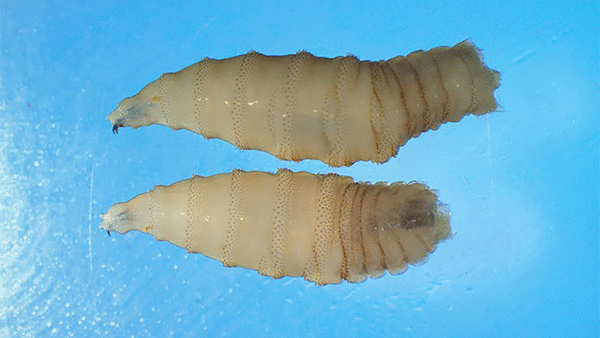
LOS ANGELES — Federal agricultural inspectors detected a case of New World screwworm larvae — maggots that burrow into the flesh of living animals and sometimes humans — on a 3-week-old calf in south Texas, near the U.S.-Mexico border. Officials anticipated the arrival of screwworm in the United States and say they're prepared to contain it.
New World screwworm, also known as Cochliomyia hominivorax, is starkly different from the average maggot that feeds on decaying organic matter such as garbage, rotting food or dead animals, said Tom Talbot, veterinarian and member of the California Cattlemen's Association.
That's because a screwworm larva "attacks living flesh," Talbot said.
On Thursday, the U.S. Department of Agriculture confirmed the detection of New World screwworm in the umbilical area of a bovine in Zavala County, Texas, more than 60 miles from the northern Mexico border.
As of Friday morning, there have been no additional cases of infected animals reported.
Screwworm is endemic in South America and parts of the Caribbean, according to the Centers for Disease Control and Prevention. However, the parasitic fly has been steadily moving north from Central America to Mexico since 2023.
The USDA says it has actively monitored the fly's movement. Last month, the USDA was aware of more than 200 active screwworm infestation cases in the border states of Nuevo León and Tamaulipas, according to Mexico's Secretary of Agriculture and Rural Development dashboard. There are currently more than 2,000 active cases throughout Mexico.
It was believed that the New World screwworm would enter the U.S. in 2025, "however, thanks to the hard work across the entire Trump administration and our industry, state, and local partners, we were able to buy time for this moment," said Dudley Hoskins, undersecretary for Marketing and Regulatory Programs for the USDA, in a statement.
The potential economic impact of New World screwworm on the cattle industry due to import restrictions, reduced productivity and animal loss is substantial, said Sally DeNotta, director of the University of Florida's Equine Performance Laboratory.
Last year, 175 key agricultural organizations signed a letter urging additional federal funding for screwworm-control measures, emphasizing USDA estimates that a New World screwworm outbreak in the U.S. could cost producers $4.3 billion annually and cause economic losses of more than $10.6 billion across the southern United States.
"While the fly does not survive at temperatures at or below freezing, infected animals could carry the parasite northward and spread infection during the summer months, and the temperate climate of Southern California could certainly support year-round New World screwworm populations," DeNotta said.
Talbot said from the federal to the local level, everyone in the ranching community has been talking about the arrival of screwworm and how to combat it.
"My expectation is that there will be a minimal number of cases of [New World screwworm] in California," he said.
That's because there are several stations on the border in Southern California, he said, that are collecting data, monitoring for any incidents of the parasitic fly and trapping them.
Talbot says he's confident that the proactive measures on behalf of the federal government will mitigate the screwworm's reach and therefore not impact the beef supply locally or nationally.
How screwworm infection spreads
Female screwworm flies are attracted to the smell of wounds — that can be as small as a tick bite — and body openings such as the nose, eyes, ears and mouth where they can lay eggs, according to the CDC.
A female screwworm fly can lay 200 to 300 eggs at a time and may lay up to 3,000 eggs during her 10 to 30-day lifespan.
When the eggs hatch into maggots, the maggots eat live tissue, causing a worsening, often painful and foul-smelling wound, according to the CDC.
Screwworm has hit the United States before
There was a screwworm outbreak in the southwestern region of the United States in 1965 that prompted Mexican and U.S. livestock producers to sign a declaration to establish a joint program for the eradication of the screwworm from the states on either side of the Mexico-U.S. border, according to the National Agricultural Library.
By 1966, the United States had eradicated screwworms, but livestock remained vulnerable to reinfestation from screwworms migrating from Mexico.
Eradication was possible through the sterile insect technique, which uses gamma radiation to irradiate screwworm pupae and create sterile male flies.
The U.S. Department of Agriculture's Animal and Plant Health Inspection Service maintains a screwworm pupae sterilization facility in North America and is currently building a new center in southern Texas.
When produced and released in large numbers, sterile male flies mate with wild female flies, which then lay unfertilized eggs, according to the USDA.
"Since female screwworm flies normally mate only once, the population progressively reduces and is, ultimately, eradicated," according to USDA officials.
Last year, the Trump administration cut thousands of grants and programs from the U.S. Agency for International Development, which includes U.S.-funded animal disease monitoring projects operated by the United Nations Food and Agriculture Organization, Argi-Pulse Communications reported. Among the slashed programs were some dedicated to monitoring and containing New World screwworm in Central America.
Today, screwworm infestations aren't a regular occurrence in the U.S., but cases have occurred in travelers returning from areas where the flies are present, according to the CDC.
Can infected animals be treated?
Infected wounds are cleaned and debrided to remove any screwworm larvae, after which the animal is treated with an approved insecticide, DeNotta said.
Last month, the U.S. Food and Drug Administration issued an emergency use authorization for several insecticides known to be effective against screwworm.
There are approved systemic and topical options for a variety of species, including cattle, horses, small ruminants, cats and dogs, DeNotta said.
"Multiple days of treatment are often required, and antibiotics and analgesics may also be administered to treat secondary infection and control pain," she said.
If left untreated, the tissue destruction caused by flesh-eating larvae can be extensive and severe, often resulting in debilitation and eventual death of the host, DeNotta said.
"Animals that survive may suffer weight loss, poor growth and reduced productivity as a result of pain and discomfort," she said.
Screwworm can infect humans
Human infection is rare, DeNotta said, but it can happen.
Humans are at risk of being infected by screwworms if they travel to an area where the flies are present, such as South America and the Caribbean, according to the CDC.
CDC officials said your risk of screwworm infection increases when you:
—Spend a lot of time outdoors during the day, especially if sleeping or unable to keep the flies at bay.
—Have any open wounds. A small break in the skin, including from a scratch, insect bite or recent surgery, may attract screwworm flies.
—Have a medical condition that causes bleeding or open sores, such as from skin or sinus cancer, or from treatments that can create breaks in the skin.
—Live, work or spend an extended amount of time with or near, livestock or other warm-blooded animals in areas where screwworm flies are present.
The symptoms humans experience when infected by screwworm
The following are symptoms of screwworm according to the CDC:
—Feeling maggots move or seeing maggots within a skin wound, sore or body opening.
—Painful skin wounds or sores that worsen within a few days.
—Foul-smelling odor from the site of the infestation.
—Bleeding from open sores.
Bacteria can also infect wounds where screwworm maggots are present and may cause an infection that can lead to symptoms like fever or chills.
To treat a screwworm infection, DeNotta said, people undergo the same combination of wound debridement and insecticides used in animals.
©2026 Los Angeles Times. Visit latimes.com. Distributed by Tribune Content Agency, LLC.






Comments