LA city attorney becomes first incumbent ousted in primary in nearly 100 years
Published in News & Features
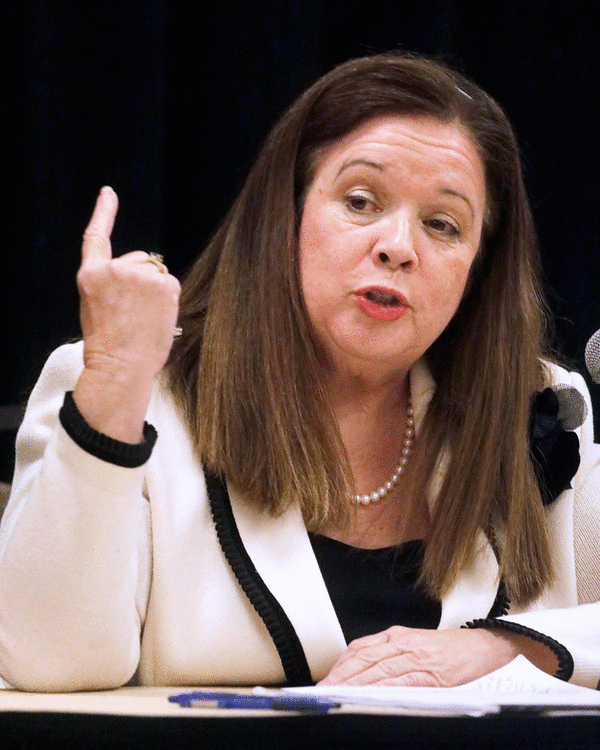
LOS ANGELES — The last time Angelenos sacked an incumbent city attorney in the primaries, almost 30% of them were unemployed.
That was May 2, 1933, the nadir of the Great Depression, when sprawling encampments blanketed downtown, King Kong ruled movie theaters and violent crime reached a fever pitch not seen again for nearly half a century.
Incumbent City Atty. Hydee Feldstein Soto’s blowout defeat on Tuesday may have little in common with Erwin P. Werner’s primary loss 93 years ago, but themes of Depression-era Los Angeles echo through the contest.
Marissa Roy, a deputy attorney general with the California Department of Justice who leads the race with ballots still being counted, wooed voters with shoe-leather and social media savvy, promising to use the office to fight for wage workers and tenants. But it was the city’s powerful unions and its increasingly democratic socialist bloc that propelled her to the top spot, mirroring the coalition that drove California’s sharp left turn in the early 1930s.
Meanwhile, county prosecutor John McKinney tapped into voter frustration with homeless encampments, a blighted downtown and general distrust of City Hall to pull off a last-minute heist of the second runoff spot. McKinney only started campaigning in earnest five weeks ago, but managed to win votes with a tough-on-crime campaign — even as some categories of city crime have dipped to historic lows.
On Friday morning, Feldstein Soto issued a formal concession, quoting Supreme Court Justices Louis Brandeis and Ruth Bader Ginsberg, as well as Elphaba of Wicked and Deuteronomy 6:5.
“I have given it all my heart, all my soul and all my might and will continue to do so through the end of my term this December,” the incumbent wrote of her work, paraphrasing a key commandment about how to love God from Judaism’s central prayer.
Her campaign did not respond to a request for comment for this story.
Feldstein Soto’s ouster is nearly unprecedented. Werner’s 1933 loss is the only similar instance since the city adopted its current primary ballot process in 1917, according to the City Clerk’s office. No other incumbent city council member or mayor has ever failed to advance out of the primary when facing two or more opponents.
“This is not something that has happened in the lifetimes of most people who follow city government,” said Mike Bonin, former City Council member and executive director of the Pat Brown Institute for Public Affairs at Cal State L.A.
McKinney’s sudden emergence in the race in May saw him hijack the incumbent’s support from law enforcement. His campaign received $3 million worth of independent expenditures. An official with a group supporting McKinney — who spoke on condition of anonymity because they were not authorized to speak to the media — said an internal poll showed Feldstein Soto falling nearly 10 points outside the runoff a week before election day.
Since Roy had already captured the support of the county Democratic Party and energized left-leaning voters, that put Feldstein Soto in the center, analysts said, which left her vulnerable in a race that most people casting ballots hadn’t closely followed.
“To the extent that people had any information, they knew that one of them basically wanted to be tougher and somebody on the other side wanted to be kinder, that left her with very little room to maneuver,” said Roy Behr, a longtime consultant to veteran politicians in the city.
Roy “micro-targeted” likely progressive voters in social media spots, experts said, presenting as an affable presence in her ever-present purple blazer while sharing her vision of serving as the “people’s lawyer.”
Boosted by a massive influx of cash from rental giant Airbnb, some of McKinney’s ads played up his hard-luck upbringing in one of New Jersey’s most violent cities. His campaign also sent out texts that painted his opponents as “George Gascón”-style Democrats, invoking the former progressive district attorney as a bogeyman for voters anxious about crime.
AI-generated videos depicted McKinney as a stoic, suit-clad crime fighter walking through a dystopian version of L.A.’s Metro system.
“The debate isn’t necessarily two candidates on one stage appealing to one person, it’s for attention and information in the same sphere,” said Spencer Slovic of Mycorrhiza Digital, who ran Roy’s digital advertising. “That battle of information will play out almost in different realms.”
Without a compelling story for her powerful but poorly understood role, Feldstein Soto often struggled to explain her achievements in office.
In a recent interview with The Times, she said she delivered on “public safety, public integrity and public services.” She went on to discuss granular improvements she made to the office, such as limiting access to law enforcement databases by former employees, modernizing internal systems and improving the rapport between the city attorney’s office and LAPD. By her own admission, she doesn’t often publicly celebrate her accomplishments.
“I didn’t hold some big press conference and hop up on a white horse and declare myself Joan of Arc and the savior of all things Los Angeles,” she said. “Which I could have done.”
Tumult during Feldstein Soto’s lone term in office was easier for voters to identify. The cost of litigation exploded. A high-ranking city lawyer accused her of abusing her power, prosecuting political enemies, mistreating employees and engaging in “inappropriate alcohol consumption.” Feldstein Soto claimed she improved her office’s rapport with the LAPD, but the police union’s decision to rescind its endorsement of her and instead back McKinney cost her a key voting bloc.
Feldstein Soto’s messaging was at times muddled and lacked the flair of her challengers, political observers said. Campaign finance records show she paid for 80 email blasts, mailers and other messages that sought to influence voters.
In one video, she stood in front of a static background and talked for three minutes straight about her record while describing her opponents as representing the “extreme left” and “extreme right.” She attacked both for receiving large sums of money from “special interests,” especially McKinney for accepting Airbnb’s largesse. Feldstein Soto sued the rental giant for price gouging in the wake of the 2025 wildfires.
Roy’s campaign sent out 180 communications, records show, the bulk of them ads for Instagram and Facebook, where her team said they saw instantly which stories resonated with likely voters and which were duds.
Slovic said a “clip of Hydee talking about how she wasn’t going to prosecute the Trump administration” seemed to touch a nerve with voters.
“That was by far our best performing ad,” he said, adding, “What Democrats really want in primaries is someone who will fight and have some sort of backbone.”
McKinney had just 23 communications, campaign records show, plus 19 more made by independent groups. He often leaned into the same gritty visuals that defined mayoral candidate Spencer Pratt’s viral AI spots.
In a race for a position most voters don’t understand, McKinney’s and Roy’s ability to play a consistent character may have proved critical, political analysts said.
“ The vast majority of voters started off with no strong feelings about the race,” Behr said. “Nobody had any votes locked down other than their friends and neighbors.”
©2026 Los Angeles Times. Visit at latimes.com. Distributed by Tribune Content Agency, LLC.




Comments