Trump administration is disbanding climate research during hurricane season
Published in News & Features
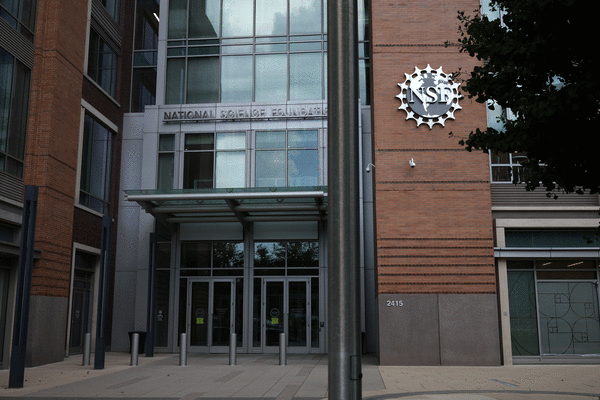
The Trump administration’s most recently wave of defundings directly affects North Carolinians at one of the most crucial times of the year: hurricane season.
The National Science Foundation has begun descaling their Ocean Observatories Initiative following President Donald Trump’s firing of the NSF’s independent board through an email in late April, Science.org reported. The $368 million initiative is a deep-sea observation system that has provided data on ocean systems and climate change for a decade.
Question: How does this affect North Carolinians?
Answer: The NSF said it would send ships in June to begin removing monitoring instruments off the coast of North Carolina, Alaska, Oregon and other states. Recovery of the Pioneer Array, a data collecting instrument located near Nags Head Island, is set to take place in June 2027, according to OOI.
Barely two years after Hurricane Helene, a devastating storm that killed more than 100 people in western North Carolina, locals should know that they will still be able to access accurate storm predictions, Erica Grow Cei, a public affairs member of the NOAA’s National Weather Service, told The News & Observer.
Other weather monitoring entities such as the National Oceanic and Atmospheric Administration, which supply data for the National Weather Service, collect their own data to predict hurricanes. This group uses their own technology of buoys and other resources to foresee hurricanes, Cei said.
Q: What does this mean for collecting data to predict hurricanes?
A: All previously collected data from the OOI will still be available. In a statement, Cassandra Eichner, a member of the NSF’s media affairs team, explained that the National Science Foundation remains committed to ocean science and will continue working with the scientific community on high-priority research objectives, including storm forecasting.
The devices measure ocean currents and water conditions from the ocean’s surface to thousands of feet below. Once the Pioneer Array’s recovery takes place, real-time data and observations will end, limiting scientific and educational discoveries.
The system became operational in 2016 and was intended to last for 25 years.
©2026 Raleigh News & Observer. Visit newsobserver.com. Distributed by Tribune Content Agency, LLC.






Comments