First-time homebuyers face hurdles despite gradual improvement
Published in News & Features
The idea started with a sermon Micah Longmire heard at his Presbyterian church in Ogden, Utah, about the importance of grandparents in a child’s life.
Longmire, now 31, exchanged a look with his mother-in-law. “We were like, ‘I’d be OK living with you after that sermon,’ and the ball rolled downhill from there,” Longmire said.
Both families are now living in a house they bought together in Chattanooga, Tennessee, after a two-year nationwide search. Their partnership is an example of the lengths first-time homebuyers have gone to this year amid stubbornly high home prices and interest rates.
“I make $200,000 and I wouldn’t have been able to buy a house by myself. That’s ridiculous,” Longmire said. His wife’s parents contributed $200,000 from selling their own home in Utah and retired to live with them in a 3,500-square-foot house that cost $585,000.
Home prices rose this year, though not as much as inflation, so affordability increased in all regions as of April compared with a year before, according to the National Association of Realtors.
But prices are settling at a high level. After inflation adjustment, they’re still less than 4% below the 2022 peak, though some areas with large-scale building, mostly in Florida and Texas, have seen prices drop, according to real estate analyst Bill McBride’s CalculatedRisk newsletter.
Help from family and even shared living arrangements are becoming the norm in higher-priced areas.
“The family now has accumulated so much equity that they’re able to help their kids make these downpayments. Many people like to live in multi-generational households for reasons of culture and also cost,” said Nadia Evangelou, senior economist for the National Association of Realtors.
Nationally a typical single-family home cost $422,300 in April, up $4,300 from a year before, according to the National Association of Realtors. But the typical family made about $6,000 more in that time, and mortgage rates came down a little, so affordability improved.
But a shortage of affordable starter homes is slowing the market and keeping it hard to buy for first-timers. Last year the median age of first-time buyers reached a record 40 years old, while the median repeat buyer was 62, as the housing market became dominated by repeat buyers who could sell a house at today’s high prices.
“Affordability today is still nowhere near what it was for much of the last decade,” Evangelou said. Between 2009 and 2016, the typical family had about 70% more income than it needed to buy the typical median-priced house, while today it’s a much smaller margin of about 11% as of April.
San Francisco is an extreme example: The artificial intelligence boom has driven median home prices to a record $2.15 million, according to the real estate brokerage firm Compass. So Charlie and Nettie Culp felt lucky to get a 1,500-square-foot condo for $1.5 million. The couple, both 32, work in finance and tech and saved for years with some family help, putting down $500,000 and taking a $1 million mortgage in May.
“That’s a lot of money for what you get, but that’s the market and it’s a beautiful city,” Charlie Culp said. He has lived in the city since 2015, at times sharing rent among as many as four people while saving money.
“I saw the AI boom coming in San Francisco, so we decided to reach out to our landlord and ask if she was willing to sell,” he said.
First-time buyers are particularly hard-pressed: They lack profits from a previous house, and the smaller houses they can buy are in short supply. The number of houses on the market is rising, but mostly at the high-priced end.
“Many young households still face the most challenging homebuying environment in decades,” Evangelou said. “The question isn’t simply whether more homes are coming into the market, the question is whether those homes that are available for sale are at price points that local households can actually afford.”
The nation needs another 311,000 houses selling for less than $261,000 to meet the needs of middle-income families — buyers earning around $75,000 — according to a May report that Evangelou co-authored. Several states considered legislation this year aimed specifically at creating more starter homes.
A New Mexico law signed in March by Democratic Gov. Michelle Lujan Grisham creates no-interest loans of up to $75,000 for down payments to first-time buyers with moderate income. The loans are meant as an incentive for builders to create smaller houses.
Several states moved to curb minimum lot sizes, seen as an impediment to starter homes and other affordable housing, often drawing opposition from cities.
Colorado considered a measure this year allowing smaller lots for building, hoping to “expand attainable homeownership opportunities for first-time homebuyers.” It was opposed by the Colorado Municipal League, which said it “removes community planning and public input from the decision-making process.” The bill passed the state House but was killed in a state Senate committee.
Florida also considered smaller lots and other incentives for starter homes in a bill this year that died in committee after opposition from the Florida League of Cities.
A similar bill that would limit minimum lot sizes, aimed at creating more starter homes and other affordable housing, was under consideration this year in Hawaii but did not pass after clearing a state Senate committee. Democratic state Sen. Stanley Chang, the bill’s sponsor, told Stateline that “some version of the concept” will be considered in future sessions.
The Midwest continues to have the highest affordability, according to the National Association of Realtors report.
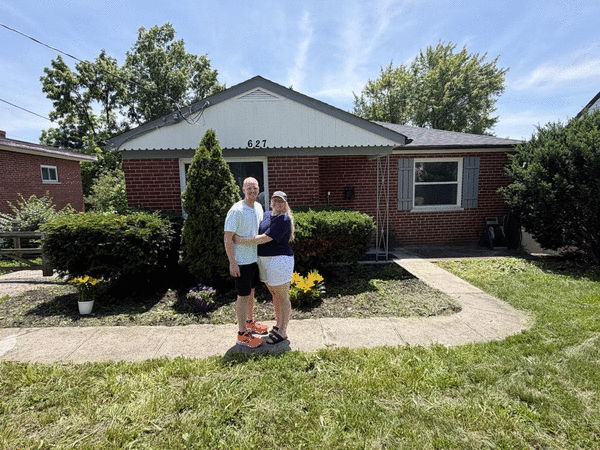
Ty Setty, 29, and his wife, Allisha, 32, had been renting for six years near Cincinnati, but they needed no family help to buy their new $170,000 house, a two-bedroom in suburban Delhi Township, Ohio.
“We had been looking at houses for a few years and just couldn’t afford them, or we let ourselves think that,” Ty Setty said.
After two weeks of looking on Zillow and touring nine houses, they saw this house as a new listing and “fell in love. We put an offer on it that night,” Ty Setty said. “They accepted the next morning. That was a long 12 hours.”
For the Longmire family in Chattanooga, the partnership between parents raising children and grandparents needing their own affordable housing has worked out well.
“Grandparents want to live with their grandchildren, and you know parents need a babysitter on date night,” Micah Longmire said. “The story that we’re telling through our life right now is, that if you can work with your family, don’t give in to the pressure of the world to go it alone.”
____
Stateline reporter Tim Henderson can be reached at thenderson@stateline.org.
____
©2026 States Newsroom. Visit at stateline.org. Distributed by Tribune Content Agency, LLC.






Comments