US, Iran exchange military strikes to put fresh strains on ceasefire
Published in News & Features
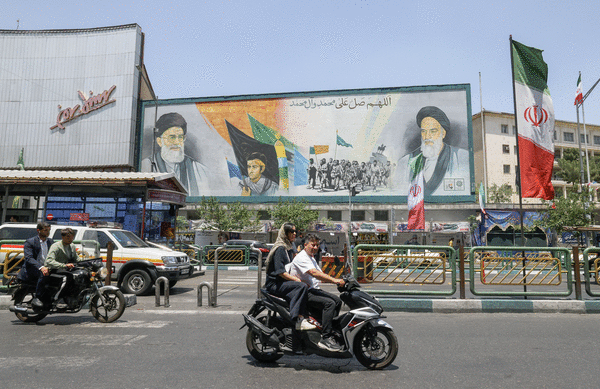
The U.S. and Iran clashed again overnight, with Kuwait and Bahrain caught in the crossfire of one the most serious flare-ups since a ceasefire went into effect in early April.
The developments follow days of rising tension, including over Israeli operations against Tehran-backed Hezbollah militants in Lebanon, that threatens to derail U.S.-Iran talks about an interim peace deal. The sides have agreed on a rough framework that should extend their truce by two months and reopen the Strait of Hormuz, though negotiations over the final details are dragging on.
Shortly after “disabling” an empty oil tanker heading to Iran, the U.S. military said it came under missile and drone attack.
Iran targeted the U.S.’s main naval base in the region, located in Bahrain, and the Ali Al-Salem airbase in Kuwait. At least one person at Kuwait’s civilian airport was killed in a separate strike.
The U.S. said Iran fired several ballistic missiles at its allies Bahrain and Kuwait, with all “failing to hit their intended target,” as well as drones at commercial ships. American forces struck a communications tower on the Iranian island of Qeshm near the strait as part of the skirmishes.
Kuwait said its airport was significantly damaged and it suspended flights for a few hours. A number of people were injured in addition to the person who was killed, it said.
The U.S. military said its strikes on Iran were all in self-defense and no American personnel or assets were harmed.
Iran’s foreign ministry “strongly condemned” the U.S. attack on the Iranian tanker and Qeshm, adding that Kuwait and Bahrain’s rulers bear a “direct and clear responsibility” for Washington’s actions.
“Disrupting security in the Strait of Hormuz will carry a heavy cost for the U.S. aggressor army,” Iran’s Islamic Revolutionary Guard Corps said in a statement.
Trump has spent months projecting confidence that an interim deal, to be followed by further talks over Iran’s nuclear program, is within reach. He’s largely brushed off suggestions the ceasefire, which began on April 8, is fraying.
In Lebanon, the U.S. and Israel have different ideas about what an end to the war should look like. Israel is keen to continue attacking Hezbollah. Yet Iran insists there must be a ceasefire there too as part of an interim accord with the U.S., and President Donald Trump urged Israeli Prime Minister Benjamin Netanyahu in a call on Monday to abandon plans to bomb the Lebanese capital of Beirut.
Israel has, for now, refrained from that and Hezbollah has reduced its drone attacks on the Jewish state. Fighting, however, continues in southern Lebanon, much of which is now occupied by Israel.
Oil prices have risen along with Iran-U.S. tensions. Brent climbed 3% on Wednesday to $98.80 a barrel, extending its gains since last Friday to almost 7%. That’s reversed most of the benchmark’s losses from last week, when some traders anticipated a deal was imminent.
Maritime traffic thought the Strait of Hormuz, which normally handles one fifth of the world’s oil and liquefied natural gas supplies, has dwindled since Iran started attacking ships soon after the war erupted in late February.
More vessels have gone through the chokepoint in past two weeks, some of them coordinating with the U.S. military, Bloomberg reported. Though, the numbers are still way down from pre-war levels, which has kept energy prices high and strained the global economy.
While Trump says Iran is desperate for a deal, the Islamic Republic has repeatedly pushed back against American demands and says it’s prepared for a resumption of all-out war.
U.S. and Iranian negotiators are grappling with several critical questions beyond Lebanon, including whether Tehran will allow free passage for ships under an interim accord, which the sides are describing as a memorandum of understanding.
Iran also wants billions of dollars of funds stuck in countries such as Qatar to be unfrozen and is resisting U.S. pressure to destroy or send to a country like China its stocks of highly-enriched uranium.
The wider talks, to commence once there’s a short-term deal in place, will be complicated and focus on Washington’s demand that Iran holds off on processing uranium for around 15 years.
Washington fears Tehran wants to enrich uranium build an atomic weapon. Iran has always denied that, but has processed the metal almost to military-grade levels.
Here’s more on the Iran war:
•The Trump administration sanctioned Iran’s biggest cryptocurrency exchange and three other entities in a continued effort to pressure the Islamic Republic into a deal.
•Vitol’s top executive in the Middle East said that many Western governments still aren’t reckoning with the oil supply crunch that’s rippling around the world due to the blockade of the Strait of Hormuz.
-------
—With assistance from Derek Wallbank, Michelle Jamrisko, Nick Wadhams, Anand Krishnamoorthy and Magdalena Del Valle.
©2026 Bloomberg L.P. Visit bloomberg.com. Distributed by Tribune Content Agency, LLC.





Comments