College mergers take a long time. Trump officials want to speed them up
Published in News & Features
The U.S. Department of Education wants to grease the wheels for college mergers and acquisitions, a rare Trump administration proposal with broad support from university leaders who see the policy helping the sector withstand a wave of financial distress.
The agency aims to expedite and simplify M&A reviews within the next year, according to Under Secretary Nicholas Kent, the top federal official overseeing higher education.
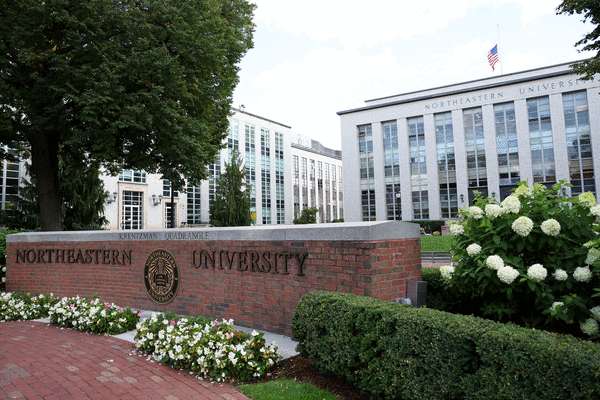
A soon-to-close transaction underscores how drawn out the timeline can be: Northeastern University’s purchase of Marymount Manhattan College is expected to get final approval next month, more than two years after the initial announcement. The lag partly reflects a long federal regulatory process.
Many schools seeking a lifeline simply don’t have that much time. And for prolific acquirers like Northeastern, which fields inquiries about once a week from small colleges offering themselves up, it’s an obstacle to expansion.
Now, Kent aims to undo a two-step process implemented by former President Joe Biden, as well as a slew of decades-old hurdles that he said can jam up a transaction for months.
“We’ve made it increasingly complicated and really time-consuming for institutions to enter into these partnerships,” he said in an interview with Bloomberg. “We need to be facilitating a process that moves a lot quicker.”
The change could benefit many struggling schools looking to engineer a rescue. But it would also leave the sector more vulnerable to profiteers, from private capital to hostile competitors, at a moment of unprecedented tumult.
Colleges contending with lower enrollment, federal funding cuts and rising operating costs often find themselves on the verge of closure. Mergers and acquisitions are becoming a common offramp. More than 50 such deals have been announced since 2020, according to data from Huron.
Joseph Aoun, president of Boston-based Northeastern, said that delays in closing mergers make it harder to recruit students, faculty and staff and to start investing in infrastructure.
“The transition period is always a period of uncertainty. This uncertainty impacts the students, the families, the staff and the faculty,” Aoun said. “You want to move as fast as you can.”
For schools with short financial runways, a multiyear regulatory horizon can be a deal killer. In 2023 Notre Dame College — not the football powerhouse in Indiana, but a tiny Catholic school in northern Ohio — floated a possible merger with Cleveland State University. Notre Dame had been hemorrhaging students and money for years and was looking for an exit.
They announced their talks in January 2024. But within a matter of weeks, Notre Dame suddenly moved to close its doors.
A few hours west, Bluffton University, another small Ohio religious college, thought it had found a partner in neighboring University of Findlay. The pair signed a formal agreement and started down the regulatory road toward approval. A year later, they aborted their merger.
Jane Wood, Bluffton’s former president, stepped down shortly after the deal fell apart. She said there was more to the dissolution than regulatory hurdles, but that the federal approval timeline was “certainly a key factor.”
Ricardo Azziz, principal at SPH Consulting Group, advised Bluffton and Findlay throughout their abandoned merger process. He said their situation was just one example of an issue that he’s seen scuttle deals time and again.
“If you examine the closures across the country, many had sought to merge before they ran into the issue of the regulatory timeline,” Azziz said.
Struggling colleges are more eager than ever to partner with stable institutions, in part because of pressure from board members and bondholders nervous about credit downgrades. Many colleges, Azziz said, “are starting to violate bond covenants,” an issue “at the heart of some mergers.”
Larger schools with more spending power are pouncing on the chance not only to boost their enrollment capacity, but to buy up valuable real estate. Northeastern’s acquisition of Marymount delivered the school more than $200 million in assets; its acquisition of Mills College in Oakland, California, added around $700 million.
Brian Weinblatt, founder of Higher Ed Consolidation Solutions, which helps colleges plan for mergers, said interest from “buy-side” schools has spiked in the past two years. “They’re like sharks smelling the blood in the water,” he said.
The market has also piqued the interest of private capital.
“Private equity is and was interested in higher ed institutions, but the requirements the department imposed made ownership of a college by a PE firm essentially impossible,” said Jonathan Helwink, a higher education lawyer who served in the first Trump administration.
Kent said changes to the oversight process would likely open doors for those frustrated investors. “We’re not going to give them a free pass just because it’s the private market, but we’re certainly not going to put our foot on the necks of private capital,” he said.
Clare McCann, a former policy adviser at the Education Department under Biden who helped fortify the M&A review process, said those measures were meant to protect the students, staff and local economies most affected by changes in ownership. Part of their focus was on for-profit colleges applying to convert to nonprofit status, a transaction covered by the same federal oversight rules as mergers.
Still, McCann said the process was never meant to take as long as it has. She blames that on understaffing, not regulatory burdens.
Even before Trump laid off nearly half of the Education Department, “there already were not very many people at the department who had that kind of expertise,” she said. “There are now next to none.”
Kent said he was confident he has the appropriate staff to handle approvals.
Schools looking to expand aren’t necessarily relying on M&A; they’re sometimes buying up campuses where enrollment has dwindled, purchasing the real estate outright. Wagner College, a small private school in New York, is taking on debt to buy the Staten Island campus of Queens-based St. John’s University. Those transactions don’t require federal approval.
A report from Huron found 442 private colleges are at risk of closure or serious financial downturn. That’s more than a quarter of the country’s private schools.
Many recent closures have been concentrated in New England, where two colleges have shuttered already this year: Anna Maria College in Massachusetts and Sterling College in Vermont. Another, Hampshire College, announced in April that it would close after the fall 2026 semester.
Larry Schall, president of the New England Commission of Higher Education, the accreditor overseeing all three of those schools and hundreds more across the Northeast, said the organization has tried to make consolidation as seamless as possible. But while more of his members are exploring partnerships, he said the timeline for approval usually deters them.
“Virtually every school you end up reading about that closes, certainly at the board level there’s been conversations about finding a partner,” he said. “If you have 30 days of cash on hand and the process takes — in part because of federal requirements — years to happen, you just don’t have the funds to do it.”
Still, a quicker federal review won’t always mean approvals. Kent said the government is not in the business of bailing out colleges.
“We have 6,000 institutions of higher education in this country, and not all of them are going to make it out of this decade,” he said. “Nor should we incentivize that.”
©2026 Bloomberg L.P. Visit bloomberg.com. Distributed by Tribune Content Agency, LLC.






Comments