Minnesota to return thousands of acres of forest to Fond du Lac Band
Published in News & Features
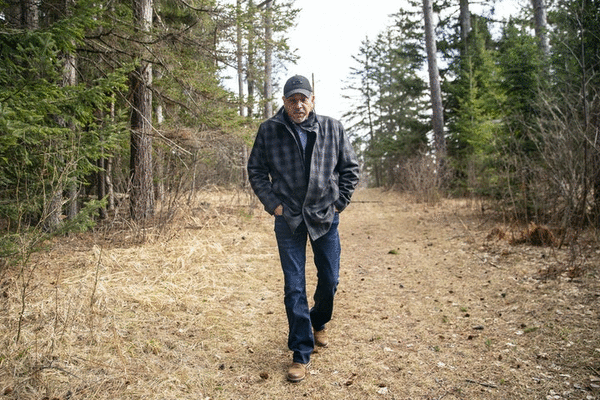
A large stretch of forest inside the Fond du Lac Reservation that has been in state hands for more than 100 years will soon be returned to the Fond du Lac Band of Lake Superior Chippewa.
Minnesota lawmakers enabled the transfer of the 3,400 acres in a bonding bill signed by Gov. Tim Walz on Wednesday, resolving a yearslong push by the band and, more recently, by the University of Minnesota to return the land.
The U has housed its Cloquet Forestry Center research complex on the site for more than a century. The land is located entirely within the reservation and was taken from the Fond du Lac by the state after a series of treaty-busting acts in the late 1800s were used to wrest control of valuable timberland.
“It’s a wonderful thing and I believe the community will welcome that land back like a member of the family,” Fond du Lac Tribal Chairman Bruce Savage said.
The band will continue to work with the U to conduct research at the site, he said.
With ownership, the Fond du Lac will have a unique asset in northern Minnesota that will open up a host of opportunities for the community, Savage said.
“We’ll be able to do research that greatly impacts the band, not just timber extraction,” he said.
Savage sees the chance to study plant medicines, agro-forestry, water quality, wolves, wildlife and prescribed burns.
“What we really look forward to is our youth being able to be a part of that research,” he said. “Hopefully, we’ll encourage them to pursue careers in land stewardship, in forestry, in agriculture, in becoming conservation officers, water specialists, soil scientists, food scientists, or whatever it might be.”
Lawmakers set aside $1.3 million to resolve all outstanding debt on the land and to convey any state-owned parcels to the U, which will allow the transfer to take place.
Fond du Lac and university leaders are working on a formal operational agreement for the future of the site. University President Rebecca Cunningham said the U will continue to conduct research and teach at the center once the transfer is complete.
“We’re really excited about this,” Cunningham said. “There’s been a commitment to return this land where it rightfully belongs. And it’s about more than just the land. This will deepen our partnership with the tribe, and it opens the door to even stronger future learning and shared knowledge.”
The land came into university’s hands in the early 1900s.
The boundaries of the reservation had been set in 1854 by a treaty between the U.S. government and the Fond du Lac. By the 1890s, federal and state lawmakers had passed a series of allotment acts that aimed to open much of that land to settlers.
Under allotment, individual tribal members and families were to be given to own certain acres within a reservation. The rest would be sold as “surplus land” by the government, with the proceeds supposedly used to benefit the tribe.
By 1900, the government had agreed to sell about 2,000 acres inside the Fond du Lac Reservation for a little more than $1 an acre to a logging company out of Cloquet. Those loggers were required to turn the land over to the U once the area had been cut.
In 1909, the U established the Forestry Center on the site. It continued buying parcels within the reservation as they became available to grow to its current size.
The Fond du Lac have always maintained that the land was stolen, sold without the tribe’s consent in violation of their treaty. They started approaching the U to ask for its return in the 1990s.
University leaders started considering the transfer in 2021. By 2023, the Board of Regents declared its intent to return the land, and the university has been asking lawmakers ever since to make it possible.
Over the past five years, researchers at the center have been operating as though the land were already transferred back to the Fond du Lac, said Kyle Gill, the center’s director of operations and forest stewardship.
“We’ve been making sure to include them in our process more fully,” Gill said.
The U has been consulting tribal members about any research projects and has been working with the Fond du Lac to manage the forest.
As the land returns to tribal ownership, the Fond du Lac will continue building a relationship that “supports the land, honors our sovereignty and creates space for learning and stewardship,” Savage said. “This is a meaningful step for our people today and for the generations yet to come.”
_____
©2026 The Minnesota Star Tribune. Visit startribune.com. Distributed by Tribune Content Agency, LLC





Comments