Community gathers to remember George Floyd 6 years after death
Published in News & Features
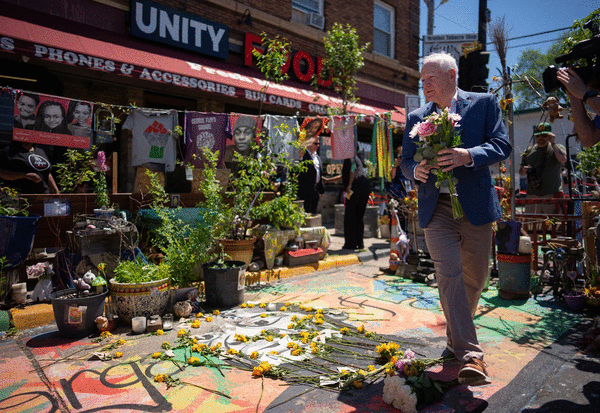
MINNEAPOLIS — The scent wafting from food trucks and the groove of music booming from a DJ booth guided the way to George Floyd Square, where people came from near and far Monday to remember an event that shook Minneapolis and sent shockwaves around the world.
Dancers performed in front of the statue of a fist that has come to symbolize all that has passed at 38th Street and Chicago Avenue since May 25, 2020, when George Floyd was murdered there by former Minneapolis police officer Derek Chauvin.
Next year will look different as plans move forward to change the intersection and the neighborhood around it.
But on this Memorial Day, shaded from the hot sun under the awning of the former Cup Foods — the convenience store immortalized in videos of Floyd’s death — several people danced along.
The event, organized by Rise and Remember, a nonprofit run by caretakers of George Floyd Square and members of Floyd’s family, was both solemn and joyful.
"When people show up and demonstrate they remember, they demonstrate their love," said Jeanelle Austin, executive director of Rise and Remember. She said bringing people together on the anniversary is a way to remember Floyd, and also commemorate the ways community members showed up for one other after his death.
The Rise and Remember Festival featured three days of programming, including discussions about civil rights and racial justice, culminating in Monday’s all-day block party, centered on community.
“Today is not just about remembering George Floyd, it is about remembering what his life and his death revealed to the world,” said Ruth Anna Buffalo, president of the Minnesota Indian Women’s Resource Center, told attendees from the stage. “Years later, many of our communities are still carrying grief, trauma, fear and exhaustion. But we are still, we are still here.”
By the next anniversary of Floyd’s murder, 38th and Chicago will look different. Minneapolis plans to reconstruct parts of both streets, beginning June 8.
City officials say the redesign balances transportation needs with the significance of George Floyd Square.
Following Floyd’s murder, activists shut down the intersection, declaring it an autonomous zone. After crime issues and business complaints, the city reopened it in 2021.
Reconstruction plans call for assessing local property owners to help pay for the work at the intersection. Some community members oppose that and say the city hasn’t been communicative enough about what the reconstructed streets will look like.
That’s not the only controversial plan taking shape for the area. This month, city officials chose Minnesota Agape Movement from several proposals to develop the People’s Way. The city bought the site, a former Speedway gas station that has served as a headquarters for activism at George Floyd Square, in 2023.
While Agape’s plan to build a six-story building with restaurants, a museum, an affordable business incubator, music studio and rooftop garden has the support of Mayor Jacob Frey, the Minneapolis City Council still has to approve it.
Members of the council have joined activists in criticizing the plan, arguing a city survey showed more support for a competing proposal by Rise and Remember to build a memorial garden and greenhouse.
On Monday, Clifford David Johnson was one of several people who pulled up chairs in a circle in the shade of the People’s Way. A rhythm and blues guitar player who lives nearby, Johnson said people have all kinds of different ideas about the future of George Floyd Square.
He said he hopes whatever’s next fits the neighborhood — maybe a museum people around the world could visit: “Something with some permanence," he said.
Down the block, Yolanda Simmons and her friends posed for photos in front of a George Floyd mural. The group was in town from Chicago for a birthday. In addition to visiting Paisley Park to remember Prince, Simmons said it was important to visit George Floyd Square.
“It is surreal to see it in real life, in person,” she said, calling it a reminder of the work that’s still be done to stand up for people who are mistreated because of the color of their skin, who they love or because of their culture.
---------
—Susan Du of the Minnesota Star Tribune contributed to this story .
©2026 The Minnesota Star Tribune. Visit at startribune.com. Distributed by Tribune Content Agency, LLC.






Comments