Gabbard to resign as Trump's spy chief after awkward tenure
Published in News & Features
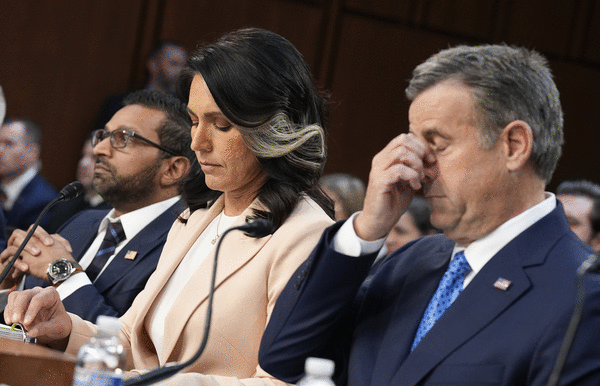
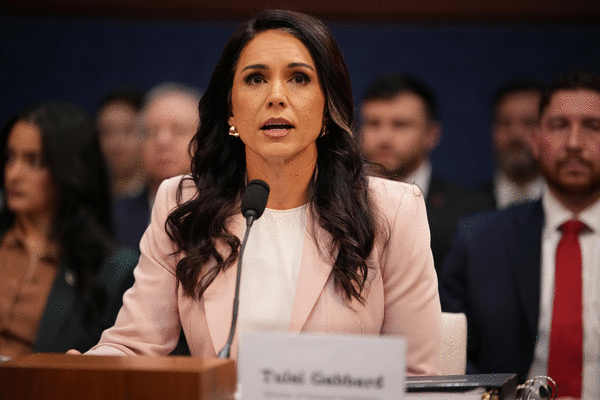
WASHINGTON — Director of National Intelligence Tulsi Gabbard, whose anti-war views spurred tension with the White House, said she was resigning from the post to help her husband confront a bone-cancer diagnosis.
Gabbard notified President Donald Trump during an Oval Office meeting of her decision and her last day is expected to be June 30, she said in a resignation letter she posted to social media.
“My husband, Abraham, has recently been diagnosed with an extremely rare form of bone cancer,” Gabbard said in the letter. She said her office had made significant progress “advancing unprecedented transparency and restoring integrity to the intelligence community.”
Gabbard, a long-time skeptic of American involvement in overseas wars, had seemed increasingly out of step with the White House as Trump launched two military campaigns against Iran and ordered a raid to capture Venezuela’s president, Nicolas Maduro. She had been cut out of months of planning for the mission to seize Maduro, people familiar with the matter said at the time.
Her exclusion from meetings became so well-known that some White House aides joked that the acronym of her title, DNI, stood for “Do Not Invite,” the people said.
As Director of National Intelligence, Gabbard oversaw the nation’s 18 intelligence agencies. But she had taken a back seat to CIA Director John Ratcliffe, who played a prominent public role in the decision to oust Maduro and flew to Cuba last week for meetings with government leaders.
“Tulsi has done an incredible job, and we will miss her,” Trump said in a social media post. He said her deputy, Aaron Lukas, would take over in an acting capacity.
Trump had also tapped Gabbard to oversee U.S. election security in a move that the president’s critics cast as a bid to influence future elections. Earlier this year, Gabbard was seen at an elections center in Atlanta during an FBI raid where voter records and other data had been seized.
Gabbard told lawmakers in March she was there at Trump’s request. The president said she went there because then-Attorney General Pam Bondi — who Trump ousted in early April — “wanted her to do it.”
She had also clashed with the intelligence community she ran and sought to root out “politicization” by referring intelligence officers for prosecution over alleged leaks of classified information. In 2025, she unveiled plans to shrink her agency by some 40% in what she said was a bid to make it more efficient.
Gabbard adviser Joe Kent, who Trump endorsed in failed bids for Congress in 2022 and 2024, had resigned in mid-March over the war in Iran, claiming in a public letter that Israel misled Trump into believing the regime in Tehran posed an imminent threat.
Gabbard, 45, is a veteran of the Iraq War who continues to serve as an officer in the Army Reserve.
Her skepticism of overseas entanglements had continued when she became Trump’s intelligence director.
She had declined to express her views on the decision to attack Iran, waiting more than three weeks to issue a statement. When she did, she said Trump “is responsible for determining what is and is not an imminent threat.” That drew skepticism from experts and members of Congress who said it was her job, not just the president’s, to make an assessment of the threats faced by the United States.
She also seemed to covertly undercut Trump’s main rationale for the Iran war in a hearing on Capitol Hill. Gabbard submitted a written statement saying Iran’s uranium enrichment program had been “obliterated” in U.S. and Israeli airstrikes last year and that there “has been no efforts since then to try to rebuild their enrichment capability.” But in her oral testimony, she didn’t repeat that conclusion out loud.
“You omitted that paragraph from your oral opening — was that because the president had said there was an imminent threat?” Sen. Mark Warner, the ranking Democrat on the Senate Intelligence Committee, asked her.
“I recognized that the time was running long, and I skipped through some of the portions of my oral delivered remarks,” she replied.
On Friday, Warner expressed sympathy for Gabbard’s family over her husband’s battle with cancer. He also indirectly faulted her for what he said were the increasingly blurry lines between verified intelligence and “politically convenient claims.”
“The next DNI must be committed to restoring trust in the office, protecting the integrity of our intelligence, and ensuring our nation’s intelligence professionals can speak truth to power, without fear or interference,” Warner said.
While past directors of national intelligence had sought to maintain distance from politics, Gabbard repeatedly echoed Trump’s grievances against perceived enemies. In April, she oversaw the release of declassified records that she said exposed how “deep state actors” in the intelligence community had constructed a false narrative that Congress later used to impeach Trump.
Like the president, she also dismissed as the “Russia hoax” the conclusion from the U.S. intelligence community and bipartisan congressional investigations that Moscow interfered in the 2016 election in an effort to help Trump win.
Gabbard, a former Democrat who ran for president in 2020, said in a speech in late October that “for decades, our foreign policy has been trapped in a counterproductive and endless cycle of regime change or nation-building.”
“The old Washington way of thinking is something we hope is in the rear-view mirror,” she said.
_____
(With assistance from Michelle Jamrisko and Jordan Fabian.)
©2026 Bloomberg L.P. Visit bloomberg.com. Distributed by Tribune Content Agency, LLC.


Comments