Xi and Putin wrap talks showcasing ties amid global unrest
Published in News & Features
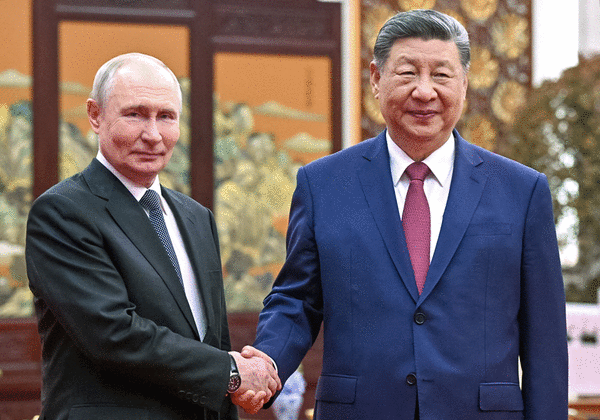
Russian President Vladimir Putin left Beijing after a day of talks with Chinese counterpart Xi Jinping, with the two leaders seeking to underscore the strength of their relations amid global tensions over wars in Ukraine and Iran.
“It was successful, fruitful and intensive work,” Putin said at a meeting over tea with Xi late Wednesday. Xi said they had reached a “new important consensus” on advancing their partnership.
The two leaders signed a pact on deepening strategic cooperation during the visit, while Russian and Chinese officials also inked a series of other documents on topics ranging from trade and technology to railway construction. Putin said approximately 40 agreements had been reached, even as they didn’t mention a key gas pipeline project.
“We have built a stable system of mutual trade that is protected from external influence and negative trends in global markets,” Putin said after talks between the two sides.
Discussions between the two leaders at the Great Hall of the People included the Middle East, state news agency Xinhua reported, with Xi adding urgency to his earlier calls for a ceasefire in a conflict that started with the U.S.-Israeli bombing of Iran and then spread across the region. Hours earlier, U.S. President Donald Trump — who held a summit with Xi in Beijing last week — threatened to resume strikes on Iran in the coming days as part of the push for a deal to end the war.
“A comprehensive ceasefire is imperative,” Xi said in Beijing. “Restarting war is even more unacceptable, and adhering to negotiations is particularly important.”
The tea conversation also touched on Ukraine, as well as bilateral relations, Xinhua reported.
The planned Power of Siberia 2 pipeline had also been the agenda for the talks between the two countries, the Kremlin said before the visit. Neither leader mentioned the long-delayed project in remarks during the signing ceremony, however, and there was no public indication of progress on securing a final agreement on a proposed gas contract.
Kremlin spokesman Dmitry Peskov said Wednesday that the main parameters for the pipeline project had been agreed upon, but some details still needed to be finalized, though he didn’t elaborate.
The leaders of Russia and China — two of Tehran’s biggest backers — met after Trump said he’d held off on a new bombardment of Iran planned for Tuesday at the request of Persian Gulf allies.
The comments raise the prospect of a return to active hostilities with Iran, which has so far refused to bow to Trump’s demands to relinquish the remaining elements of its nuclear program after weeks of strikes that began in late February.
Russia had hoped the turmoil in energy markets from the Middle East conflict and the effective closure of the Strait of Hormuz would make China more flexible in negotiations on a contract for gas prices for the project, which at full capacity would be able to transport 50 billion cubic meters of gas per year.
Xi welcomed Putin on Tiananmen Square at the start of their summit, giving him the same treatment Trump received days earlier. A 21-gun salute rang out as a military band played their national anthems, while dozens of children holding Russian and Chinese flags greeted them and shouted, “Welcome, welcome.”
Putin told Xi that Russia-China relations are at an unprecedented level and a model of partnership. The visit was formally timed to mark the 25th anniversary of a friendship and cooperation treaty between Russia and China.
Calling Xi a “dear friend,” Putin said Russia remains a reliable supplier of energy to China. “In the current tense situation on the international stage, our close cooperation is especially needed,” he said.
Xi said their nations should “build a more just and reasonable global governance system” in the face of “rampant unilateral hegemony,” the state broadcaster China Central Television reported, making what appeared to be a veiled swipe at the United States.
China’s Foreign Ministry said it was Putin’s 25th visit to the country. Besides his discussions with Xi, Putin also held separate talks with Chinese Premier Li Qiang, while top Russian government officials and heads of major companies from Gazprom PJSC to Rosatom and Roscosmos were part of the visiting delegation.
China released a joint communique after Putin’s departure that said the two nations pledged to expand cooperation in areas from artificial intelligence and civil aviation to mining and agriculture, and said that the two militaries would increase joint exercises and patrols. They agreed to develop energy partnerships including in oil, gas and nuclear power, though the document made no mention of the Power of Siberia 2 pipeline.
The communique also noted that Russia welcomed China’s role in seeking to resolve the war in Ukraine.
With its economy under growing strain, Russia is heavily reliant on trade with China to weaken the impact of Western sanctions over the full-scale invasion of Ukraine that’s in its fifth year. Russia is importing more than 90% of its sanctioned technology through China, Bloomberg News reported earlier.
China has denied that it’s provided weapons to any parties in the war in Ukraine, saying it strictly controls exports of dual-use articles.
While Beijing sees Moscow as a useful partner in weakening US dominance and advancing the so-called multipolar world order, China appears determined not to become too closely identified with the risks of Putin’s war in Ukraine — particularly as it tries to present itself globally as a force for stability.
That balancing act helps explain apparent contradictions in China’s position. Beijing has refused to condemn Russia’s invasion, though Chinese officials continue to invoke sovereignty, territorial integrity and the authority of the United Nations — language that sits uneasily beside Moscow’s territorial demands in Ukraine.
“Putin could not continue to fight the war in Ukraine without the systematic support China is providing to the Russian war machine,” said Henrietta Levin, a senior fellow at the Center for Strategic and International Studies.
--------
(With assistance from Qianwei Zhang, Elaine To and Josh Xiao.)
©2026 Bloomberg L.P. Visit bloomberg.com. Distributed by Tribune Content Agency, LLC.


Comments