US indicts Raúl Castro for Cuba's 1996 shoot-down of two civilian planes from Miami
Published in News & Features
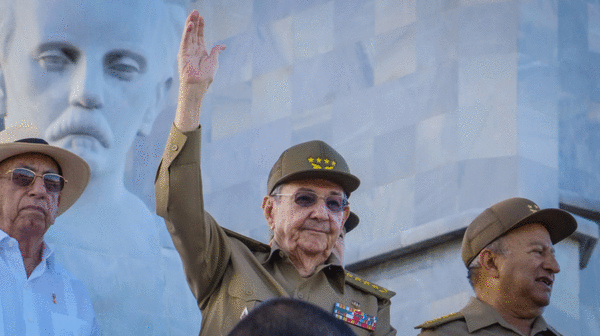
MIAMI — In a watershed moment for the Cuban American community, the U.S. Department of Justice has indicted Cuba’s longtime ruler Raúl Castro in Miami on Wednesday with the murder of four people in the 1996 shoot-down of two civilian planes belonging to the Cuban exile organization Brothers to the Rescue.
While the indictment itself was not immediately available in the federal court record system, U.S. Magistrate Judge Mary Fulgueira Elfenbein issued an order Wednesday afternoon to unseal the indictment against Castro and five other defendants.
The indictment of Castro, who will be 95 next month but remains the island’s ultimate authority, was brought by a federal grand jury led by Jason A. Reding Quiñones, the U.S. attorney for the Southern District of Florida.
The indictment charges Castro with the murders of the four people aboard the two planes that were shot down: Armando Alejandre, Mario de la Peña, Carlos Costa and Pablo Morales.
The formal accusation comes at a time the Trump administration has escalated the pressure on the communist government in Havana to make significant reforms. It has generated much expectation in Miami, where activists believe the indictment could pave the way for the sort of U.S. military action that ended with the Jan. 3 capture of Venezuela’s strongman Nicolás Maduro, indicted for narcoterrorism during the first Trump administration.
The indictment revisits events that happened 30 years ago, on Feb. 24, 1996, when Cuban MiG fighter jets shot down two Cessna aircraft operated by the Brothers to the Rescue, a Miami-based Cuban exile organization that searched for Cuban rafters at sea. A third plane carrying the head of the organization, José Basulto, was able to escape. The shooting happened over international waters, according to an investigation by the International Civil Aviation Organization. The Miami planes were unarmed, but the Cuban government justified the shootings, arguing the organization had dropped leaflets over Havana in previous incidents.
Ahead of the indictment announcement, the Cuban Embassy in Washington had been sharing media reports and declassified documents showing Cuba had complained about the flights, and that White House officials in the Clinton administration, worried about a potential incident, had unsuccessfully tried to ground the Brothers to the Rescue planes.
The downing of the planes ended up triggering even harsher U.S. sanctions against Cuba and the codification of the decades-old embargo when Congress approved the 1996 Helms-Burton Act. There is suspicion among Cuban experts that Fidel Castro might have given the order to shoot down the planes in order to shut down efforts by the Clinton administration to improve relations. Before the shoot-down, Cuban spies had infiltrated the Brothers to the Rescue group.
The head of the Cuban air force, two of the pilots involved in the shoot-down, and the head of a Cuban spy ring in Miami were all indicted in different U.S. cases in the years that followed, but neither Fidel nor Raul Castro was ever charged.
Public statements implicating Raul Castro, who was the actual head of the armed forces, in the decision to shoot down the planes had emerged over the years, some of which were mentioned in the indictment.
Fidel Castro also told Time magazine in 1996 that his brother Raúl, the Cuban defense minister at the time of the downing of the planes, was part of the chain of command that decided to target the Brothers to the Rescue aircraft.
A transcript of the conversations between the two MiG jet fighters released in 1996 by then U.S. ambassador to the United Nations, Madeleine Albright, shows the pilots were gleeful after downing the planes. “This one won’t mess around anymore,” said one of the pilots after shooting one of the civilian planes, which carried three American citizens and a U.S. resident.
“It’s hard to imagine it has been 30 years since those four men were murdered in cold blood in such a monstrous way,” said Bob Martinez, a former U.S. attorney for the Southern District, who as a civilian attorney won a wrongful-death lawsuit on behalf of the men’s relatives against the government of Cuba. “The glee from the pilots and the military tower after each destruction that pulverized the men and their aircraft just puts an exclamation point on their depravity.”
Referring to Fidel Castro’s well-known phrase, “history will absolve me,” Martinez said “history will condemn Fidel, Raúl and their family dictatorship into the dustbin of history.”
A major vindication
After so many years, many Cuban exiles see the formal accusation of Raul Castro — who has been accused of murdering people during the 1950s guerrilla fights in the Sierra Maestra mountains that brought his brother into power, presided over the country’s armed forces and continued the family rule over the island after his brother Fidel got sick and died in 2016 — as a major vindication.
Marcell Felipe, a lawyer and chairman of the American Museum of the Cuban Diaspora, said the formal accusation against Castro “represents justice for the families, vindication for the Cuban exiles, and a pragmatic message for the generals on the island: Raúl will not be part of the solution, and therefore they must think about their own future.”
Several Cuban exile organizations had asked President Donald Trump during his first term to indict Castro as an act of justice that could speed up regime change on the island. In February, the three Cuban American members of Congress from Miami — Mario Díaz-Balart, Carlos Giménez, and María Elvira Salazar — and New York Republican Nicole Malliotakis wrote to Trump to ask the Department of Justice to reopen the investigation into Castro’s role in the shoot-down.
“We believe unequivocally that Raul Castro is responsible for this heinous crime; it is time for him to be brought to justice,” they wrote.
In March, Florida Attorney General James Uthmeier announced the state was reopening a criminal investigation into Raul Castro’s role in the incident.
Experts note that the indictment is part of a pressure campaign to get concessions that the Cuban government has so far resisted, as well as a symbolic gesture of the administration on behalf of Cuban Americans, a solid Republican bloc that helped elect Trump. Local politicians canceled scheduled events for the chance to be seen at the gathering at the Freedom Tower.
But some doubt that the nonagenarian Castro, who turns 95 in June, will ever be brought to justice in the United States.
“It’s hard to see how this ends up as anything other than a huge symbolic show to satisfy the anxieties of the Cuban-American constituency ahead of the midterms,” Orlando J. Pérez, a professor of political science at the University of North Texas at Dallas, wrote on X. “The prospects that Raul Castro will end up in a U.S. court are infinitesimal.”
The indictment will allow Trump to say he did what others couldn’t do, said John Kavulich, a longtime Cuba observer and president of the U.S.-Cuba Trade and Economic Council. “It’s optics, it’s performance, people will be happy, but that’s as far as it’s going to go,” he said, adding that he doesn’t think Trump would order military action to apprehend Castro.
“Raúl Castro will not be extradited,” he added. “He will not do a perp walk. He will never see a courtroom in South Florida. He will die in Cuba.”
©2026 Miami Herald. Visit at miamiherald.com. Distributed by Tribune Content Agency, LLC.



Comments