Colorado Gov. Jared Polis reduces former election clerk Tina Peters' sentence, making her eligible for release next month
Published in News & Features
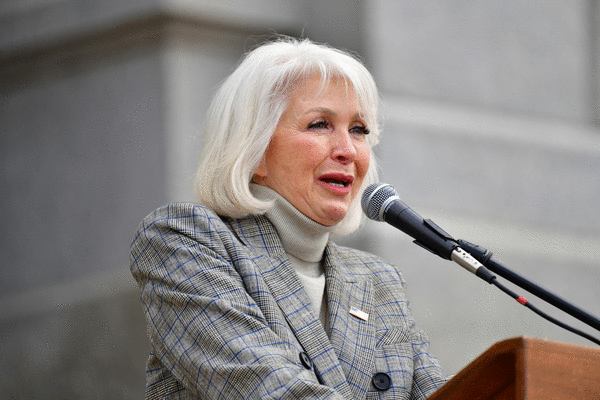
DENVER — Gov. Jared Polis will reduce Tina Peters’ sentence by half, he confirmed Friday, appearing to bend to demands from President Donald Trump — while ignoring the pleas of many other Colorado elected officials and the prosecutor who won the former county clerk’s conviction in an election data-breach scheme.
The commutation will reduce Peters’ original sentence of nearly nine years, which was thrown out last month, to about 4.5 years, Polis said in an interview Friday. His decision will make her parole-eligible for release from prison beginning June 1.
Peters, the former Mesa County clerk, has been a public supporter of election conspiracies rooted in Trump’s reelection loss in 2020. Polis told The Denver Post on Friday that “just because somebody believes the Earth is flat — just because somebody believes in conspiracy theories — does not mean that they should receive a harsher sentence for a very specific crime.”
It’s not immediately clear how the decision will impact Peters, 70. Last month, the Colorado Court of Appeals reversed her eight-year prison term, which was part of an overall nine-year sentence, and ordered a Mesa County judge to resentence her. But that hasn’t yet happened, and Peters’ attorneys also still have time to further appeal her convictions.
She has been serving her sentence since October 2024.
On Friday, Polis quoted from the appeals court’s decision, which said Peters’ original sentence was wrongly based on her exercise of protected free speech, to defend his clemency decision. She will remain a felon under the commutation, and Polis argued that her sentence would remain harsher than what her co-defendants received — just not unduly harsh.
While Peters has not publicly shown contrition for her crimes, Polis said she did so in her clemency application. His office previously denied a public records request for that application.
“It’s important to get past our emotions, which I share, about election conspiracy theories,” Polis said. “I condemn them. I condemn any acts of threats or violence against our incredibly talented election workers on both sides of the aisle.
“And it’s important to look at, as we do in any case, the facts of the case — and make sure that we live in a society that upholds the value of freedom of speech, and that even when somebody holds incorrect and unpopular opinions, that speech is not held against them in a sentencing.”
Polis’ decision comes two days after the annual legislative session adjourned — meaning that the governor appeared to have timed the commutation for when Democratic lawmakers, who had blasted him for even considering intervening, could no longer take any action to formally condemn him. Polis is term-limited, so lawmakers will not convene for another regular session until after he has left office.
Lawmakers sent the governor a letter in March, urging him not to release Peters early, and some had discussed holding a formal vote to censure him if he went ahead with commuting or pardoning the former clerk. Some lawmakers were told Friday morning that Polis planned to make an announcement about Peters’ sentence later in the day.
The commutation was also apparently not communicated well in advance to various outside officials.
Dan Rubinstein, the Mesa County district attorney who prosecuted Peters, told The Post on Thursday that he had not received any new information about Polis potentially altering Peters’ sentence, and he was still had not received word by early afternoon Friday. Matt Crane, who leads the Colorado County Clerks Association, said he was also unaware of any plans.
As of late Friday morning, the offices of Secretary of State Jena Griswold and Attorney General Phil Weiser said they still had not received any word from the governor’s office on the matter.
Polis’ decision did not only ignore the pleas of the legislature’s majority Democrats. His announcement also bucked repeated requests from a slew of elected officials— including Griswold, Weiser, Rubinstein and a coalition of county clerks — who had publicly implored him not to interfere.
Polis said that “my judgment is not based on what I hear from other people,” whether it was from people who wanted Peters’ sentence upheld, lessened or wiped away. That included the Republican president, who has claimed to pardon Peters— a power he does not have for state-level convictions — and who said on New Year’s Eve that he hoped Polis and others would “rot in hell” for Peters’ sentence.
Around that same time, Polis’ office sought input on Peters’ clemency application from District Court Judge Matthew Barrett, who sentenced Peters. In a Jan. 13 letter to the governor obtained by The Post, Barrett wrote that Polis’ chief legal counsel had spoken with him about the application, as required under Colorado law. Barrett wrote that he had “carefully considered” Peters’ personal circumstances before sentencing her, as well as “her lack of accountability.”
“I chose a sentence in roughly the midpoint of the presumptive ranges that this state’s General Assembly has set,” the judge wrote.
He told the governor that he would respect whatever decision Polis made and that he trusted any decision would be made “for the right reasons.”
“I’m hopeful that my decision today will restore the confidence that the people of Colorado have that, regardless of their political opinions or beliefs, they will receive equal justice under the law,” Polis said Friday.
He announced Peters’ commutation as part of a slate of clemency decisions Friday. Polis has typically announced commutations and pardons around the holidays at the end of each year, which he did not do in December amid renewed pressure from the Trump administration.
In addition to Peters, Polis announced he will commute the sentences of eight other inmates, including people who had been sentenced to life in prison without parole for murder charges, and that he would pardon 35 others. He says he is still reviewing other clemency applications and plans to announce others before he leaves office in January.
Despite the intense public and private pressure and months of open consideration for granting Peters clemency, Polis said other commutations, particularly those in cases involving the loss of life, were much harder decisions.
A jury found Peters guilty in August 2024 of providing a person outside the clerk’s office — who was affiliated with noted election-denier Mike Lindell — with access to Mesa County’s voting systems after the 2020 election, as part of Trump’s baseless claims of election fraud.
In the 19 months since she was sentenced, neither Peters nor her legal team has shown any contrition publicly for the conduct that led to her felony convictions. Indeed, just last week, her supporters published an apparent letter she’d written to Trump, in which she calls herself a political prisoner and repeats election conspiracy theories.
The former clerk was convicted of three counts of attempting to influence a public servant, one count of conspiracy to commit criminal impersonation, first-degree official misconduct, violation of duty and failing to comply with the secretary of state.
Peters received at least four negative write-ups during her first year in prison. In January, surveillance footage showed Peters grabbing and shoving a fellow inmate during a brief scuffle in a prison common area. Peters was later found not guilty of assault but was found guilty of a lesser charge.
As he has faced pressure from the president, Polis has said he would not release Peters as part of any sort of deal with the Trump administration. Other officials, including U.S. Sen. Michael Bennet, have accused Trump of retaliating against the state for its refusal to release Peters.
Since last fall, federal officials announced the dismantling of Boulder’s National Center for Atmospheric Research, while Trump vetoed a bipartisan bill to help pay for a water pipeline in southeastern Colorado, and his administration halted and stripped federal funding for state programs.
Federal officials have also threatened to undercut the state’s wolf reintroduction program, hampering an effort that’s been embraced by Polis’ husband, Marlon Reis.
It was unclear if Polis’ commutation decision would ease or reverse any of those moves. A message sent to the White House on Friday was not immediately returned.
-----------
©2026 MediaNews Group, Inc. Visit at denverpost.com. Distributed by Tribune Content Agency, LLC.






Comments