Cuba accepts $100 million US aid offer as country says it has run out of oil
Published in News & Features
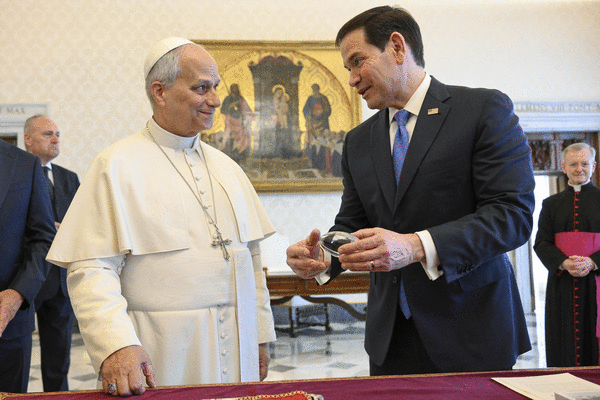
Cuba’s leader, Miguel Díaz-Canel, said Thursday that his government will accept a U.S. offer to provide $100 million in humanitarian aid, as the country runs out of fuel and Washington signals its impatience with stalled diplomatic talks between the two countries.
Secretary of State Marco Rubio said Friday the U.S. government had offered to send $100 million in humanitarian aid to the country, but that Cuban authorities had not accepted it. Earlier this week Cuban Foreign Minister Bruno Rodríguez said his government had no knowledge of the offer and accused Rubio of lying.
But after the State Department on Wednesday said the offer was still standing, Díaz-Canel said the Cuban government would not stand in its way.
“If the U.S. government is truly prepared to provide aid in the amounts it has announced—and in full conformity with universally recognized practices for humanitarian assistance—it will encounter neither obstacles nor ingratitude on the part of Cuba, however inconsistent and paradoxical such an offer may seem to a people whom that very same U.S. government systematically and ruthlessly subjects to collective punishment,” Díaz-Canel wrote in a posting on X.
The State Department said the aid could be distributed by the Catholic Church and other reliable independent humanitarian organizations. Rubio discussed the aid delivery in a meeting at the Vatican with Pope Leo XIV last week.
Cuba’s leader said his government’s “experience working with the Catholic Church is rich and productive.” He said, “The priorities are more than evident: fuel, food, and medicines.”
The Herald reached out to the State Department for comment, but had not had a response by the time this story was published.
Cuba’s economy, which has been in a steep decline for several years, has hit rock bottom, and the population has been enduring shortages, blackouts and the effects of collapsing infrastructure. The economy has been almost paralyzed for well over a year. Still, the situation on the island was about to get much worse, which might have factored into the Cuban government’s decision to accept U.S. aid.
On Wednesday, the country’s energy minister said the government has run out of fuel and diesel entirely, just when the island’s hot summer season is starting.
“We have absolutely no fuel, we have absolutely no diesel,” said Vicente de la O Levy, the energy minister, on state television on Wednesday evening.
On Wednesday afternoon and evening, protests broke out around Havana, after some neighborhoods in the capital had experienced blackouts lasting up to 48 hours during the week.
Cuba’s energy problems are not new and are largely due to a lack of maintenance of outdated power stations. But on top of the limited generation capacity and the poor state of the electrical grid, which partially collapsed again on Wednesday, Cuba lost its regular oil suppliers. Venezuela stopped sending free oil to Cuba after the United States captured strongman Nicolás Maduro in January, and Mexico did the same after President Donald Trump signed an executive order threatening tariffs to countries selling oil to the island.
It is unclear if the United States would be willing to provide fuel to Cuba as a humanitarian gesture. But if Cuba doesn’t secure fuel soon enough, “we might witness a super blackout,” said Jorge Piñón, an energy expert at the University of Texas at Austin. The challenge Cuba faces is not just generating electricity but also the lack of fuel for transport and the economy in general, he added.
Cuba’s acceptance of the U.S. aid comes at a time when talks between the two countries were fizzling.
On Wednesday, Rubio said he didn’t believe the U.S. could bring about major changes in Cuba with the current leadership in place, signaling growing skepticism that diplomacy and sanctions would persuade the communist government to make significant reforms.
Speaking on Air Force One to Fox commentator Sean Hannity on his way to China, Rubio said Cuba had a “broken, nonfunctional economy, and it’s impossible to change it. I wish it were different.”
Rubio had been leading back-channel negotiations with members of the Castro family in Cuba, particularly with Raúl Castro’s grandson, Raúl Guillermo Rodríguez Castro, which later turned into diplomatic talks.
In February, Rubio suggested Cuba needed to start reforming its economy to ease U.S. pressure. The Cuban government responded by announcing that Cubans abroad will be allowed to own private businesses on the island, but within the current legal framework. Rubio quickly dismissed the measures as “not dramatic enough.”
Fast-forward to May: Rubio did not seem optimistic that Cuba’s current leadership – a mixture of Communist Party bureaucrats and generals surrounding the Castro family– can steer the country through the sort of drastic reforms the impoverished island needs to avoid total collapse.
“I believe – it’s my personal opinion – you cannot change the economic trajectory of Cuba as long as the people who are in charge of it now are in charge of it,” he told Hannity. “That’s what’s going to have to change because these people have proven incapable. I hope I’m wrong. We’ll give them a chance. But I don’t think it’s going to happen. I don’t think we’re going to be able to change the trajectory of Cuba as long as these people are in charge in that regime.”
The Trump administration has offered Cuba substantial humanitarian aid, free internet and major economic deals, but has also demanded the replacement of the country’s formal president, Díaz-Canel, the release of political prisoners and political liberalization, among other key issues, such as the settlement of claims on property confiscated by the Cuban government.
So far, however, the Cuban officials have repeatedly said the island’s government will not make any political concessions. Several Herald sources have said that Cuban officials have privately signaled that the country is ready for a major economic opening, but have made clear that regime change is not on the table.
©2026 Miami Herald. Visit at miamiherald.com. Distributed by Tribune Content Agency, LLC.





Comments