British Prime Minister Keir Starmer losing fight to stay in power as rebellion spreads
Published in News & Features
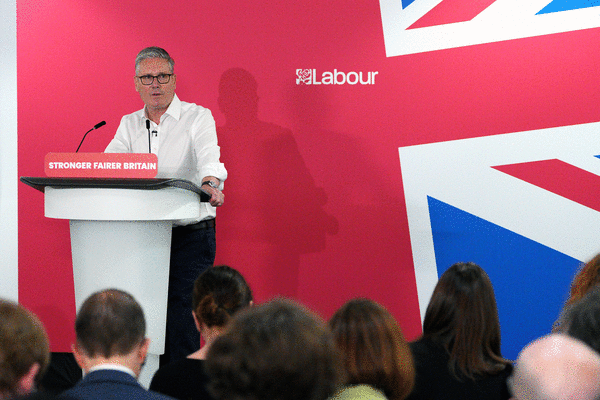
LONDON — Keir Starmer was facing a decision to step down as prime minister as dozens of members of Parliament, including his own home secretary, joined the calls for him to set out a time table for his departure.
Home Secretary Shabana Mahmood, who has overseen Starmer’s controversial immigration crackdown, told the prime minister that he should consider laying out a plan for a successor, according to people familiar with the matter. The Home Office didn’t respond to a request for comment on the exchange, which was first reported by the Times newspaper. No. 10 Downing St. declined to comment.
The addition of Mahmood to the ranks of those calling for Starmer to resign signals a new level of peril for the prime minister in the wake of Labour’s disastrous performance in last week’s local elections. She was among more than 70 members of Parliament who had urged the prime minister to step aside, with many speaking up in the hours after the prime minister announced his plans for a reset on Monday.
Such critics included Joe Morris, a ministerial aide of Health Secretary Wes Streeting, and Streeting’s constituency neighbor Jas Athwal, leading to intense speculation in Labour that the health secretary was preparing to challenge Starmer. Around half a dozen other ministerial aides also resigned Monday.
Mahmood’s comments follow a similar overture by Energy Secretary Ed Miliband in recent weeks. A Labour official said they believed several more Cabinet members were ready to tell the premier he needed to set a timetable for his departure. Starmer is due to chair a regularly scheduled meeting of his Cabinet on Tuesday morning.
A turbulent day began with a speech by Starmer aimed at saving his premiership, after his party lost control of the Welsh parliament and almost three of every five English council seats it was defending on Thursday. But the intervention fell flat among Labour lawmakers, doing little to improve his prospects of survival.
In the hours that followed, the number of the party’s members of Parliament calling for his departure steadily rose and the pound erased earlier small gains against the euro.
That followed a fall in U.K. government debt Monday, with 10-year gilt yields rising nine basis points to 5.00%, as bond investors expressed concern that any replacement for Starmer would increase fiscal spending, potentially driving borrowing costs higher.
Labour MPs and aides told Bloomberg that developments could happen quickly in the coming days if momentum continues to build against the prime minister.
Asked in a BBC interview whether Cabinet ministers were planning to tell Starmer to resign at that meeting, Care Minister Stephen Kinnock — who does not attend Cabinet, but serves under Streeting in the health ministry — said, “they may well do.” He added: “I just hope that they really will take a beat, pause, reflect, and think about the potential that that has for chaos that might be unleashed.”
As the numbers of those calling for his departure rose — many of them issuing statements lauding the premier as a man with integrity, but whose leadership was damaging Labour — one MP who has hitherto been loyal to Starmer told Bloomberg the question was now when, rather than if, the premier goes.
Labour MPs and Starmer’s remaining allies are awaiting the next moves of Streeting and Greater Manchester Mayor Andy Burnham, the two favorites to succeed the premier.
Streeting remained silent Monday, disappointing some of his supporters who had wanted him to announce a challenge. When he called for Starmer to step down, Streeting’s ministerial aide, Morris, said there should be a “swift timetable” to replace him. A speedy contest would favor Streeting since Burnham’s path to parliament would take many weeks.
One senior lawmaker said that any contest that didn’t include Burnham would be seen as illegitimate, and even if Streeting won it he would be vulnerable to fresh challenge.
Despite the rancor spilling out into the open Monday, a number of loyal MPs — including Cabinet minister Steve Reed — expressed their support for Starmer. The rearguard action by the prime minister’s office to galvanize support appeared lackluster however, with many senior ministers remaining quiet.
Labour figures said that calls by known allies of Streeting for Starmer to go appeared to be an orchestrated effort to build momentum against the premier in order to give the health secretary cover to announce a challenge — something an ally of Streeting denied.
Burnham’s allies expect in the coming days to be able to set out a path for him to return to Parliament in order to be eligible to stand in any leadership contest. His backers said a sitting MP in the northwest of England is likely to soon stand down, giving him an opportunity to apply to be the Labour candidate in the ensuing by-election. That would set up a clash with Starmer’s allies on Labour’s National Executive Committee, who blocked him from running in a by-election earlier this year.
Burnham pulled out of a long-planned speech at a London conference on Tuesday without explanation. It was unclear if he had done so because he is preparing to make an intervention, or because he was not yet ready to address his intentions in public. A spokesperson for Burnham declined to comment.
Angela Rayner, another possible contender, made her second public remarks in two days on Monday, but again stopped short of saying she wanted to challenge Starmer for his job. She endorsed Burnham’s return to Parliament, leading some MPs to conclude support has fallen away from her in recent weeks and that she is now hoping to be the junior partner on a Burnham ticket.
_____
(With assistance from Lucy White, Greg Ritchie and Jacob Reid.)
©2026 Bloomberg L.P. Visit bloomberg.com. Distributed by Tribune Content Agency, LLC.






Comments