China urges reopening of Hormuz in talks with top iran diplomat
Published in News & Features
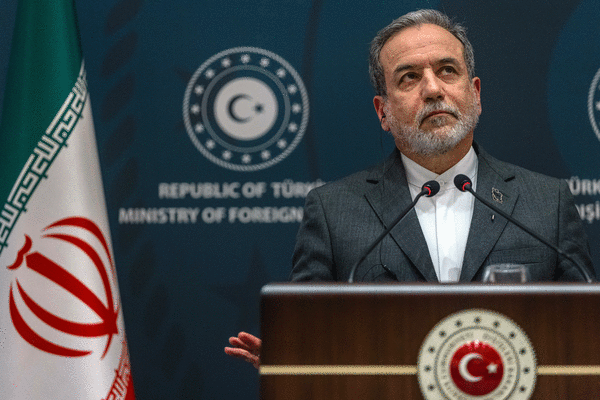
China’s top diplomat called for the swift reopening of the Strait of Hormuz in the first meeting with his Iranian counterpart this year, signaling Beijing’s efforts to de-escalate a global crisis just days before President Xi Jinping is set to meet with Donald Trump.
“The international community shares a common concern for the restoration of normal and safe passage of the strait,” Foreign Minister Wang Yi told Iran’s Abbas Araghchi on Wednesday, according to an official Chinese statement. “China hopes that the parties concerned will respond to the strong appeal of the international community as soon as possible.”
The visit by the Iranian envoy is his first trip to China since U.S. and Israeli strikes against his country sparked the most severe global oil supply shock in history.
The Iranian readout made no mention of the critical waterway, which has become a sticking point in peace talks between Tehran and Washington. According to the statement, Araghchi expressed both Iran’s resolve to defend itself and a willingness to pursue dialogue.
“Just as Iran appeared in the field of self-defense with strength and remains fully prepared to confront any kind of evil, it is also serious and constant in the field of diplomacy,” Araghchi said.
The meeting suggests the two strategic partners are stepping up coordination before Trump’s expected summit with Xi on May 14-15, where the Iran war is expected to be high on the agenda. Wang and Araghchi have spoken by phone at least three times since the start of the war.
Araghchi briefed his Chinese counterpart on Iran’s negotiations with the U.S., according to the Iranian readout. He also praised “China’s principled position in condemning the violation of the fundamental principles of the United Nations Charter by the U.S. and Israel.”
Wang repeated China’s call for a ceasefire. “A resumption of hostilities is inadvisable, and persisting with negotiations is particularly important,” Wang told Araghchi at the start of their meeting in Beijing.
The comments follow an uptick of Iranian strikes on the United Arab Emirates this week and clashes involving ships in the Strait of Hormuz.
As talks intensify with Tehran, Beijing is maintaining close contacts with Moscow. Russian President Vladimir Putin will likely travel to China in May, according to a Russian business daily, Vedomosti, for what would be his first trip abroad this year.
Last month, China and Russia vetoed a U.N. Security Council resolution that would have encouraged countries to coordinate defensive efforts on reopening the Strait of Hormuz.
Beijing is a key diplomatic and economic backer of Tehran, buying most of Iran’s oil exports. The two countries have maintained close communication during the nine-week war, with their top diplomats having held at least three phone calls.
Araghchi’s visit will be under scrutiny in Washington, as the U.S. ramps up economic pressure on Iran to reopen the Strait of Hormuz, the waterway through which a fifth of global oil and gas flows passed before the war.
“I hope the Chinese tell him what he needs to be told, and that is that what you are doing in the straits is causing you to be globally isolated,” Secretary of State Marco Rubio said at a White House press briefing on Tuesday. “It is in China’s interest that Iran stopped closing the straits. It’s harming China as well.”
The U.S. Treasury has sanctioned Chinese private oil refiners for processing Iranian crude, including Hengli Petrochemical (Dalian) Refinery Co., one of the country’s largest. China responded by ordering companies to defy U.S. sanctions in an unprecedented step that raised tensions before the Trump-Xi summit.
The Chinese president has previously called for the strait to be reopened, but Beijing has so far turned a cold shoulder to Washington’s request to help it unblock the waterway. Next week’s summit offers the two leaders the first opportunity to discuss the Iran war in person.
Trump on Tuesday sought to downplay tensions with China over the conflict, saying Xi has “been very nice” about it.
“He’s been very respectful. We haven’t been challenged by China,” he told reporters at the White House. Trump has previously suggested that Beijing may be providing help to Tehran, claiming the U.S. had intercepted a boat with a “gift” from China bound for Iran.
The key question is what role Beijing is willing to play to end the conflict that’s roiled global markets and supply chains — and what kind of pressure it’s prepared to put on Tehran. China has portrayed itself as a stabilizing force and neutral mediator in the war, while seeking to balance strategic ties with Iran and its vast economic interests in the Gulf.
Last month, Iranian officials credited a last-minute push by China with securing their acceptance of a ceasefire brokered by Pakistan — though Beijing hasn’t publicly taken credit for it. Chinese state media have also pushed back on those claims, saying China’s role in the ceasefire is overstated.
Still, Araghchi’s visit highlights China’s status as one of the few geopolitical heavyweights with some leverage over both Iran and the U.S.
Before his trip to Beijing, Araghchi visited Russia, Iran’s other major backer, meeting Putin in Moscow on April 27.
Russian Foreign Minister Sergey Lavrov was the first counterpart Wang called to discuss the conflict, on the day after the initial strikes began in late February. The two diplomats also held extensive talks in Beijing during Lavrov’s visit last month.
---------
—With assistance from Patrick Sykes and Golnar Motevalli.
©2026 Bloomberg L.P. Visit bloomberg.com. Distributed by Tribune Content Agency, LLC.





Comments