China's Xi, warning of a clash, tells Trump: 'We must make it work'
Published in News & Features
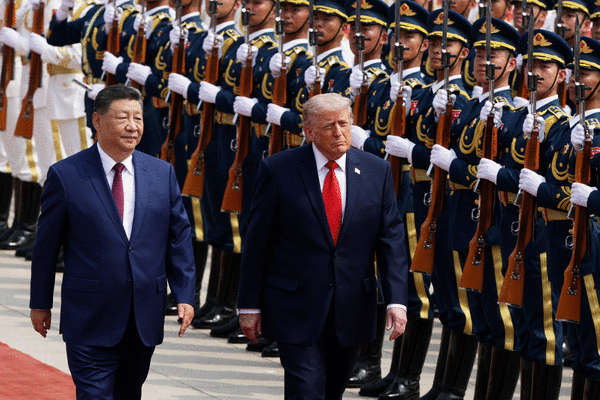
BEIJING — An extraordinary display of power and precision along Tiananmen Square greeted President Donald Trump in Beijing on Thursday, kicking off a two-day summit with particularly high stakes for the Americans.
It was not immediately clear what the two sides had accomplished in their first day of meetings. But carefully choreographed visuals sent a clear message to the world that both governments sought more stable footing in the relationship — described by Chinese President Xi Jinping as "constructive strategic stability" — as an ultimate goal of the summit.
The day was filled with ceremony and spectacle, beginning at the Great Hall of the People, where Xi greeted Trump with a military honor guard, a cannon salute and cheering schoolchildren. American flags waved and "The Star Spangled Banner" rang out on a smoggy morning in the heart of the capital as the two shook hands.
It concluded with a state banquet at the hall over lobster soup, Peking duck and pan-fried pork buns, where Trump hailed the depths of ties between the American and Chinese peoples, and where Xi described the bilateral relationship as the most important in a "changing and turbulent" world.
"Achieving the rejuvenation of the Chinese nation and making America great again can go hand in hand," Xi said during his toast. "We can help each other succeed."
The red carpet treatment also came with a warning, issued publicly through Xinhua, China's state news agency, and delivered as the first meeting of the summit was still ongoing.
Xi told Trump behind closed doors that U.S. opposition to Chinese reunification with Taiwan could lead to direct conflict between the superpowers, the report said, placing the fate of the island front and center of the negotiations.
"Taiwan independence and cross-strait peace are as irreconcilable as fire and water," Xi said, according to the state report. "Safeguarding peace and stability across the Taiwan Strait is the biggest common denominator between China and the U.S."
In a statement, a spokesperson for Taiwan's Cabinet, Michelle Lee, said it was Chinese ambitions to change the status quo around Taiwan driving global instability.
"China's military threat is the sole source of insecurity in the Taiwan Strait, and broader Indo-Pacific region," Lee said.
By Thursday evening, as the two sides were preparing to sit down for the banquet, the White House had issued a readout of the meeting that made no mention of Taiwan.
"President Trump had a good meeting with President Xi," the statement read. "The two sides discussed ways to enhance economic cooperation between our two countries, including expanding market access for American businesses into China and increasing Chinese investment into our industries."
A White House official said that Trump and Xi discussed the continued sale of fentanyl precursors into the United States — a longstanding concern of the Trump administration, and the justification for one of Trump's most aggressive rounds of tariffs against Beijing — as well as China increasing its purchase of American agricultural products.
U.S. officials told The Times ahead of the trip that Trump would hold firm on longstanding American policy toward Taiwan — a "One China" policy of strategic ambiguity that acknowledges Beijing's claims over the island, while maintaining relations with Taipei. Taiwanese officials also said they were assured by the Trump administration that its policy would not change.
At a cultural engagement after their first round of talks, at the Temple of Heaven, a soaring monument to imperial China and Confucian thought, American reporters asked the two presidents whether Taiwan had come up in the negotiations. Neither responded.
'Biggest summit ever'
Trump reflected on the stakes of his visit at the start of the meeting, telling Xi that his welcome ceremony was an honor "like few I've seen before."
"There are those who say it may be the biggest summit ever," he said. "I have such respect for China, the job you've done."
Both men struck a conciliatory tone, despite the agenda for the summit featuring some of the thorniest issues facing the two superpowers today. Out of character and on foreign soil, Trump refrained from speaking with the press for the entire day, adhering to scripted remarks at public events.
"We've gotten along — when there have been difficulties, we've worked it out," Trump said. "We're going to have a fantastic future together."
The agenda exposes the mutual dependence of the two rival superpowers, marked by distrust but driven by a quest for cooperation and stability.
While China's statements emphasized the importance of Taiwan at the summit, the White House readout suggested Trump's focus was firmly on securing Beijing's cooperation on Iran.
"The two sides agreed that the Strait of Hormuz must remain open to support the free flow of energy," the White House readout said.
"President Xi also made clear China's opposition to the militarization of the strait and any effort to charge a toll for its use, and he expressed interest in purchasing more American oil to reduce China's dependence on the strait in the future," it read. "Both countries agreed that Iran can never have a nuclear weapon."
The welcome ceremony outside the Great Hall kicked off with Xi shaking the hands of Trump's delegation, including figures such as his political advisor, James Blair, his communications director, Steven Cheung, and his daughter-in-law, Lara Trump.
They were just a few members of a U.S. delegation accompanying Trump filled with curiosities.
Chinese officials were surprised to learn that Pete Hegseth had joined Trump on the trip, marking the first time a president has brought his secretary of Defense on an official state visit. It wasn't immediately clear to the Chinese what his inclusion was meant to convey.
Eric Trump, the president's son, is also here, seeking to leverage the family name for lucrative business deals as Beijing aggressively campaigns against government corruption at home. And First Lady Melania Trump decided to stay back, an unusual snub of such a high-level event.
A contingent of U.S. business leaders was given little notice to prepare for the trip, including the chief executive of Nvidia, who raced to join Trump aboard Air Force One at a refueling stop in Alaska. They stood behind Trump's aides at the welcome ceremony, and departing the Great Hall, appeared pleased with what they heard in private, offering gestures of approval to gathered press.
The summit follows weeks of Chinese frustration over what its officials saw as lack of preparation by the Trump administration — a perceived display of incompetence that had boosted their confidence heading into the negotiations.
There was little sign throughout the city of the president's visit, other than the gardens around the Temple of Heaven — an area roughly the size of 400 American football fields — closing days before his arrival in preparation for his stop here.
Reporters traveling with the president witnessed some tense exchanges between the Secret Service and Chinese security authorities, including over one U.S. agent bringing a weapon into the revered site.
At the banquet dinner, Trump emphasized the strength of his personal relationship with Xi, whom he has come to know since his first term in office. But Xi's remarks focused on their responsibility as statesmen to keep the bilateral relationship "generally stable."
"We must make it work," Xi said, "and never mess it up."
Additional meetings and a break for tea are scheduled Friday morning before Trump departs for home.
©2026 Los Angeles Times. Visit at latimes.com. Distributed by Tribune Content Agency, LLC.



Comments