Miami jury begins deliberations in Haiti presidential assassination trial
Published in News & Features
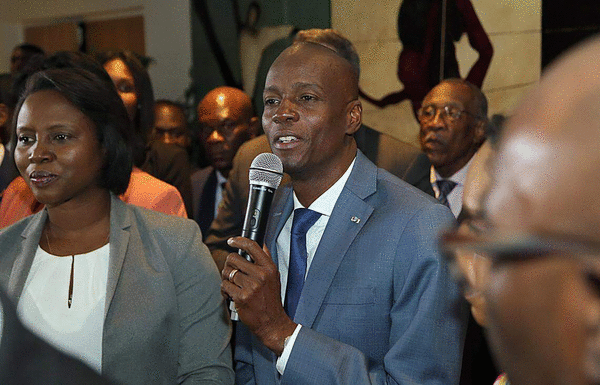
Gunfire awakened Haiti’s first lady Martine Moïse at 1 a.m. on a summer night nearly five years ago. As the popping sound drew closer to her family’s hillside home above Port-au-Prince, her initial concern was the safety of her two children, prosecutor Jason Wu said during the Miami federal trial of four men accused of plotting to kill her husband.
“She rushed downstairs and told them to get into a windowless first-floor bathroom where she hoped they would not be hit by any stray bullets,” which was where the couple’s college-age daughter and son hid with the family dog, Wu told jurors during closing arguments on Monday.
When she returned to the upstairs master bedroom, Martine and President Jovenel Moïse “lay on the ground, hoping against all the odds” for help to arrive, Wu said. But a squad of Colombian mercenaries arrived first and smashed through the bedroom door, opening fire and “hitting and badly wounding” the first lady. As she bled, she was forced to watch as the “trained killers” shot her husband “so many times that it looked like his body was bouncing off of the floor,” Wu said.
The assassination of Haiti’s president on July 7, 2021, was the culmination of three months of planning that began in South Florida, where the four defendants on trial and others met to overthrow the country’s leader in their quest for power, contracts and money in Haiti, according to the indictment. All four defendants face up to life in prison if they are convicted of conspiring to kidnap or kill Haiti’s president. The indictment includes several other counts related to the conspiracy charge.
On Tuesday, the U.S. District Judge Jacqueline Becerra instructed the 12-member jury, telling them they could not consider the guilt of other suspects in their deliberations, which began late in the day and will resume Wednesday. She was alluding to Joseph Félix Badio, a former Haitian anti-corruption official who played a pivotal role in transforming the plot, at a meeting in Port-au-Prince in mid-June 2021, from arresting Moïse arrest to killing him.
And while all four defendants were tried at the same time, the jurors were instructed they have to consider each one’s guilt individually. Arcángel Pretel Ortiz and Antonio Intriago, the owners of Counter Terrorist Federal Academy and Counter Terrorist Unit Security, collectively known as CTU, are accused of hiring the squad of former Colombian soldiers who stormed the president’s home.
The two men, along with co-defendants James Solages, who worked for CTU, and Walter Veintemilla, who is accused of helping to finance the operation, are charged with conspiring to kidnap or kill the president and related offenses.
A fifth defendant, Christian Emmanuel Sanon, a Haitian doctor and pastor, could not go to trial with them because of his poor health. Sanon, 67, was a key figure in the South Florida-Haiti coup plot because he was initially the man that CTU’s owners and other co-conspirators backed as a successor to Moïse as Haiti’s president.
Long before trial, six other defendants pleaded guilty to the main conspiracy charge or lesser charges, including a former Haitian senator, a Haitian businessman once convicted of drug trafficking, and two former Colombian soldiers, all of whom testified for the prosecution at trial.
‘Called the shots’
While the former Colombian soldiers were the hired guns who “pulled the trigger,” Wu said, the defendants on trial in Miami were “the men who called the shots.”
“They are the ones who plotted for months from the comfort of their office chairs and cell phones right here in South Florida to overthrow, kidnap or kill president Moïse,” he said.
The widow of Haiti’s slain president testified at the beginning of the trial that her husband’s assailants were speaking Spanish when they fatally shot him — bolstering the government’s case that a Colombian hit team was recruited by the four South Florida men linked to the security firm in the Miami area.
Martine Moïse identified two of the gunmen as “Pipe” and “Jefe.” In a key court filing, prosecutors said that the gunman called “Pipe” was a former Colombian special-forces soldier named Victor Albeiro Pineda Cardona. During closing, the prosecution identified him and the leader of the first group of Colombians as those responsible for sending a photo of the president’s blood-soaked corpse at 1:58 a.m. the day of the assassination from a burner cell phone.
In an effort to cast doubt on the government’s case, defense lawyers have insisted that Moïse was already dead by the time the 20 Colombians, along with Solages and Joseph Vincent, a Haitian American who has pleaded guilty, arrived at the president’s home. They maintained that the commandos were accompanying Haitian authorities to carry out an arrest – and over two days of closing arguments accused Haitians of carrying out the killing and setting up the four defendants and the Colombians.
Neither the government’s evidence nor that from the Haitian police, including an AR-15 style assault weapon borrowed from the parallel Haiti investigation, can be trusted, lawyers for each of the defendants told jurors.
“This is a Haitian plot, and it is a Haitian conspiracy,” Intriago’s attorney, Emmanuel Perez, said on Monday.
“History is not going to remember him as the martyred son of Haiti,” he continued about Moïse, a controversial figure who was the subject of mass anti-government protests in the months before his brazen murder. “History will remember him as a dictator, as a drug trafficker, as someone that was involved in the murder of people in La Saline and is a usurper of democracy.”
‘All lies’
Intriago, 62, was being used “as a scapegoat,” Perez said. Prosecutors are asking the jury “to ignore 250 years of American jurisprudence and American police procedures,” he said, arguing that FBI agents conducted a flawed investigation of the president’s murder, with no fingerprints, no DNA and no chain of custody. He described the autopsy and forensic examination as “horrific,” saying two bullets pulled out of the president’s forearm and back were planted from the semi-automatic AR-15 rifle that was used in the president’s slaying.
Defense lawyers pointed to inconsistencies in the testimony, especially that of the first lady, who initially told the FBI that she was hiding under the bed in the couple’s bedroom but testified that she couldn’t fit under it because the frame was too low.
They also questioned the credibility of cooperating witnesses, including German Rivera, a leader of the Colombian commandos who was at the president’s home when he was killed. Rivera, who accused Haitian police of torturing him for 29 days after his arrest, testified that Solages, 40, informed him and others in the hours before the attack on Moïse’s home that it was going to be a slaughter.
“He comes out and tells us, ‘James said, ‘We’re going to kill the president, his wife, the children, the dog, the cat and even the parrot,’ Solages’ lawyer, Jonathan Friedman, told jurors on Monday. “All lies, all fabrication.”
Solages, he said, did not join any plan to kidnap or kill Moïse. Solages “just honestly believed in good faith that he was assisting Haitian authorities in the lawful arrest” of Moïse.
If anything, Friedman said, the behavior of the president’s wife seemed suspicious.
“Martine Moïse, it’s our position, somehow was involved in this,” Friedman said. “I don’t think she killed her husband, but I think she somehow knew about it. I think she was complicit in it.”
‘Rush to judgment’
Attorney David Howard, whose client, Pretel, had worked as an FBI informant for 10 years until the killing, argued that prosecutors had failed to prove their case beyond a reasonable doubt. He pointed out that Pretel, 53, and others hosted a meeting at CTU’s office in Doral with a few FBI agents to talk about criminal activity in Haiti, but they also tried to raise the sensitive topic of Haiti’s political crisis and regime change.
“You don’t invite your FBI handler to your murder plot,” Howard said.
Howard said FBI agents had already made up their minds about the assassination case before they went to Haiti after Moïse’s death.
“Before they commenced their investigation, they had their man, or their culprits,” Howard told the jurors “I am not telling you that, they said that. … There’s a difference between investigating a case and making a case. When you investigate, you follow where the evidence leads. When you make a case you have a target.”
Like other defense lawyers, Howard said the FBI’s probe was sloppy and incomplete, noting that Moïse’s body was removed and missing for three days. Other evidence, such as shell casings, was removed. He said prosecutors stitched together a bunch of disparate text messages.
“They cherry-picked the ones that put the poorest light and they doubled down by giving you the poorest interpretation and they patched it all together in what they call a 900-page exhibit,” he said. “It does not match the forensic evidence. What happened here … was a rush to judgment.
“I don’t know what happened down there. They don’t either. You don’t either,” Howard said. “For you, this is not the time to investigate. … Your sole job is to grade their efforts and determine whether or not what you’ve been presented is free of reasonable doubt.”
Though the government has accused the Colombians of killing Moise, they did not identify the shooter and neither did any of the witnesses who testified. The other mystery is the timing of the attack.
Both the prosecutors and defense used footage from a drone video on the night of the attack to make their cases. Howard told jurors that vehicles arriving in the president’s Pelerin 5 neighborhood at just after 2 a.m. were carrying the Colombian commandos. And that timing would place them at the crime scene after Moise was killed, he said.
“The Colombians got there after the shooting started,” he said. “An hour and eight minutes after (the couple’s daughter) Jomarlie and her mother said the shooting began.”
But prosecutors disagreed, saying the Colombians had already arrived at the scene and were directly responsible for the Haitian president’s death before 2 a.m.
Howard also highlighted $20,000 worth of ammunition that Badio had acquired as the Colombians struggled to acquire bullets and guns. The ammunition, he said, ended up with members of his presidential detail, who were being bribed by Badio to lay down their guns and on the night of the attack did not suffer any casualties or injuries.
Howard, the final defense lawyer to close, told jurors that the real culprit is Badio, the former Haitian official in Moise’s government. U.S. authorities refused to ask the Haitian government to turn him over to face charges in Miami, despite Haiti’s request to do so.
Howard cited a set of stipulations both sides had agreed to that further sowed doubt, including unverified allegations the U.S. government had received that former president Michel Martelly and the prime minister at the time, Ariel Henry, helped hide Badio while he was on the lam for two years – and that Henry was in contact with him right before or after the killing.
“What are they talking about?” Howard said. “Ariel Henry and Michel Martelly were allegedly aware. … Haitians were responsible for his (Moise’s) death.”
In a rebuttal, prosecutor Sean McLaughlin told jurors that the fact the government agreed on the stipulations is no indication that they have any proof of the allegations.
“What the stipulation is … we are agreeing, in fact, that when you go to Publix, the National Enquirer and tabloids are in the shop,” he said. “By no means are we agreeing that what’s inside the National Enquirer is true.”
‘A rat’
Marissel Descalzo, one of the lawyers for Veintemilla, said in her closing arguments that few of the 40-plus witnesses mentioned her client during the trial for a reason: he was not involved in any assassination plot, she said.
Veintemilla, she said, is a businessman who was told that Sanon, the initial candidate to be Haiti’s next president, had significant political support. The idea was to replace Moïse with Sanon, who would deliver on future security projects for CTU’s owners.
Veintemilla was also told the FBI and State Department were involved and he tried to get politicians and the press involved. “He tells other people to try to get support for this project,” she said.
She acknowledged that Veintemilla’s company, Worldwide Capital Lending Group, loaned CTU about $175,000 to provide security for Sanon in Haiti, and that her client paid for the Colombian commandos to travel to Haiti. He also paid for hotel arrangements for Sanon and some of the Colombians in Haiti. And, she admitted that her client provided $1,000 after Moïse was killed to try and bring some of the Colombians back home.
“No money to kill or kidnap the president, no material support,” Descalzo told the jurors. “Why is it unreasonable for Walter to believe he was providing security?.… That’s what he thought.”
The government, she said, wants to convict her client because he sent a voice mail on June 9, 2021 – less than a month before Moïse’s death – about “hitting the rat.”
“Calling someone a rat is not enough to convict someone of kidnapping or an assassination,” Descalzo said. He was exercising his freedom of speech, “his right to call President Moïse a rat because that’s what he thought of him.”
_____
©2026 Miami Herald. Visit miamiherald.com. Distributed by Tribune Content Agency, LLC.




Comments