The military wants to host data centers in Alaska, raising questions about whether there's enough gas to power them
Published in News & Features
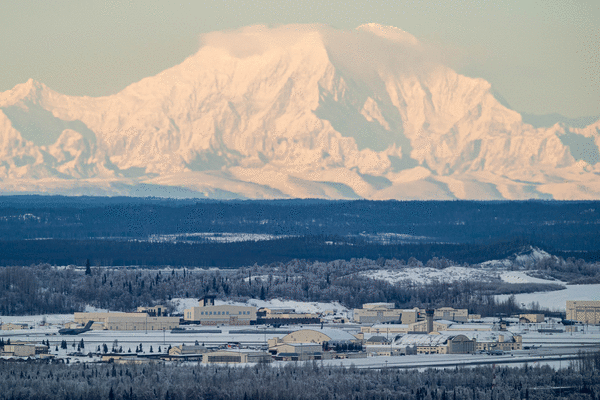
The Department of the Air Force is offering developers an opportunity to build artificial intelligence data centers on bases around the country, including in Alaska.
The plans stem from President Donald Trump's executive order to boost artificial intelligence in the U.S. It allows the Air Force to use "its real estate portfolio for technological advancement while creating new economic opportunities," an Air Force spokesperson said in a statement.
But there's a problem with the plans in Alaska.
Electric associations that would potentially serve the facilities — Chugach Electric Association in Anchorage and Golden Valley Electric Association in Fairbanks — say that with natural gas from Cook Inlet dwindling, they can't produce enough electricity to meet the needs of large data centers.
An official with Chugach Electric suggested that the utility could potentially serve smaller data centers, depending on the details.
Some say the answer for large, power-hungry data centers could lie in the Alaska LNG megaproject that seeks to tap vast quantities of long-stranded gas from the North Slope.
Gov. Mike Dunleavy has said the project, if built, could help power data centers in the state.
But it's unknown whether Alaska LNG, which has been unsuccessfully pursued for generations in one form or another, will ever be built.
The challenge for serving any large data centers will be the fuel supply that utilities need to make electricity, said Robert Pickett, a former longtime commissioner with the Regulatory Commission of Alaska.
"I mean, the whole electric industry right now in Southcentral Alaska is in a world of hurt," he said.
Huge jump in power prices
The Air Force department issued the request for proposals involving Alaska bases in April.
It offered five sites for lease to potential developers at Joint Base Elmendorf-Richardson. The sites range from about 60 acres to nearly 200 acres.
The department also offered land for lease at Clear Space Force Station and Eielson Air Force Base, both in the Fairbanks area.
The request comes as controversy has grown around data centers, with companies investing hundreds of billions of dollars to build them across the U.S. to boost computing power.
The facilities, about the size of large warehouses, have raised a number of concerns, including about higher electric rates.
In some areas, data centers have forced power bills higher for residential customers, due to the increased demand for power and upgrades built by utilities.
"Hyperscale data centers have increased the cost of wholesale electricity significantly, with costs up as much as 267% over five years in regions where they are developed," The Alaska Center, a group that advocates for clean air and water, said in a January report.
In Alaska, data centers also offer opportunities to strengthen grid infrastructure and address setbacks that have created "excess energy capacity and fewer consumers to share system costs," the report says. Construction jobs and some high-tech jobs, as well as property tax revenue, have also been cited as some of the benefits of data centers.
Dunleavy has taken steps to lure data centers to Alaska, along with the Matanuska-Susitna Borough Assembly.
The Anchorage Assembly recently established rules for potential data centers, including limits on location and an assurance from the local electric utility that the grid has "sufficient system capacity."
The new municipal rules would likely not apply to Joint Base Elmendorf-Richardson, which falls outside the Municipality of Anchorage's jurisdiction, said Anna Brawley, chair of the Anchorage Assembly and a co-sponsor of the ordinance.
Brawley said in an interview that she doesn't have a position on the military's pursuit of data centers.
But she said there has been concern about their potential impact to electric rates. Noise pollution, excessive water use, and other impacts have also been an issue.
On the flip side, she said, a selling point of Lower 48 data centers has been that if they produce their own power, they could sell some back into a grid, contributing to lower rates.
"Broadly, I would be hoping that our local leadership has conversations with the Department of Defense, with the entity that would be coming, and with the utility," she said.
Military: 'Insufficient power' at JBER sites
Asked how energy will be provided when Alaska faces a natural gas shortage, an Air Force spokesperson pointed to the request for proposals.
The solicitation says any potential project shall obtain and provide "power and water, and all services necessary for the Project."
That could happen in different ways.
A data center developer could have its own on-site power generation, the request says.
The project would need to "provide a mitigation and contingency plan" to ensure the local utility's "capacity" and resilience aren't negatively affected, the request says. It must comply with local and state energy regulations.
Any "proposed generation assets will at minimum require coordination" with the state's Alaska Energy Authority and the "Raibelt region" between Homer and Fairbanks to discuss energy cost needs and "resource adequacy," among other factors, the request says.
The solicitation also suggests that data sites may need to hook up to local power.
The sites at JBER have "insufficient power" for a data center, and will require "a new connection" to Chugach Electric Association in Anchorage, it says.
Sites at the Fairbanks-area military bases could tap into power from Golden Valley Electric Association, the solicitation suggests.
The request points out that Alaska faces a "short-term" lack of natural gas.
May 29 is the deadline for submissions.
Utilities: Not enough natural gas currently
Officials with the utilities said they currently can't meet the power needs of a large data center.
Julie Hasquet, a Chugach Electric spokesperson, said the utility is aware of the military's plans for data centers.
She also said other "other data center entities" have reached out to the utility in recent months, but declined to disclose names, saying the discussions are preliminary and confidential.
"We are always interested in new ideas and proposals for load growth in our system," she said in an email.
But Chugach Electric currently doesn't have enough natural gas to make the electricity needed by a large data center, she said.
Larger facilities can consume the same amount of electricity as 100,000 households, roughly about the same number of houses in the Anchorage area served by Chugach Electric.
But power demand for data centers can vary significantly, Hasquet said. Whether one can be served by the utility or not depends on different circumstances.
"We currently do not have gas to serve a large data center, but we do have generation capacity, so it depends on the size of the data center, their economics, project timing, and specific contractual terms of service," she said.
Chugach Electric's gas supply contract with Hilcorp Alaska, its primary supplier, is set to end in 2028. But the utility is looking at importing liquefied natural gas, or LNG, to close the looming gap.
Hasquet said the utility follows a standard process for any prospective, large customer, including integration studies to determine "if, how, and when" they can be connected.
"Chugach's position is that any large new customer, including a data center, should pay rates that fully cover its cost of service," she said. "Existing members should not be required to subsidize the new load. That principle applies whether a project succeeds or fails."
To that end, Chugach Electric would rely on "cost-of-service-based ratemaking principles, long-term purchase commitments, and potential contributions in aid of construction," for any infrastructure that would be built specifically to serve a customer, she said.
The Regulatory Commission of Alaska would oversee those efforts under its requirement to ensure rates are just, reasonable and not unduly discriminatory, she said.
"Our objective in any arrangement of that size would be for the project to benefit members, not burden them," she said.
Ashley Bradish, a spokesperson with Golden Valley Electric, said the Fairbanks utility can't currently support a large data center.
Part of the problem is that the Cook Inlet natural gas it relied on in previous years to make power has dropped dramatically, from about 30% of its fuel supply to less than 1% last year.
Also, the utility, which relies heavily on diesel fuel and coal to make power, was at its power-production limits this winter during historically cold temperatures, she said.
Newly commissioned storage facilities for liquid fuel were the "saving grace," she said.
"If we did not have that storage, we would not have been able to meet our load this winter," she said.
Bradish said she's not aware of any large data centers looking to enter the Fairbanks area.
She said if a developer did plan to install a large data center on a military base with hopes of tapping into Golden Valley Electric's power, ratepayers would be protected under the Regulatory Commission of Alaska.
"Through the RCA, if we have to put new things on our system to meet a specific entity or load that does not serve the rest of our membership, that entity would pay for that," she said.
Pickett, the former commissioner with the RCA, said the commission would likely prevent "cross-subsidization," in which ratepayers subsidize the costs of a data center.
"That would be something the commission would definitely have a hard look at and probably not go along with," he said.
_____
© 2026 Anchorage Daily News. Visit www.adn.com. Distributed by Tribune Content Agency, LLC.






Comments