Trump assassination suspect Cole Allen's attorney wants him taken off suicide watch
Published in News & Features
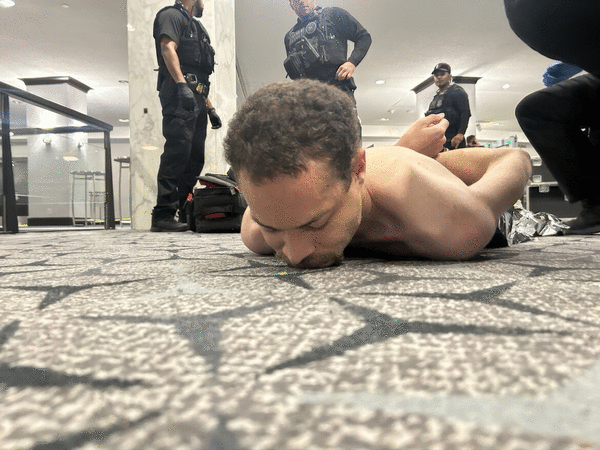
An attorney for Cole Tomas Allen is seeking the removal of suicide precautions while the Torrance man remains jailed on charges of attempting to kill President Donald Trump.
In a motion filed Saturday in U.S. District Court in the District of Columbia, federal public defender A. J. Kramer argued that Allen is being unlawfully punished by his continued confinement in a padded cell despite multiple assessments that found no indications of suicide risk.
“Mr. Allen is forced to be escorted to the shower, strip searched when entering and exiting his cell, and wear a padded vest while inside,” Kramer wrote. “These conditions are excessive restrictions on his liberty that serve no justifiable purpose and deprive Mr. Allen of dignity while incarcerated.”
A hearing on the motion is scheduled for noon Monday before U.S. District Court Magistrate Judge Zia M. Faruqui in federal court in Washington. A court filing says a representative from the U.S. Department of Corrections will appear at the hearing.
Neither Kramer nor the U.S. Department of Justice responded to email questions Sunday.
In his argument, Kramer cited case law finding that “if a restriction or condition is not reasonably related to a legitimate goal—if it is arbitrary or purposeless,” a court could infer it to be punishment that “may not constitutionally be inflicted” on a detainee.
Allen is being held in the District of Columbia jail prior to trial after agreeing to ongoing detention during an April 28 hearing.
According to the motion, Allen was assigned to a “safe cell,” defined as a padded room with constant lighting, and is required to wear a vest “akin to a strait jacket,” not to leave the cell except for legal or medical visits and to be strip-searched upon entry and exit.
During intake on April 27, Allen was initially advised he would be in a safe cell even though a member of the intake team “did not note any suicide risk factors,” the motion said.
He was assessed again on April 28 and, despite a second assessment finding no suicide risk factors, was upgraded to suicide “watch,” with a requirement for dimmed lights and no access to phone calls or jail tablets to communicate with anyone outside the jail, according to the motion.
Kramer wrote that he visited Allen on April 28 and was assured he would be placed in a regular cell by Thursday or Friday. The next day, a third assessment found no signs of suicide risk, but Allen was only restored to suicide precaution.
“Though relatively less stringent than suicide watch, Mr. Allen was still not permitted to make phone calls to—or receive visits from—anyone outside of his legal team, have access to a jail tablet, or except for legal visits or showers—which still must be done with an escort—spend time outside of his cell.” Kramer wrote.
As of Saturday, Kramer said he still believed Allen was on suicide precaution.
Allen faces a potential life sentence on the terrorism-related charge of trying to kill Trump. He has also been charged with two firearms violations related to his allegedly transporting two guns across state lines as he traveled from California to Washington by Amtrak train, and allegedly discharging one of those firearms — a shotgun — during the incident.
Authorities detained Allen April 25 after he sprinted past U.S. Secret Service agents at a checkpoint a floor above the ballroom where Trump and other administration officials were attending the annual White House Correspondents’ Assn. dinner. According to prosecutors, he was armed with the shotgun, a pistol and various knives. He then fell to the ground and was detained.
Trump administration officials who were at the dinner, including acting Atty. Gen. Todd Blanche and Jeanine Pirro, the U.S. attorney for D.C., charged him swiftly — leaning heavily on an email Allen had sent to family just as he was breaching event security, which Trump and others referred to as a “manifesto” but which was titled “Apology and Explanation.”
_____
©2026 Los Angeles Times. Visit at latimes.com. Distributed by Tribune Content Agency, LLC.






Comments