NASA keeps Boeing Starliner flights in holding pattern in updated space station plan
Published in News & Features
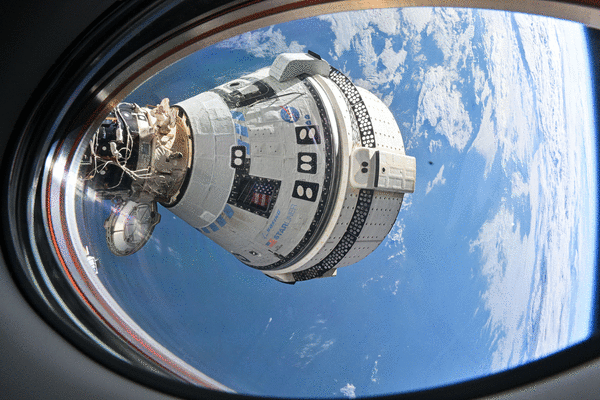
ORLANDO, Fla. — NASA said it was not ready to nail down Boeing Starliner’s next flight to the International Space Station as it continues to work through the problems found during its beleaguered Crew Flight Test mission in 2024.
NASA had since last year been targeting Starliner’s return to flight as early as April 2026, but that month came and went with no clear sign on progress to work through the failures of its last mission, which flew up NASA astronauts Butch Wilmore and Suni Williams for what was supposed to be as short as an eight-day stay on board the station.
Because of helium leaks and thruster failures after launching from Cape Canaveral, NASA opted to send Starliner back to Earth without its two crew, who stayed on board the space station eventually flying home on a SpaceX Crew Dragon and having remained in space for 10 months.
In February, NASA Administrator Jared Isaacman called out the agency’s handling of the problematic mission, which had its critical flaws detailed in a report from the independent Program Investigation Team. Isaacman at the time said Starliner had “qualification deficiencies [and] is less reliable for crew survival” than other vehicles.
“Launch opportunities for NASA’s uncrewed Boeing Starliner-1 cargo mission remain under review as teams continue working through technical issues discovered during the Crew Flight Test in 2024, as well as final actions from the Program Investigation Team report,” the agency stated in an update released on its website Friday. “The agency is assessing operational readiness and space station traffic to determine the earliest feasible launch window.”
Some of the leadership that had been in place of NASA’s Commercial Crew Program were replaced soon after the report’s release.
Starliner was supposed to share astronaut ferry duties alongside SpaceX’s Crew Dragon when Boeing and SpaceX were originally awarded contracts in 2014 to develop spacecraft to launch from Florida and end NASA’s reliance on Russia after the end of the Space Shuttle Program in 2011.
SpaceX was the first to fly crew to the station with the Demo-2 mission in 2020 and followed that with its first operational mission later that year. Including 12 crew rotation flights so far as well as Demo-2, four private astronaut flights for Axiom Space to the station and three private astronaut orbital flights, SpaceX’s fleet of five Crew Dragon spacecraft have flown 20 mission carrying 78 humans. Isaacman flew two of those missions, Inspiration4 and Polaris Dawn, before he became the head of NASA.
Boeing’s efforts to keep up kept hitting development snags including its first uncrewed test flight, which missed its rendezvous with the space station entirely in 2019. Boeing’s redo of that mission came more than three years later, and while it seemed to perform well, several other issues struck Starliner that forced more delays before it finally launched its first mission with crew, the CFT mission, in 2024.
With the spacecraft grounded until its problems are fixed, NASA redid Boeing’s contract. The company was originally tapped to fly six operational crew rotation flights after performing both of its uncrewed and crewed test flights successfully. Now Starliner-1, which was supposed to be with crew, will instead be cargo only. And it won’t be until Starliner-2 that crew get back on board, and then only if NASA certifies it as safe.
That will be only one of three crew rotation missions Boeing would be allowed to fly to the station under the revised contract, and then only if the space station is still around by the time Starliner’s issues are resolved. The space station still is slated to be decommissioned after 2030 and brought back down to crash into Earth in 2031. NASA, though, has recently floated the idea of prolonging the space station’s life until at least one commercial space station is up and running as a replacement.
In the meantime, without a spot to shoehorn in a Starliner docking, NASA nailed down its plans for cargo and crew missions for the remainder of 2026.
First up is a SpaceX cargo Dragon spacecraft launching from Cape Canaveral Space Force Station’s Space Launch Complex 40 on May 12 carrying 6,400 pounds of cargo on the CRS-34 mission.
Then in July, NASA astronaut Anil Menon on his first spaceflight, will join Roscosmos cosmonauts Pyotr Dubrov and Anna Kikina, flying on the Soyuz MS-29 mission launching from the Baikonur Cosmodrome in Kazakhstan.
Menon will be relieving NASA astronaut Chris Williams, who will fly back home on a Soyuz with two cosmonauts soon after Menon’s arrival. The two men will for a short time be on board alongside their 2021 astronaut classmate Jack Hathaway, who has been on board the station since March as part of the Crew-12 mission that launched from Cape Canaveral in the Crew Dragon Freedom.
“Jack told me to grow a mustache,” Menon joked during a press conference this week as Hathaway grew one ahead of his launch. “If you’ve seen pictures, he’s got quite an amazing one. But, you know, I like to play basketball, but I never challenge Michael Jordan to a competition. … I’m excited to see them. It’s super special to be up there with two of them.”
The Crew-12 quartet will remain on board until their relief comes in the form of SpaceX Crew-13, which includes Central Florida’s Luke Delaney, who is also a member of the 2021 class, known as “The Flies.” He’ll be making his first spaceflight joined by NASA crewmate and commander Jessica Watkins, who flew on Crew-4, and two other first-timers, Canadian Space Agency astronaut Joshua Kutryk and Roscosmos cosmonaut Sergey Teteryatnikov.
Kutryk had originally been tied to Starliner before being shifted to a Dragon mission. He said his preference on which spacecraft to fly in would be “anything. That’s a serious answer. I feel lucky, and all of the work that I’ve gotten to do with Starliner especially, I do feel just so lucky to have had that experience. … For someone interested in engineering, test pilot background, it’s awesome … It’s a really fortunate time to be involved in spaceflight.”
Crew-13 will launch in an unnamed Crew Dragon spacecraft atop a Falcon 9 rocket from Canaveral’s SLC-40, in mid-September, which is a quicker timeline than NASA originally planned. The agency had been trying out longer eight-month stays for its crew rotation missions, so Crew-12 had been planning to not return until November, but NASA recently opted to shift back to six-month stays.
NASA then plans two more cargo missions in the fall and winter. First will be a SpaceX cargo Dragon on the CRS-35 mission with another 7,200 pounds of payload including roll-out solar arrays for the station.
Then Northrop Grumman, flying still on a SpaceX Falcon 9 from Cape Canaveral, will finish up with its Cygnus XL cargo spacecraft with 11,000 pounds of cargo.
“NASA will review operations and make future adjustments, as necessary, to support the space station’s needs, crew safety, and maximize science capabilities aboard the orbiting laboratory,” the agency posted.
©2026 Orlando Sentinel. Visit orlandosentinel.com. Distributed by Tribune Content Agency, LLC.






Comments