Recycled plastics industry gets unexpected boost from Iran war
Published in News & Features

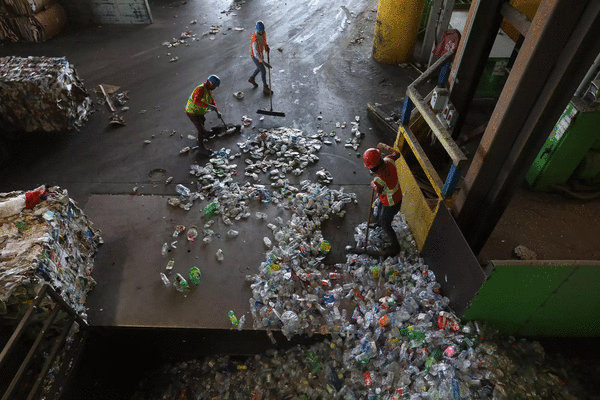


LOS ANGELES — As the war with Iran sends the price of virgin plastic skyward, speculation is growing as to whether recycled plastic could finally have its day after struggling for years to gain a greater foothold among manufacturers.
Not since the collapse of the global recycling market in 2018 and the COVID-19 pandemic has the world faced as big a shock to the production and sale of plastic products — all of which are made from oil and gas.
Today, roughly half of the global ethylene and polyethylene supply is stranded, constrained, or directly affected by the halt to commercial shipping through the Strait of Hormuz — a crucial transit point for 20% of the world’s crude.
Typically, recycled plastic is more expensive than virgin plastic. But in April, that calculus began to shift in many markets as the cost of plastics used in car parts, toys, bottles, food containers, cosmetics and many other products began to soar.
“Recycled plastics are having a major moment,” said Matt Slutzker, a principal analyst with Wood Mackenzie, a global research and consulting firm.
War in the Middle East already has affected the supply of plastic packaging significantly, according to Slutzker, who noted that Asian refineries and upstream facilities are unable to get the material they need for processing.
In Western markets including the U.S., producers such as Dow Chemical have announced price increases — in some cases between 30% and 40% — for the two plastics used most in packaging: Polyester and polyolefins, he said.
In late March, Dow told customers that it planned to double a previously announced price hike in plastic resins. And last week, during the company’s first-quarter earnings call, the company’s chief executive, Jim Fitterling, said it anticipated prices climbing even higher.
Recycled plastics, which are made from post-consumer, industrial and agricultural plastic waste, aren’t as closely tied to oil and gas markets; their prices have remained relatively stable throughout this period.
“Anecdotally, I’ve heard both recyclers and composters say that high oil prices are helping them because they are competing with fossil-fuel derived alternatives — plastic and fertilizers respectively,” said Nick Lapis, director of advocacy for Californians against waste. “However, I imagine that many people have long-term offtake agreements in place, so temporary fluctuations in price might take a while to trickle down.”
The wartime boost to recycled plastics comes after a particularly difficult period for the industry, and skepticism over the future of plastic recycling remains deep-seated.
Last year, seven U.S. polyethylene terephthalate, or PET, recycling plants were shut down — accounting for 25% of the nation’s capacity. PET is the plastic used to make water bottles and food packaging. In the recycling labeling system, it’s No. 1.
Plastic recycling suffered a significant blow in 2018, when China banned imports of most plastic waste. Up until then, China imported almost half of the world’s used plastic, and the collapse in this market spread turmoil among U.S. recyclers and resulted in more used plastics being sent to landfills.
Then, during the COVID-19 pandemic emergency, demand for single-use plastics in personal protective gear supercharged demand for virgin plastics.
Despite what appear to be recent favorable price trends, plastic recyclers remain skeptical about their long-term prospects.
“War is not a long term policy,” said Steve Alexander, president and CEO of Assn. of Plastic Recyclers.
Alexander said that although some forms of recycled plastic, such as polyethylene, may see a temporary boost, it’s unlikely to last. When the strait reopens, the price disparity is likely to shift again.
In addition, transportation costs are also high, increasing the costs for companies to access the recycled materials market.
In the meantime, getting producers to switch over to recycled plastic is not as straightforward as switching a light on or off.
Most producers have preexisting contracts with plastic suppliers.
“There are still contracts that are being fulfilled, and they’re usually quarterly or monthly,” said Sally Houghton, executive director of the PET Recycling Corporation of California.
Also, there are still several ships at sea carrying inventory from before the war, meaning cheap virgin supplies are still making their way to processors.
Alexander said until governments mandate that product manufacturers use recycled material, companies are going to stick with virgin, because it’s plentiful and cheap.
He said its a shame that more recycled plastic isn’t used in manufacturing. Research from UC Berkeley and UC Santa Barbara show policies mandating the incorporation of the recycled material is the most consequential way of reducing plastic waste and overall plastic production.
There are clear benefits to using recycled plastic: Fewer new plastics are introduced into the environment and it reduces the energy needed to make new products, thereby reducing greenhouse gas emissions.
A California law enacted in 2022 aims to boost the prospects of recycled material, as it requires that by 2032, 100% of the single-use plastic sold in the state is recyclable or compostable, Alexander said. But even then, manufacturers are likely to import cheaper material from elsewhere — from places where energy costs, environmental regulations and worker protections aren’t baked into the cost.
____
Times staff writer Blanca Begert contributed to this report.
____
©2026 Los Angeles Times. Visit at latimes.com. Distributed by Tribune Content Agency, LLC.





Comments