Florida's 'race-neutral' map would flip 4 seats, making 3 whiter
Published in News & Features
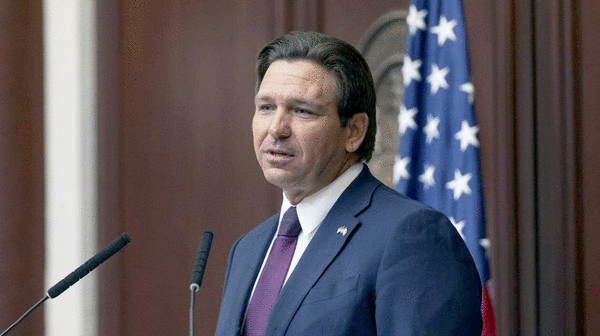
A new congressional map drawn by Florida Gov. Ron DeSantis is expected to create four more Republican-leaning seats, and three of them will be whiter.
Staff for the governor repeatedly said they did not consider race when drawing the map, which legislators approved Wednesday. Officials said they did, however, consider partisan data.
The new map would increase the number of majority- or plurality-white districts from 21 to 23, based on 2020 Census counts of the adult population, a Tampa Bay Times analysis found. (A plurality means a group forms the largest population in the district but not the majority.) States are required to use the decennial census data in redistricting.
The Fair Districts amendment in the Florida Constitution bans the government from drawing maps to diminish racial or language minority groups’ power to elect candidates of their choice. They also ban it from partisan gerrymandering.
DeSantis’ team had argued it expected that a U.S. Supreme Court ruling in a case on Louisiana districts would “impact the current map” by overturning a key section of the Voting Rights Act that protects the voting power of racial minorities.
The court issued its ruling hours before Florida lawmakers voted to approve the new map. It said that Louisiana had illegally gerrymandered a majority Black district. But while the ruling gutted the Voting Rights Act, it did not overturn it.
Still, the DeSantis administration, in a Wednesday letter, said the decision meant Florida could not comply with the Fair Districts Amendment’s requirements on race.
Here’s how the racial makeup is changing for the four blue districts that are likely flipping red.
Central Florida district breaks up Puerto Rican voters
One of the most apparent changes was the elimination of a majority-Hispanic district in Central Florida.
In District 9, Hispanic people made up just over 50% of adults, while white residents accounted for about a third, according to the 2020 census. The new map flips those numbers, dropping the Hispanic share to 36% while boosting the white share to nearly 50%.
Orlando-area Hispanic voters will be divided among the nearby 8th, 10th and 11th districts.
The 9th district will lose a little over a third of its Puerto Rican-born population, according to an analysis of recent American Community Survey data. More than 96,000 born on the island had called the prior district home. In the new one, it will drop to around 62,000.
That means Puerto Rican voters will be split into multiple noncompetitive Republican seats, diluting their voting power.
Rep. Darren Soto, a Puerto Rican and Italian American Democrat who represents the 9th District, posted on X on Wednesday that DeSantis “declares war on Puerto Ricans / Hispanics.”
Hillsborough district adds whiter suburbs
Tampa Bay will lose its lone safe blue seat under the new map. The 14th District, which included half of Tampa and half of St. Pete and is represented by Democrat Kathy Castor, had been a majority-minority area.
About 49% of the district’s adult population was white as of 2020; 26% was Hispanic, and 17% was Black. Under the new map, the population would be 6 percentage points whiter, trading away Black residents at the same rate.
The district will lose its share of Pinellas County. The redrawn boundaries also cut out Ybor City, East Tampa, downtown Tampa and parts north. It replaces those areas with whiter Hillsborough suburbs, including Brandon and Plant City.
South Florida shuffle
Under the prior map, South Florida’s blue seats included majority-white districts 22 and 23, represented by Lois Frankel and Jared Moskowitz, and the plurality-Hispanic District 25, represented by Debbie Wasserman Schultz.
Under the new map, the 25th, a long sliver stretching from Broward County to South Beach, would have an adult population that is majority white (59%), with 28% of them Hispanic.
The area that was the 22nd would now largely be in the new 23rd, which would be plurality-white and still lean blue. The new District 22 would be entirely different, stretching from Broward to Florida’s southwest coast. Its adult population would also be plurality-white.
Bottom line
The changes make apples-to-apples comparisons hard; but on net, the three blue districts would be replaced by a group that splits 2-1 for the GOP, based on the 2024 election. The plurality-Hispanic seat would be lost.
©2026 Tampa Bay Times. Visit at tampabay.com. Distributed by Tribune Content Agency, LLC.






Comments