Anchorage bans feeding of wild animals, with $250 fine for first offense
Published in News & Features
ANCHORAGE, Alaska — Residents and visitors caught feeding bald eagles or other wild animals — even feral rabbits — may now be subject to hundreds of dollars’ worth of fines.
In a 9-3 vote Tuesday, the Anchorage Assembly approved a new law banning the human feeding of birds of prey and other wildlife. The municipality can now fine those who intentionally feed wildlife, as well as individuals who “negligently” leave out food and garbage that may attract them.
Human feeding creates an increased potential for conflicts with people and pets, spreads wildlife disease and causes behavioral changes due to habituation, the ordinance states. The intentional feeding of birds of prey and other wildlife is subject to a fine of $250 for the first offense and $500 for subsequent offenses, the ordinance states.
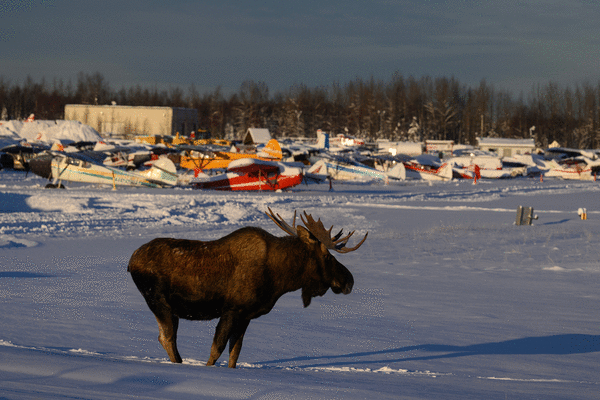
In addition to prohibiting the feeding of birds of prey, the new law also bans the feeding of invasive species such as starlings, English sparrows, raccoons and any ferret, swine or rabbit “not under the direct control of an owner,” the ordinance states. Moose, deer, fox and bears are also on the list.
Enforcement will be complaint-based, Municipal Manager Becky Windt Pearson said. Residents who want to report wildlife feeding should call the code enforcement hotline at 907-343-4141 or reach out to the Anchorage Parks and Recreation Department, according to city officials.
Assembly member Yarrow Silvers, who sponsored the ordinance, introduced an updated version that made it clear residents may still feed “backyard birds.”
“We are addressing the issue of people feeding eagles at the parks. They (the eagles) are getting aggressive, they are fighting and people are afraid to take their dogs to the dog park because they are becoming habituated to humans,” Silvers said.
According to an April 14 memo Silvers and Mayor Suzanne LaFrance shared with the Assembly, the Parks and Recreation Department received numerous reports of people feeding bald eagles at Chanshtnu Muldoon Park in East Anchorage. After investigating, staff learned people fed the eagles on a “very regular basis,” and in some cases left behind unsecured meat.
On Wednesday, municipal Natural Resource Manager Brad Muir opened up a video shared with him by park staff in February. On his iPhone screen, bald eagles, almost too many to count, flew in overhead and roosted in the trees near the parking lot.
While Muir said he received reports of humans offering wild animals food in other places along the Chester Creek Trail and Kincaid Park, he considered Chanshtnu to be the “epicenter.”
“There’s probably over 100 but I stopped counting at 55. ... They were everywhere,” Muir said.
Food left behind by birds can cause problems later when the snow begins to melt, creating an additional draw for black and brown bears, said Cory Stantorf, an Anchorage biologist with the Alaska Department of Fish and Game.
“We want to keep our wildlife wild, and we don’t need them hanging out at front doors, in neighborhoods (or) in city parks. There’s plenty of additional forage for them in the woods,” Stantorf said.
During Tuesday’s public hearing, Spenard resident Christopher Jensen requested the municipality make an exception for domestic bunnies that are “often cruelly cast out into the woods.”
“Either do something about the people who cruelly leave the bunnies out or keep allowing caring neighbors to continue feeding them,” Jensen told the Assembly.
The ordinance became effective immediately following its passage Tuesday.
_____
©2026 Anchorage Daily News. Visit at adn.com. Distributed by Tribune Content Agency, LLC.






Comments