White House says Trump discussing Iranian proposal with aides
Published in News & Features
The White House said U.S. officials are discussing Iran’s latest proposal but maintained red lines on any deal to end the eight-week war, including preventing Tehran from obtaining a nuclear weapon.
White House press secretary Karoline Leavitt told reporters Monday that President Donald Trump had convened a meeting of national security officials earlier in the day to discuss the Iranian proposal.
“His red lines with respect to Iran have been made very, very clear,” she said, adding that Trump would address the matter “very soon.”
The comments followed reports that Tehran proposed an interim deal whereby it reopens the Strait of Hormuz in exchange for Washington ending its blockade of Iranian ports. That proposal would also postpone more thorny negotiations over the country’s nuclear program.
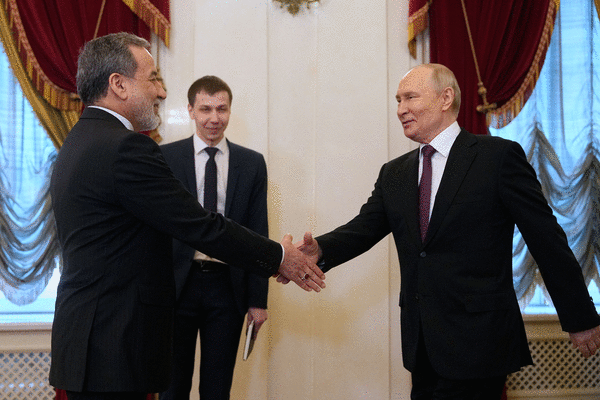
Separately, Iran’s Foreign Minister Abbas Araghchi told Russian President Vladimir Putin that Tehran is committed to strengthening the country’s partnership with Russia.
Araghchi said on a visit to Russia that the Iranian people are able to resist “U.S. aggression and will be able to overcome it,” Iran state-owned Nour News said Monday.
Iranian media said Sunday that Araghchi would convey to mediator Pakistan that the conflict could end if the Americans lift their naval blockade, agree to a new legal framework for traffic going through the strait and guarantee there will be no future military action against the Islamic Republic.
Iran told Pakistan that negotiations over Iran’s nuclear program — a longer-standing issue — could be dealt with later, Axios reported, citing a U.S. official and two people with knowledge of the matter.
Brent crude prices rose for a sixth straight session to more than $108 a barrel by 1:44 p.m. in New York. U.S. oil climbed above $96 a barrel.
Oil traders added to bullish trades after hopes for peace talks over the past weekend were dashed. Investors remain largely focused on a growing supply crunch created by the virtual standstill of flows through the strait.
Foreign leaders have expressed frustration over the prolonged conflict.
German Chancellor Friedrich Merz told a group of students the U.S. is being “humiliated” by Iranian leaders and that he can’t figure out what exit the Americans are pursuing.
An interim deal would echo what many Middle East analysts have said for weeks — that the U.S. and Iran should reopen the strait as soon as possible to lower fuel prices and ease pressure on the global economy, while leaving issues such as Iran’s nuclear program for later talks. Some Persian Gulf Arab and European leaders believe that such negotiations will take at least six months, Bloomberg has reported.
Trump, however, has indicated that Iran’s atomic program must be resolved as part of any agreement and that the blockade will stay in place until then. The White House has said the blockade is putting pressure on Iran to make concessions by choking off its oil exports.
Here is more on the U.S.-Iran talks:
—“We must ensure the rights of the Iranian people after 40 days of resistance and secure the country’s interests,” Araghchi said Monday, according to state-run Islamic Republic News Agency.
—“There is a high degree of alignment between Iran and Oman” on the future of the strait, Araghchi said, according to IRNA.
—Iran has previously said it wants to toll traffic moving through Hormuz and share the revenue with Oman, which sits across the strait.
—Efforts to resume in-person peace talks stumbled again Friday when Trump canceled a trip to Pakistan by Steve Witkoff and Jared Kushner, two of his main envoys. That was after Araghchi signaled he would not meet American negotiators while there and the Iranian government reiterated it will not agree to more talks while facing military threats from the U.S.
—Israel’s preferred option would be for the U.S. to maintain the blockade on Hormuz and for the allies to use the time to prepare for any resumption of hostilities, according to an Israeli official familiar with the government’s discussions, who asked not to be identified by name because the matter is private.
—Israeli strikes in southern Lebanon on Sunday killed 14 people, Lebanese state media reported, citing the country’s health ministry. The victims include two children. Trump said Lebanon and Israel, which has waged a conflict against Iran-backed Hezbollah, agreed to extend a ceasefire by three weeks until around mid-May. Yet both Israel and Hezbollah continue to accuse each other of attacks that violate the truce terms.
—In a statement on Monday, Hezbollah’s Secretary-General Naim Qasem rejected the Lebanese government’s direct negotiations with Israel. The group, Qasem said, would not back down against Israel or relinquish its weapons.
_____
(With assistance from John Bowker and Paul Wallace.)
©2026 Bloomberg L.P. Visit bloomberg.com. Distributed by Tribune Content Agency, LLC.





Comments