Insider trading cases threaten reckoning for prediction markets
Published in News & Features
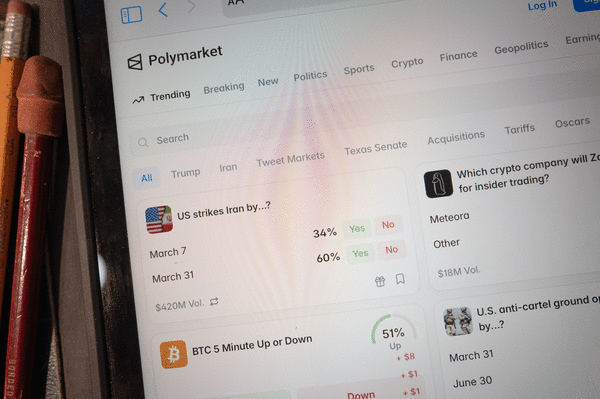
Prediction markets have quickly grown from a niche corner of finance to a multibillion-dollar industry with big Wall Street investment, but a growing list of insider trading allegations is bringing concerns about the platforms all the way to the White House.
The most significant development came on Thursday afternoon, when prosecutors announced charges against Gannon Ken Van Dyke, a U.S. soldier who allegedly took advantage of classified intelligence to win more than $400,000 betting on the capture of Nicolás Maduro in Venezuela.
The indictment came not long after French authorities said that they were probing whether someone had tampered with a weather station that was used to settle prediction market bets on the temperature in Paris. Those bets, and the Venezuela trades both happened on Polymarket, the largest international prediction market. Earlier in the week, Polymarket’s main rival, Kalshi Inc., said that it suspended and fined three congressional candidates for betting on their own races.
President Donald Trump told reporters in the Oval Office, right after Van Dyke’s criminal charges were announced, that he didn’t like prediction markets “conceptually” and was “not happy” with them, calling the world “somewhat of a casino.”
The comments marked a shift for an administration that had largely taken a supportive approach to the nascent industry. As recently as a few weeks ago, Trump spoke glowingly about the exchanges and their forecasts of his 2024 election win, saying that they were more reliable than “fake polls.” His son Donald Trump Jr. advises both Polymarket and Kalshi, while the president’s media company has announced plans to enter the industry.
Trump’s willingness to voice skepticism of the industry is the most visible sign of a fresh reckoning with the legal problems presented by prediction markets, which have exploded in popularity over the last year by making it possible to bet on almost anything, from movie awards ceremonies to geopolitical events. Democrats in Congress — and state lawmakers — have recently proposed several pieces of legislation aimed at cracking down on the industry.
“There’s a huge amount of attention right now that somebody has to do something,” said Andrew Verstein, a law professor at UCLA who testified on the issue last week at a congressional hearing on fraud and exploitation in capital markets. “Polymarket saw that this story was not going to go away, and the DOJ saw that this story was worth doing and was not going to go away.”
Prediction market companies have emphasized they are cooperating with authorities in their efforts to root out wrongdoing.
After the soldier’s arrest, Polymarket’s founder, Shayne Coplan, said on social media that his company had gone to the Department of Justice immediately after spotting Van Dyke’s suspicious trades. The indictment says that Van Dyke asked Polymarket to delete his account after taking out his profits.
“Noise aside, the reality is we work proactively with all relevant authorities on any suspicious activity on our marketplace,” Coplan said. “This happens constantly behind the scenes, despite what many are led to believe.”
When asked for comment on Friday, a Polymarket spokesperson pointed to Coplan’s post.
A few weeks before the indictment, Polymarket updated its rules to prohibit trading on the exchange based on stolen confidential information and illegal tips, or wagers by those in a position to influence outcomes. But Coplan has faced criticism because he has suggested, in the past, that people trading based on private information on prediction markets could be socially useful in helping to surface information to the public more quickly.
“What’s cool about Polymarket is that it creates this financial incentive for people to go and divulge the information to the market and the market to change,” Coplan said in a public event with Axios last fall.
Polymarket has come under particular scrutiny, in part because of Coplan’s previous comments, and in part because its main business operates offshore, outside the oversight of U.S. regulators. In 2022, the firm settled with the Commodity Futures Trading Commission over allegations that it illegally operated an unregistered derivatives exchange. It agreed to pay a $1.4 million penalty and to stop accepting business from traders in the US.
By 2024, the CFTC and Justice Department attorneys were investigating whether the firm violated that agreement and allowed U.S. customers to place trades, probes that were dropped last year after Trump took office.
The new indictment says that Van Dyke was able to access Polymarket in the U.S. by using a virtual private network that made it look as though he was logging in from a foreign country.
Polymarket operates on a blockchain-based platform that allows customers to register without the identity checks required on US financial exchanges. The company has said that its blockchain records make it easier for investigators to track down wrongdoing. But the growing list of suspicious trades — many of them placed right before big market-moving announcements from Trump — has put significant pressure on both the company and on the Trump administration to do more.
“The amount of insider trading that’s been obviously and publicly occurring in connection with these event markets has been a black eye for this administration and their claims that they are actually policing anything,” said Joe Konizeski, a former chief trial attorney at the CFTC.
No evidence has emerged that White House staff have profited off insider trading. But officials recently sent a staff-wide email warning employees against using confidential information to place trades.
“All federal employees are subject to government ethics guidelines that prohibit the use of nonpublic information for financial benefit,” Davis Ingle, a White House spokesman, said in a statement on Thursday. “However, any implication that administration officials are engaged in such activity without evidence is baseless and irresponsible reporting. The CFTC will always uphold its duty to monitor fraud, manipulation, and illicit activity daily.”
Polymarket’s main rival, Kalshi, does come under CFTC oversign and it has looked to differentiate itself by publicly announcing that it has suspended traders who have broken the platform’s rules against trading on non-public information.
One of the political candidates it suspended this week had bet on his own candidacy on Kalshi right before announcing his campaign. Earlier this year, Kalshi suspended another political candidate, as well as an employee of the popular YouTube streamer MrBeast, who allegedly made trades tied to what would happen on MrBeast videos.
Industry supporters argue recent events show prediction markets growing into a regulated business, with the kind of enforcement and self-policing that mark the maturation of any new financial instrument. The CFTC also appears to be stepping up its oversight.
When the Maduro trades on Polymarket first received attention back in January, a CFTC spokesperson said the agency had “limited jurisdiction” over the trades because they were made on an offshore platform. Under Chairman Michael Selig, the agency has been broadly deferential to the platforms and supported them in their legal battles with states.
But on Thursday, the CFTC filed its own civil case against Van Dyke — the first insider trading case the agency has brought in connection with prediction markets. The complaint said that while Polymarket’s international exchange is legally domiciled in Panama, activity on the exchange came under the CFTC’s jurisdiction because the company’s headquarters and many of its employees are in New York.
“I have been crystal clear that anyone who engages in fraud, manipulation, or insider trading in any of our markets will face the full force of the law,” Selig said after the case was filed.
Legal experts say that even if there are many unanswered questions about how the platforms will be governed, the Van Dyke indictment makes it clear that the authorities are taking the problem seriously, and likely to bring more cases.
“I can’t imagine how many people insider trading on these markets are panicking this morning,” Jeff Le Riche, a partner at Husch Blackwell and a former attorney at the CFTC, said on Friday. “There’s a really detailed tracking of everything that happened, that, to me, provides a very clear playbook for future prosecutions.”
———
(With assistance from Emily Nicolle, Lydia Beyoud and Megan Howard.)
©2026 Bloomberg L.P. Visit bloomberg.com. Distributed by Tribune Content Agency, LLC.





Comments