Maryland Supreme Court vacates Baltimore's $153 million opioid verdict, sends case back
Published in News & Features
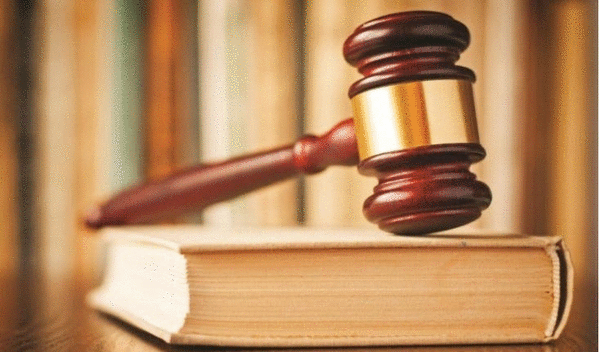
BALTIMORE — The Maryland Supreme Court on Friday wiped out Baltimore’s $153 million opioid verdict, sending the case back to a lower court and dealing a major blow to the city’s efforts to hold drug distributors liable under public nuisance law.
In a brief order, Chief Justice Matthew Fader said the court was acting in light of its recent ruling in Express Scripts, Inc. v. Anne Arundel County, which sharply limits how public nuisance claims can be used in opioid litigation. The justices granted review, vacated the Baltimore City Circuit Court judgment and remanded the case for further proceedings consistent with that decision.
The move effectively erases the jury’s finding that distributors McKesson and Cencora were liable for contributing to Baltimore’s opioid crisis.
Retired federal judge Andre Davis said the order leaves little room for the city to recover damages from the companies that went to trial.
“This order says, ‘You lose, Baltimore City,’” said Davis, who previously served on the U.S. Court of Appeals for the Fourth Circuit and for three years as Baltimore’s city solicitor. He added that by referring to the “Express Scripts” ruling, the highest court’s reasoning creates a “double loss” for the city.
“The case is over. Express Scripts held that not only does Maryland Law not afford a right to the city to bring this action, but even if the law did, it would be preempted by federal law,” Davis said.
Baltimore sued McKesson and Cencora, previously known as AmerisourceBergen, in 2024 for fueling the city’s opioid epidemic by shipping what it said were unreasonable amounts of prescription opioids to the area. The two companies accounted for 60% of the prescription opioid market in Baltimore, city lawyers said. McKesson and Cencora sent 320 million oxycodone pills within the city from 2006 to 2019, according to the lawsuit.
A Baltimore jury had originally awarded $266 million after finding the companies shipped excessive amounts of opioids into the city. Circuit Judge Lawrence P. Fletcher-Hill later reduced that award to $153 million, which the city accepted in 2025.
“They have sent the case back to the trial court for the trial court to take another look at the opioid case,” Davis continued. “The case is going to come to an end. Fortunately for the city, the city settled with most of the defendants in the opioid case.”
According to Davis, the city will be allowed to keep any settlement funds it received, “but for the companies that went to trial before jury, the city won’t get any of that money.”
Officials with McKesson, meanwhile, praised the court’s decision.
“We appreciate Supreme Court of Maryland’s order vacating the judgment of the Circuit Court for Baltimore City, a decision supported by the law and record,” a spokesperson for the company said. “In Baltimore and across the United States, McKesson continues to maintain and enhance strong programs that detect and prevent opioid diversion within the pharmaceutical supply chain.”
Baltimore Mayor Brandon Scott called the ruling unfortunate, but said the city would push forward.
“Our commitment to continuing to address the opioids crisis and the effects of their malfeasance remains steadfast,” Scott said. “We will use every available resource to continue the progress that we have seen in the last year in reducing overdose deaths.”
A Baltimore City spokesperson went into more detail.
“While we respect the Supreme Court of Maryland, we vigorously disagree with its decision to leave local governments without recourse against corporations that put profits over people and destroy communities with their actions,” the spokesperson said. “While cities and counties in particular are often left to deal with the financial and societal effects of this misconduct, the state Supreme Court has determined that federal fines are sufficient to penalize these corporate bad actors. We do not agree.”
Friday’s ruling builds on the court’s earlier decision in Express Scripts, in which the justices held that public nuisance law does not extend to the lawful distribution of regulated prescription opioids. The court said such claims fall outside the traditional nuisance doctrine, which is reserved for interference with public rights such as obstructing public spaces or polluting shared resources.
Baltimore’s case had been one of the largest opioid judgments in the country and was based on allegations that drug companies and distributors, including CVS, Walgreens and Johnson & Johnson, “recklessly” marketed and supplied addictive opioid medications despite knowing their risks.
While the Supreme Court’s order does not end the underlying litigation, it forces lower courts to revisit the case under the stricter legal standard established in Express Scripts.
Legal observers say the decision leaves Baltimore’s original public nuisance theory in doubt and forces the circuit court to reconsider the case under a narrower standard.
“It looks like they said public nuisance is not the correct standard (for these cases),” said Ocean City attorney Tom Maronick. “(The ruling) suggests it would lead to a greater instance of suits in a far wider field and the court (is) not willing to (support) that.”
(Reporter Natalie Jones contributed to this article.)
©2026 Baltimore Sun. Visit baltimoresun.com. Distributed by Tribune Content Agency, LLC.




Comments