Republican lawmakers in 3 states want voters to alter or scrap Medicaid expansion
Published in News & Features
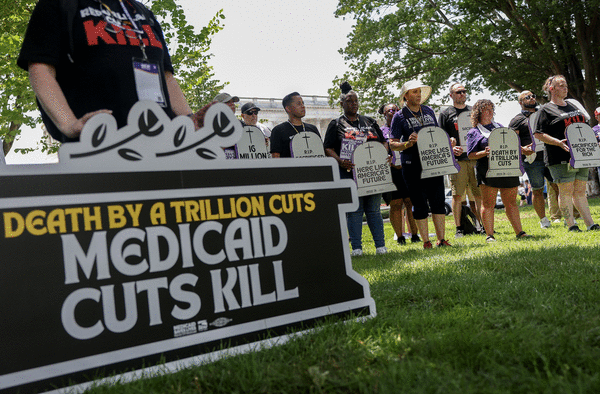
In three conservative states — Missouri, Oklahoma and South Dakota — residents in recent years voted to amend their state constitutions to expand Medicaid under the Affordable Care Act.
Now Republican lawmakers in all three states want voters to alter or scrap those amendments in upcoming elections, setting the stage for legislators to roll back expansion.
The constitutional amendments that Missouri and Oklahoma voters approved in 2020 and South Dakota voters approved in 2022 require their state Medicaid programs to cover all adults below the age of 65 who earn equal to or less than 138% of the federal poverty level, or $22,024. Forty-one states plus the District of Columbia have expanded Medicaid eligibility.
Supporters of expansion in Missouri, Oklahoma and South Dakota asked voters to amend their state constitutions to circumvent the opposition of GOP-led legislatures. Despite the success of those citizen-led initiatives, Republicans in all three states — the only three that have constitutional amendments expanding Medicaid — have maintained their antipathy toward expansion, and President Donald Trump's return to the White House has emboldened them.
Medicaid is jointly funded by the federal government and the states. Last summer, Trump signed a broad tax and spending measure that is projected to cut federal Medicaid spending by an estimated $886.8 billion over the next decade, largely because new work requirements will push people off the rolls, according to estimates by the Congressional Budget Office.
Under the ACA, better known as Obamacare, the federal government covers 90% of the cost of covering the expansion population. However, expansion opponents have long cast doubt on the federal government's long-term commitment to that match.
The recent federal changes have only fueled those fears, said Curtis Shelton, policy director for the Oklahoma Council of Public Affairs, a right-leaning think tank.
"Now that people have seen just how costly the program is going to be, I think it's fair to ask voters whether or not they want to reconsider that initial vote," Shelton said. "We don't really have sustainable options to fund that. So it's either going to come from massive tax increases or from benefits being cut for your traditional Medicaid population."
Amber England, founder and CEO of STRATEGY 77, an Oklahoma-based public affairs firm that pushed for expansion there, said any measure that undermines the constitutional integrity of expansion is tantamount to repealing it, "because the second legislators get their hands on it, they will whittle it away to nothing."
"Most importantly, it's actually taking away voter power, because the voters of Oklahoma have already decided this issue," England said.
In Oklahoma, voters might be asked to consider two Medicaid expansion proposals in the coming months. One would remove Medicaid expansion from the state constitution and put it in state statute, allowing lawmakers to alter it. The second would change the amendment so that Oklahoma could end expansion if the federal match falls below 90%.
Oklahoma lawmakers are debating whether to put one ballot measure up for a special election in August, or whether to include both on the regular November ballot.
In South Dakota, voters also will be asked to change the Medicaid amendment so that it no longer applies if federal funding declines below 90%. That measure has been approved for the November ballot.
The situation in Missouri is more complicated.
After Missourians voted in favor of the constitutional amendment, state lawmakers refused to fund Medicaid expansion, prompting a lawsuit from residents. In 2021, the state Supreme Court ruled that the legislature had to pay for expansion.
In its ruling, the state Supreme Court cited a section of the amendment prohibiting the imposition of "greater or additional burdens or restrictions" on people who qualify for Medicaid under expansion.
The measure that Missouri Republicans want to put before voters would add work requirements for people covered under Medicaid expansion. The new work rules would be identical to the ones included in the federal law Trump signed last summer.
Missouri Republican state Rep. Darin Chappell, the sponsor of the Missouri measure, told the Missouri Independent that he wants to ensure that Missouri maintains its Medicaid work requirements even if the federal government someday reverses itself.
But Chappell's proposal also would delete the "greater or additional burdens or restrictions" language the state Supreme Court cited in its 2021 ruling. And it would remove a provision that requires Missouri to "take all actions necessary to maximize federal financial participation in funding" Medicaid expansion.
Taken together, Democrats say, the changes would clear the way for Missouri lawmakers to defund expansion.
Missouri Democratic state Rep. Ashley Aune, the House minority leader, told reporters that defunding Medicaid expansion is "the one reason that Republicans want to put this measure in front of Missouri voters," according to the Missouri Independent.
The Missouri House in February approved the measure for the November ballot on a party-line vote, but the Senate is still considering it.
Kelly Hall, the executive director of the Fairness Project, a nonprofit that helped put the constitutional amendments on the ballot in all three states, said the fact that lawmakers have to go back to voters to make changes "is a testament to the strength of the original strategy."
"But it is still absolutely abhorrent that lawmakers would attempt to take health care away from people and go against the will of their own voters by trying to go back on the ballot measure," Hall said.
Idaho, Maine, Nebraska and Utah also expanded Medicaid via ballot initiative, though none of those states amended its constitution and voters won't see Medicaid on the ballot this fall.
However, Utah is one of nine expansion states (Arizona, Arkansas, Illinois, Indiana, Montana, New Hampshire, North Carolina and Virginia are the others) with laws that would automatically roll back Medicaid expansion if the federal contribution dips below 90%.
_____
_____
©2026 States Newsroom. Visit at stateline.org. Distributed by Tribune Content Agency, LLC.





Comments