Miami-based cruise line suffers a legal setback in video voyeur case
Published in News & Features
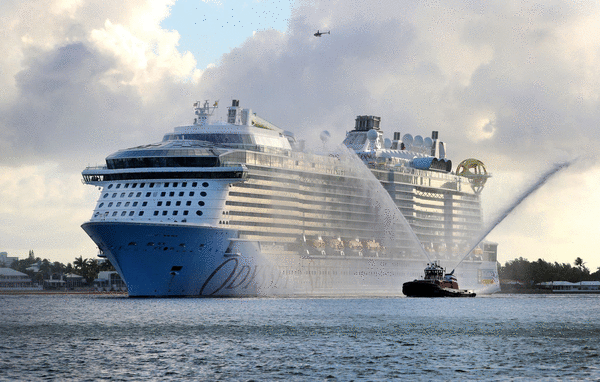
Possible victims of a cruise ship crew member who planted a hidden camera to watch a young girl undress in her cabin won a significant legal victory on Wednesday in Fort Lauderdale federal court.
U.S. Magistrate Judge Detra Shaw-Wilder ruled against Miami-based Royal Caribbean’s attempt to require that all potential victims go through individual arbitration with the cruise line, generally a secretive process often favored by corporations. Her decision removes one of the biggest obstacles each plaintiff or guest was facing in holding the company accountable and receiving damages depending on how far the case advances.
The original class action civil lawsuit was filed Oct. 15, 2024, in Miami federal court against Royal Caribbean Cruises and Arvin Mirasol, a former room attendant. The plaintiff, referred to as Jane Doe in the complaint and represented by the Miami firm Lipcon, Margulies & Winkleman, was a passenger aboard Symphony of the Seas around Feb. 25, 2024.
Mirasol regularly cleaned passenger rooms, restocked towels and changed sheets on Royal Caribbean’s Symphony of the Seas, a vessel that carries 5,518 passengers and 2,200 crew members. But that wasn’t all he did, according to court filings and the criminal complaint from the Broward County Sheriff’s Office.
Searching his electronic equipment including a USB stick device, law enforcement agents found “several videos of naked females undressing in their bathrooms.” One girl seemed to be 10 years old, they said. He’d planted small, secret cameras in passengers’ rooms.
In a separate criminal case pursued by the U.S. Department of Justice, on Aug. 28, 2024, U.S. Judge Melissa Damian gave the maximum possible sentence to Mirasol, a 34-year-old Philippines national who had pleaded guilty a few months earlier. He was sentenced in Fort Lauderdale federal court to 30 years in prison on a charge of producing child pornography.
The civil class action suit initially claimed there could be up to 960 passengers who are victims. The complaint defines the class as passengers aboard Symphony of the Seas between Dec. 1, 2023, and Feb. 26, 2024, who stayed in cabins serviced by Mirasol. That was the period when Royal Caribbean employed Mirasol on Symphony of the Seas.
The civil lawsuit alleges invasion of privacy and intentional infliction of emotional distress by video voyeurism and sexual assault committed by Mirasol and liability by Royal Caribbean. The lawsuit also accuses Royal Caribbean of inadequately training and supervising workers aboard the vessel and failing to “implement and/or enforce an adequate safety management system.”
Because of the sexual nature of the crimes and the ages of victims, the law firms and the Miami Herald are not identifying the passengers.
Royal Caribbean has tried to dismiss the suit, saying any passenger with an emotional or mental trauma complaint not involving physical contact or physical injury — like video voyeurism — must go through individual arbitration. The company says that’s because passengers agreed to that when buying their cruise ship tickets and signing the required contract.
They said there would be exceptions if physical contact or sexual assault occurred, but they denied that’s what happened here.
The cruise line also claims the Federal Arbitration Act and subsequent court cases support its argument. The firm Cozen O’Connor is representing RCL.
“Plaintiffs’ claims that they suffered mental and emotional injuries, however, must be settled in arbitration, not in this Court,” the attorneys representing Royal Caribbean wrote in a March 26, 2025, court filing. “Plaintiffs agreed in their digitally signed ticket-contract that all claims for mental or emotional injury must be resolved through arbitration.”
The plaintiffs’ lawyers countered that Royal Caribbean was greatly downplaying the injuries the victims suffered. They argue, citing experts, that sexual assault and sexual harassment don’t require physical contact.
“It is very telling that [Royal Caribbean] tries to characterize all of these claims as simply ‘video voyeurism.’ Unfortunately, the admitted and undisputed facts are much darker, and much more devastating,” attorneys wrote in a court filing on April 17, 2025, behavior they said continued during 12 cruises.
The victims’ attorneys also cited federal laws, including a maritime law and the Ending Forced Arbitration Act, which the U.S. Congress enacted in 2022 that bars employers from requiring arbitration for disputes related to sexual assault or harassment. Its full name is the Ending Forced Arbitration of Sexual Assault and Sexual Harassment Act and is often referred to as the EFAA.
“Incredibly, in their continuing effort to keep the full extent of these horrible facts hidden and out of public discussion, [Royal Caribbean] actually tries to convince this Court that none of the pending claims-as alleged could be considered related to ‘sexual assault disputes,’ as defined by the Ending Forced Arbitration Act.
On Wednesday, U.S. Magistrate Shaw-Wilder ruled that the plaintiffs were right on all these questions.
She wrote in her ruling that plaintiffs have sufficiently alleged that what is taking place is “a sexual assault dispute under the EFAA.”
During the hearings, Royal Caribbean lawyers argued that Mirasol pleasuring himself didn’t constitute sexual contact or sexual assault.
In her ruling, Shaw-Wilder noted that “Royal Caribbean argues that Mirasol’s conduct in masturbating while watching Plaintiffs on video falls short of “sexual contact” under § 2246(3) because Plaintiffs did not allege that Mirasol touched the private areas of Plaintiffs.”
However, she said that, “contrary to Royal Caribbean’s position, multiple circuits, including the Eleventh Circuit, have held that masturbation qualifies as “sexual contact.”
The magistrate also decided that the plaintiff’s claims are “sufficient to trigger the EFAA” and that law “applies to plaintiffs’ entire case.”
Shaw-Wilder also ruled the plaintiffs were correctly citing the maritime law in concluding “ ‘personal injury’ encompasses emotional injury claims.”
RCL had argued for a narrower definition of “personal injury,” limited to only physical injury.
The cited maritime law states that if a cruise ship touches a U.S. port, the cruise line may not bar by contract a passenger who suffered personal injury from going to court.
The case is far from over.
Miami federal judge Darrin Gayles, who requested Shaw-Wilder rule on the current motion, has to approve her ruling, but that’s expected. And then, Royal Caribbean can appeal.
Royal Caribbean did not immediately respond on Wednesday to provide comment. The company has previously declined to address ongoing litigation or investigations in this case and others.
In a statement, Lipcon, Margulies & Winkleman P. A. And the Moskowitz Law Firm, who represented plaintiffs, said “they are very pleased with the Magistrate Judge’s Report and Recommendation.”
Jason Margulies told the Miami Herald on Wednesday that “this is a significant victory for passenger victims, who are often unknowingly forced by cruise lines to accept provisions within the fine print of their cruise passenger tickets that significantly limit their rights and are unconscionable.”
©2026 Miami Herald. Visit at miamiherald.com. Distributed by Tribune Content Agency, LLC.






Comments