Kenya rejects rape allegations involving members of its forces in Haiti
Published in News & Features
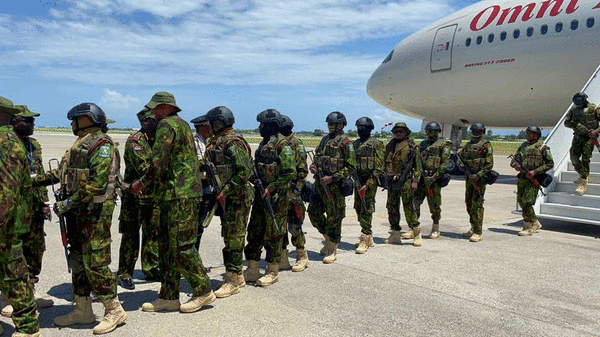
The government of Kenya is refuting a United Nations report that found members of its police-led gang-fighting security mission in Haiti were involved in cases of sexual exploitation and rape in the Caribbean country.
The rejection of the findings was conveyed in a confidential letter sent earlier this month to U.N. Secretary-General António Guterres, who had received a report indicating that the Office of the U.N. High Commissioner for Human Rights had investigated and substantiated four cases in Haiti involving members of the departing Kenya-led Multinational Security Support mission.
One of the cases, according to the report, involved a 12-year-old girl. The findings were included in the report on Special Measures for Protection from Sexual Exploitation and Abuse submitted to the secretary general.
Wycliffe Musalia Mudavadi, who serves as Kenya’s secretary for Foreign and Diaspora Affairs, said the allegations were promptly investigated through a board of inquiry and found to be unsubstantiated.
“No formal complaints were filed with any authority,” he said in the letter addressed to Guterres and obtained by the Miami Herald. He added that investigations were conducted, and the findings were shared both Haitian and U.N. agencies.
“It is therefore concerning that the secretary-general’s report … does not accurately reflect these finings,” Mudavadi said.
He said Kenya has instructed its permanent missions in Geneva and New York “to engage relevant U.N. offices to correct these inaccuracies and protect the integrity and sacrifices” of the Kenyans who served in Haiti.
Rare police reports
In Haiti, survivors of sexual violence rarely file formal police reports, and in the case of the allegations involving the Kenyans, they unfolded in a rural town where the Kenyan contingent was stationed next to a local Haiti National Police substation. The allegations remain sensitive given Haiti’s past experience with rape by foreign troops, and the location of these groups often in the middle of nowhere among extremely vulnerable populations.
The U.N.’s investigation into the rape allegations were triggered by a report of the minor, which first surfaced in late August on Haitian social media networks.
The Kenya mission was notified and established a board of inquiry in late August to look into the allegations. Its conclusions were reportedly inconclusive, a source familiar with the matter told the Herald.
When the U.N. observed a continued increase in allegations, the office dispatched Creole-speakers to the northern regions of the country to gather additional information. As they investigated, they learned about other alleged incidents in the rural area where the Kenyan troops were stationed.
The findings and calls for administrative action were all forwarded to the gang-suppression force’s leadership.
Eventually, the Kenyans put together another board of inquiry. However, the board did not include any French and Creole speakers.
The U.N. human rights office has stressed that the Kenya-Multinational Security Support mission and its replacement, the Gang Suppression Force, are not technically U.N. missions, even though they were authorized by the Security Council.
“That said, the U.N. Human Rights Office has a mandate to monitor, document and follow up on allegations of human rights violations, including sexual exploitation and abuse involving non-U.N. security forces operating pursuant to a Security Council mandate,” said Jeremy Laurence at the office of the U.N. High Commissioner for Human Rights.
“The relevant non-U.N. forces and the national state of the alleged perpetrators are responsible for ensuring accountability for perpetrators and support and justice for victims,” he added.
The allegations have put a pall over the efforts of the Kenyan mission, which while not successful in returning security and stability to Haiti, has been credited with stopping the situation from completely collapsing.
“Throughout its deployment, the (Kenyan mission) strictly adhered to all operational frameworks,” Mudavadi said. “Notably no reports have identified misconduct, underscoring the mission’s discipline and respect for human rights.”
‘Immense challenges’
The letter also noted the “immense challenges” the mission faced in Haiti, “which sadly ended in three tragic deaths of our compatriots,” naming Kenyan force members Samuel Tomoi Kaetuai, Benedict Kabiru and Kennedy Nzuve.
“Many others sustained injuries,” the letter added. “Despite these hardships, the mission remained resolute, with personnel consistently upholding the highest standards of transparency, professionalism and conduct.”
Kenya was the only country to volunteer to lead an international armed mission into Haiti and, after doing so, faced challenges both at home and in Washington that delayed the deployment of its first police officers.
Mudavadi noted that despite those challenges including operational ones, the MSS still managed to have a “strong record.”
Kenya never reached its target of 2,500 troops in Haiti, and is currently in the process of departing, with 150 police officers scheduled to leave Haiti next week. The troops’ departure will make way for the new Gang Suppression Force, authorized last fall by the U.N. Security Council.
More than five times the size of the Kenyan mission, the new international force is expected to be more heavily armed and will be able to operate independently of Haitian police units. It is also expected to expand operations beyond Port-au-Prince.
On Wednesday, the U.N. said humanitarian agencies report that armed violence continues to force people to flee their own homes in search of safety.
The fresh attacks have been prompted by gangs joining forces to expand their territorial control of the West regional department, which includes Port-au-Prince. The violence, the U.N. said, has led to the suspension of schooling for children in those areas, as well as of public transportation
Last month, nearly 3,000 people were uprooted by violence in the same neighborhoods. In the Artibonite region, armed attacks are also continuing to force people to flee.
“Food assistance, support to host families, and access to safe water and sanitation are among the top needs that we are trying to meet. We and our humanitarian partners are delivering assistance where possible,” Dujarric said. The U.N. Office for the Coordination of Humanitarian Affairs “is in close collaboration with our partners, but insecurity, access constraints, rising emerging needs and limited funding continue to hamper the response,” he added.
_____
©2026 Miami Herald. Visit miamiherald.com. Distributed by Tribune Content Agency, LLC.






Comments