Law requiring ICE agents to show identification struck down by 9th Circuit
Published in News & Features
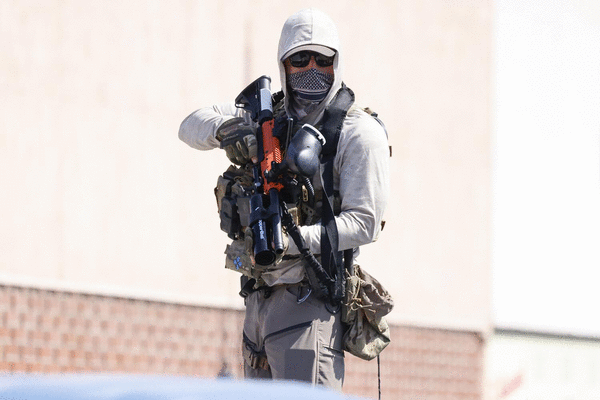
The 9th Circuit Court of Appeals slapped down a California law that would have forced immigration agents and other law enforcement officers to display ID while on duty, with a ruling Wednesday finding that the measure “attempts to directly regulate” the federal government.
“(The law) purports to override the federal government’s power to determine whether, how, and when to publicly identify its officers,” wrote Judge Mark J. Bennett. “The Supremacy Clause forbids the State from enforcing such legislation.”
The Department of Justice first challenged the law shortly after it was passed last fall, suing to block the ID requirement alongside a related effort to ban masks for federal agents and local police.
Both laws were written in response to growing public anger over the Trump administration’s aggressive immigration enforcement actions.
The joint case reached a courtroom in Los Angeles on Jan. 14, a week after Renee Good was shot and killed by an ICE agent in Minneapolis. By the time U.S. District Judge Christina A. Snyder ruled to uphold the law on Feb. 9, CBP officers had shot and killed Alex Pretti.
At the time, Snyder wrote she was “constrained” to block the mask ban because of a last-minute carve-out exempting state police, finding it discriminated against the federal government.
But she allowed the ID law to stand, saying it had only incidental impact on the federal government, similar to speed limits on the highway.
The Trump administration appealed that decision to the 9th Circuit, claiming an early victory when the three judge panel voted to temporarily block the ID law from taking effect while it considered the case.
Ultimately, the appellate panel was much more skeptical of the state’s claims.
“California has done something that we just haven’t seen before,” Judge Jacqueline Nguyen said during oral arguments in March. “It’s telling federal officers how to wear their uniform.”
The court found that was beyond the pale.
“The Act does not regulate conduct that any ordinary citizen could perform,” Bennett wrote. “Rather, it applies exclusively to law enforcement agencies and their officers, including federal law enforcement agencies and federal law enforcement officers.”
The decision favors the Trump administration and swats away another attempt to challenge its mass deportation program.
Bill Essayli, who leads the U.S. attorney’s office in Los Angeles, called the decision a “huge legal victory” in a post on X.
The ruling comes on the heels of the firing of both former Department of Homeland Security boss Kristi Noem and Trump’s former top cop, Pam Bondi.
The decision also drops at a moment when more than a dozen other states are weighing their own mask laws — laws that could create a tangle of dueling precedents across the U.S.
California Deputy Solicitor Gen. Mica Moore urged the court to consider the danger Californians faced from unidentified masked agents wielding military-grade weapons in the streets.
“We decline to do so,” Bennett wrote in Wednesday’s ruling.
_____
©2026 Los Angeles Times. Visit at latimes.com. Distributed by Tribune Content Agency, LLC.





Comments