So far in 2026, ICE has arrested at least 47 people in Alaska. One was a pregnant woman
Published in News & Features
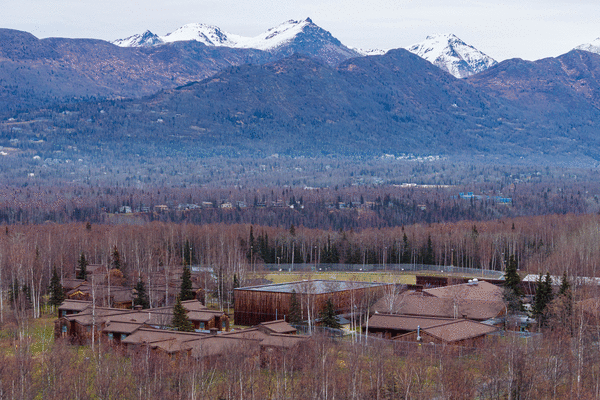
ANCHORAGE, Alaska — ICE agents arrested and briefly detained a pregnant 25-year-old woman at an Eagle River women's prison last month, before her lawyers won her temporary release by arguing the federal immigration agency's own guidelines advise that pregnant women shouldn't be confined in immigration detention except in narrow circumstances.
Valeria Mendoza Santiago's case is now playing out in Alaska's federal court.
Mendoza Santiago is one of just three women detained by U.S. Immigration and Customs Enforcement in Alaska this year, according to information provided by the state Department of Corrections. That number includes a Soldotna mother who was taken into custody with her children in February and deported to Mexico.
Because Alaska lacks a federal detention facility, the state contracts with the federal government to temporarily confine people arrested by ICE in state jails until they can be transferred to regional immigration detention centers Outside.
At least 47 people have been arrested by ICE and held in Alaska jail facilities so far this year, according to Department of Corrections records. That's an immigration arrest and detention every two or so days.
ICE confirmed it had received emailed questions for this story, but as of Tuesday had not answered the questions.
Mendoza Santiago's attorneys Lara Nations and Nicolas Olano say she is the only pregnant woman they know of who has been detained by ICE in Alaska since President Donald Trump's immigration crackdown began in early 2025.
In an interview in her lawyers' Midtown Anchorage office, Mendoza Santiago — originally from Oaxaca, Mexico — described the day she was arrested.
Though an interpreter, Mendoza Santiago said she originally entered the United States in 2021 via a border crossing near Tijuana, Mexico. She had entered several times before and had been briefly detained by border patrol before being sent back, according to court filings.
She entered the United States because she wanted to join her husband, who was already living in Alaska, she said. Mendoza Santiago says she fears returning to Mexico because of a threat of violence.
After she crossed, she traveled to Anchorage to join her husband, who is also from Mexico and a member of the Triqui Indigenous group. He worked in the flooring industry and she worked at a restaurant.
Her husband's mother entered the country with their son and joined the family later, Mendoza Santiago said through an interpreter. The family enrolled their son in school and spent time going on walks and visiting parks, she said.
But when the Trump administration's crackdown on immigration began in 2025, more people in Alaska started to be detained by immigration enforcement and the family became worried. They barely left the house other than for work and school over the last year, she said through her attorney.
Then in February, Mendoza Santiago's husband, Jhony Gonzalez Merino, was taken into ICE custody just after he dropped off their son at school. Gonzalez Merino has applied for asylum, said Olano.
After a few days at the Anchorage jail, Gonzalez Merino was transferred to the federal immigration detention center in Tacoma, Washington, where he remains.
After that, Mendoza Santiago stopped working, increasingly worried about being picked up and separated from her son. She also had learned she was pregnant.
Mendoza Santiago said on the morning of March 20, she took an Anchorage city bus to work. When she got off at her stop, she noticed an unusual number of vehicles parked at a gas station nearby. Suddenly, there were five or six people running at her, she said through the interpreter. They were federal immigration officers. She told them she couldn't speak English.
In Alaska, immigration enforcement officers have typically targeted one person at a time, tracking their movements for a few days before attempting an arrest, said Nations. It is not clear why Mendoza Santiago — or almost any of their clients facing detention and removal — have specifically been targeted, but Nations and Olano suspect it has to do with being on the radar due to their son having crossed into the U.S. with his grandmother, not them.
Mendoza Santiago said she was handcuffed and had a leg shackle put on her while being processed in the U.S. Department of Homeland Security building in Fairview.
She was worried there would be no one to pick up her son, who is in elementary school, after school that day. If she went to jail, or was flown out of Alaska on a plane, when would she see her child again?
"I was trying to do anything I could think of to avoid them taking me to jail," Mendoza Santiago said through her attorney.
She says she informed the immigration agents she was a few months pregnant. She'd had an ultrasound the day before.
She was then transferred to Hiland Mountain Correctional Center, and was told she was being flown out of state to a federal detention center the next day. There, she was dressed in prison garb and put alone in a cell, she said through an interpreter. She tried to eat dinner, which she said seemed partly frozen.
"I never thought I would be in that kind of place," Mendoza Santiago said through her interpreter.
People detained by ICE are technically civil detainees, accused of breaking immigration codes rather than charged with crimes. But in Alaska, they are detained essentially under the same conditions as anyone in a jail.
The lawyers, Olano and Nations, frantically filed for a temporary injunction with the federal court to keep Mendoza Santiago from being flown out of state to the Tacoma facility, where people sometimes spend months or even years in detention.
The crux of their argument was that ICE's own policies say officers "should not detain, arrest, or take into custody for an administrative violation of the immigration laws individuals known to be pregnant, postpartum, or nursing unless release is prohibited by law or exceptional circumstances exist."
A federal judge ruled on the application for a temporary restraining order in the middle of the night, around 2 a.m., court records show. Mendoza Santiago spent a sleepless night in jail, thinking she'd be sent to Tacoma. The next day, she was released.
Attorneys representing the federal government contend that the ICE guidance on pregnant women isn't the law.
"It is undisputed the Petitioner is a non-citizen who unlawfully entered the United States and is inadmissible. Likewise, Petitioner does not contest her removability from the United States. Instead, Petitioner challenges the lawfulness of her detention while she awaits removal to her home country of Mexico," the federal court filing says.
Attorneys representing the federal government also contend that the agency didn't know Mendoza Santiago was pregnant when she was detained, and that it was moot because she is no longer in custody.
Though Mendoza Santiago is now out of custody, she is still in immigration court removal proceedings. The petition about her confinement remains in court.
"The government has made no promise she won't be detained again," Nations said.
For now, Mendoza Santiago is living at home with her son and mother-in-law. She said she fears going back to Mexico, and she fears being put in a locked jail or detention center.
When she was detained, Mendoza Santiago said officers told her to take her son with her. They could go into detention together and the process would move faster, they said.
She told them that's the last thing she would want.
"I see where my husband is detained, and I don't think it would be a good place for a child."
_____
© 2026 Anchorage Daily News. Visit www.adn.com. Distributed by Tribune Content Agency, LLC.






Comments