Haiti, Dominican Republic resume talks, flights after months of quiet diplomacy
Published in News & Features
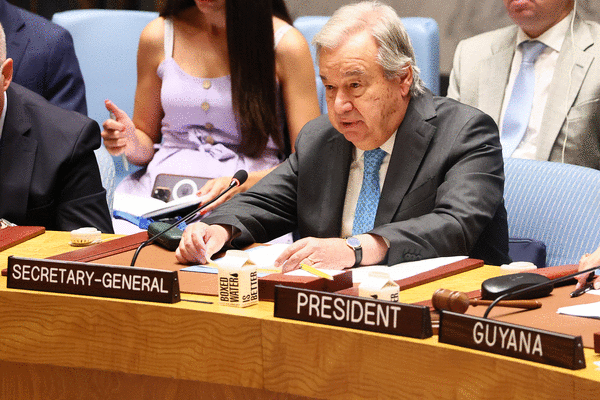
United Nations Secretary-General António Guterres is welcoming a renewed thaw in relations between Haiti and the Dominican Republic after both countries agreed to resume dialogue, and the latter agreed to allow flights to partially resume.
In a joint statement, the foreign ministers of both nations, which share the island of Hispaniola and a vexing history, announced that the Dominican Republic would restore commercial flights between Santo Domingo and Cap-Haïtien for the first time in nearly three years, beginning May 1.
“The United Nations supports the Dominican Republic and Haiti in their efforts to strengthen dialogue and build trust among the two nations,” U.N. spokesman Stéphane Dujarric told reporters. “We expect the reopening of the air corridor to help aid agencies to move staff and supplies into northern Haiti.”
Haiti and the Dominican Republic haven’t had formal diplomatic relations since September 2023, when the construction of a canal in northeast Haiti near the Massacre River triggered a diplomatic row. Dominican President Luis Abinadar shut down air, sea and land borders, suspended visas and imposed sanctions against those involved in the effort.
The deteriorating security crisis in Haiti only made matters worse, as Dominican officials also pointed to the gang-crisis as reasons for their hardened policies.
The airspace between Haiti and the Dominican Republic was officially closed in March 2024 after armed gangs united and sought to overthrow the government of the prime minister at the time, Ariel Henry. Since then, the security situation has worsened; the U.S. Federal Aviation Administration has an ongoing ban on U.S. commercial flights landing in Port-au-Prince.
In a statement, the U.S. Embassy in Haiti said the “opening of the airspace by May 1 is a welcome step. This engagement supports regional stability and bilateral engagement, while contributing to ongoing efforts to strengthen cooperation and maintain open communication between both countries.”
The partial reopening of the airspace will provide travelers to Haiti another option into the country amid the FAA ban. However, travel into Port-au-Prnce by air remains risky. On Monday, after a stray bullet hit a door at the Toussaint Louverture International Airport, local carrier Sunrise Airways announced the temporary suspension of flights to the capital.
The steps toward rapprochement come after bilateral relations were strained with the irrigation canal’s construction by Haitians in northeastern Haiti in September 2023, which intensified already tense relations between the countries. Though the canal was viewed among Haitians as a symbol of national pride, Santo Domingo opposed it, saying it would have a negative impact on agricultural production.
Relations further deteriorated in early 2024, when Dominican authorities refused to allow a plane carrying Henry to land in Santo Domingo after initially granting permission. Henry had been on an overseas trip to Kenya to finalize the deployment of a mission to combat gangs when he became locked out of his own country.
Tensions further deepened when the Dominican Republic increased the number of deportations to Haiti, including those of pregnant women and women who had recently given birth.
Months of quiet diplomacy
While Abinader has been a strong advocate for deploying an international armed force to Haiti, his stringent policies toward his country’s closest neighbor and the lack of formal diplomatic relations have created bottlenecks in dealing with arms trafficking across the border, facilitating trade or holding conversations about migration.
With a new international force preparing to deploy to Haiti — the U.N.-authorized Gang Suppression Force — there was a new to reestablish relations. For months, the U.S. Embassy’s chargé d’affaires in Haiti, Henry Wooster, had been leading a quiet diplomatic effort alongside Dominican Foreign Minister Roberto Álvarez. The two have met on several occasions and Álvarez has also had informal talks with Haiti’s ambassador to Santo Domingo, Fritz Longchamp, as well as other officials.
Those efforts recently included an informal conversation between Haitian Prime Minister Alix Didier Fils-Aimé and Abinader on the sidelines of the inauguration of Chile’s new president.
Last Friday, Álvarez and Haiti Foreign Minister Raina Forbin traveled to their shared border, where they held formal talks at the CODEVI Industrial Park. The discussions focused on border security, migration and trade.
Ahead of that meeting, Wooster and the U.S. ambassador to the Dominican Republic, Lea Campos, had traveled to CODEVI to hold talks with Álvarez about the Dominican Republic’s support for the international efforts to help Haiti combat gang violence. The U.N. has opened a satellite office for its new support mission for the anti-gang force and has been transporting personnel into Haiti via helicopter from Santo Domingo.
During the discussions, diplomats were given a tour of the site, which employs thousands of Haitians and relies on the duty-free access to the U.S. market under legislation the U.S. Congress approved known as HOPE/HELP, which was extended for another year.
“We need a permanent HOPE/HELP legislation,” Fernando Capellán, the owner of CODEVI, said after giving the diplomats a tour.
After security is restored in Haiti, the only way for it to be sustained, Capellán said, is “creating a massive amount of jobs in a country that has plenty of labor, plenty of good people .”
The diplomatic discussions were followed by a separate meeting between the Haitian and Dominican business leaders, which Capellán described as “very productive” and a first step in renewing relations.
_____
©2026 Miami Herald. Visit miamiherald.com. Distributed by Tribune Content Agency, LLC.






Comments